



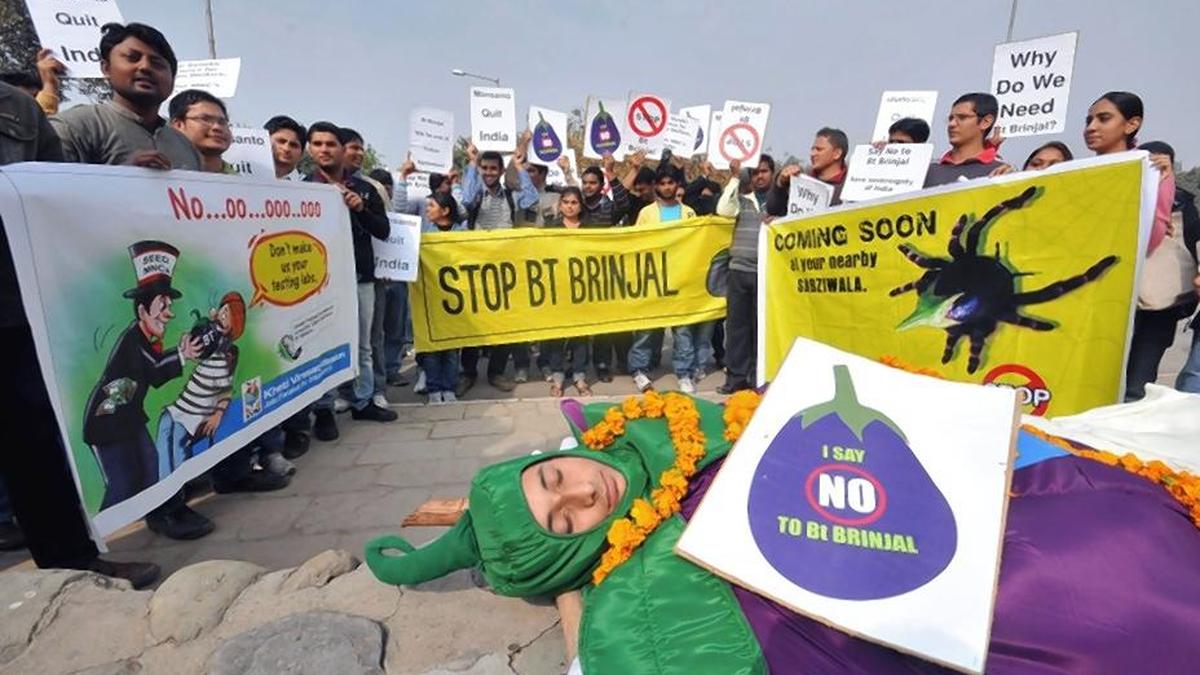

More than six years after the Haryana government destroyed a banned, genetically modified (GM) Bt brinjal crop in Fatehabad district’s Nathwan village following an outcry by environmental activists, the source of the seeds remains a mystery.
Responses to multiple RTIs filed by The Hindu show the government is yet to determine how the prohibited variety entered the open market.
A Horticulture Department official said they had undertaken the “necessary steps under our ambit and power”, referring to the destruction of the crop on half an acre of land cultivated by farmer Jeevan on May 17, 2019. However, activists who were instrumental in calling attention to the issue accused the government of “adopting a casual approach towards a serious problem”.
“The government’s claim that the farmer whose field was identified as growing the illegal crop was the only one to do so is absurd. Neither can the farmer develop such seed in his backyard nor can he have a privileged relationship with seed developers to be bestowed exclusive access of growing their proprietary seed,” said Rajinder Chaudhary, a former Professor in the Department of Economics with M.D. University, Rohtak.
The commercial cultivation of Bt brinjal is banned in India.
The background
In May 2019, when activists flagged the issue, Haryana’s Biotechnology Coordination Committee, which monitors activities related to GM organisms, proposed destroying the crop. Following this, the crop was uprooted and buried to avoid contamination.
When questioned, Mr. Jeevan, who bought the saplings of brinjal in December 2017, told the authorities that he was not aware that the saplings were of GM variety. He said the seeds were procured from a roadside vendor.
In response to an RTI query on whether any probe had been conducted in the case, the Environment and Climate Change Department said it wrote to the Horticulture Department twice in 2019 — in July and August — seeking details of those against whom action needed to be initiated. On both occasions, it added, the Horticulture Department denied information regarding the source of the seed and did not reveal the name of any farmer.
“No further communication in this regard has been received from the Horticulture Department, Haryana, till now,” read the reply shared with The Hindu on October 31, 2025.
However, in a separate RTI response, the District Horticulture Officer, Fatehabad, on October 17, identified the farmer, but said there were no details about the source of the GM seed.
“In the year 2019, Bt brinjal was cultivated by a farmer, Mr. Jeevan, son of Mr. Ishar of village Ratia in Fatehabad district, and there is no information available in the office records about where this farmer got these saplings from,” it read. When reached for comment, Horticulture Department Director General Ranbir Singh said they had shared details of the farmer who cultivated the crop with the Environment Department in November 2019.
“However, the source from whom the farmer purchased the brinjal saplings remains unknown. We have taken the necessary steps under our ambit and power,” he said.
In 2019, officials from the Horticulture Department visited the site and interacted with farmers. Following this, they submitted a report, suggesting that GM brinjal was not being cultivated in other districts.
Fear of contamination
Farm and food activists are worried about the “casual attitude” of agencies towards food safety. They believe that introducing transgenic variety [whose genes have been altered] foods could contaminate the food chain. “The government is duty-bound to protect the environment and the health of consumers. However, it has failed on both counts as it has not taken action in the matter even six years later,” said Mr. Chaudhary, who is now associated with Kudrati Kheti Abhiyan, a voluntary group that works towards promoting self-reliant organic farming.
He added that until independent tests confirm the safety of the long-term use of GM crops, the government must not allow them to contaminate the food chain.
“Addressing environmental and health concerns regarding transgenic food must be the primary concern of the government. However, the issue does not seem to be on its priority list,” said Umendra Dutt of Kheti Virasat Mission, another organisation working to promote organic farming.
Published – November 25, 2025 11:10 pm IST