



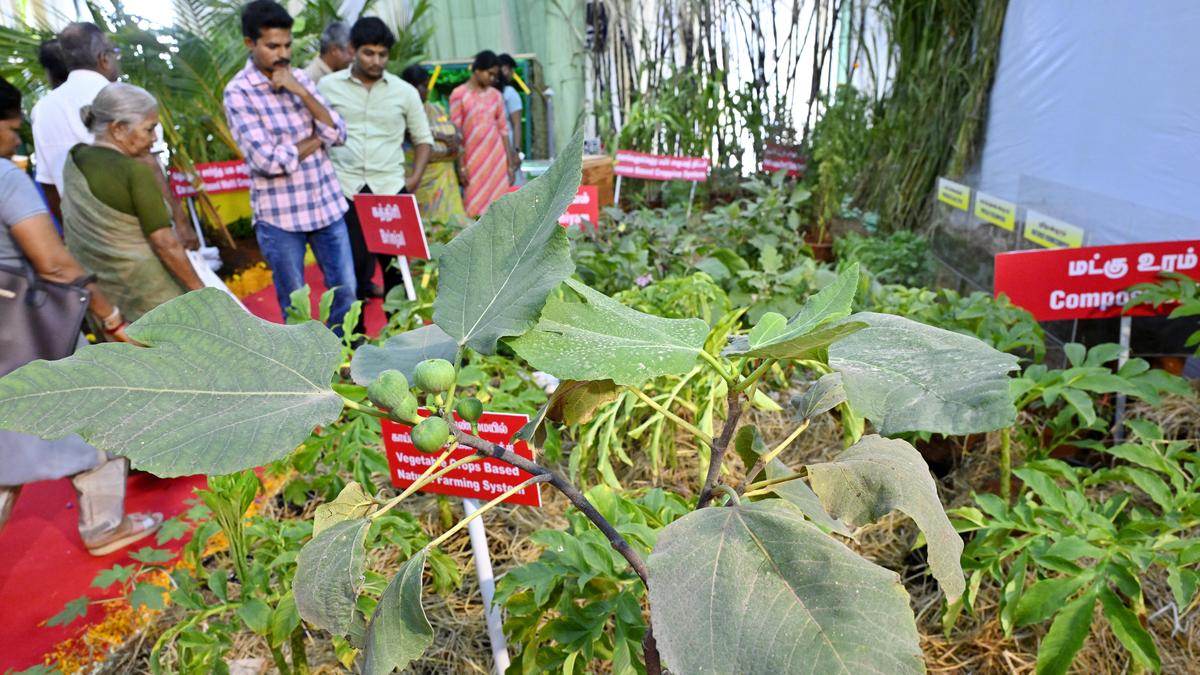

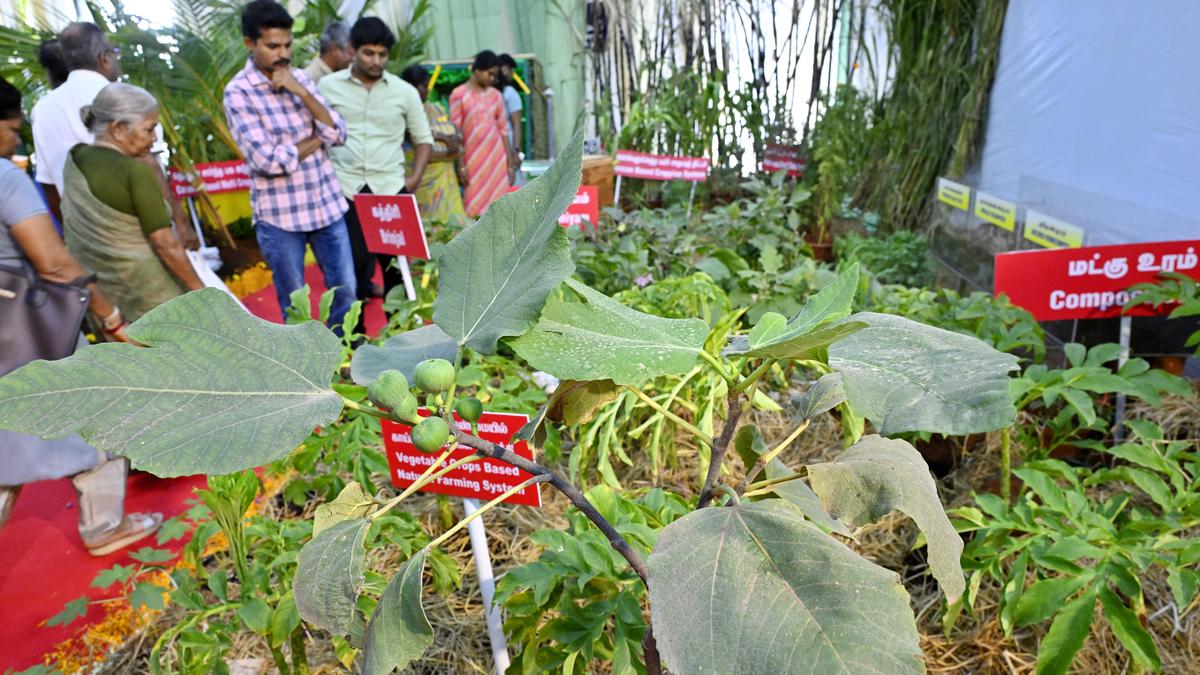
Stalls displaying organically grown agricultural products at CODISSIA Complex in Coimbatore, the venue of the three-day South India Natural Farming Summit, raised awareness on well-being in no small measure.
| Photo Credit: PERIASAMY M
Support to farmers adopting natural inputs such as jeevamruth, ghanjeevamruth, cow dung, farmyard manure, green manures, and botanical extracts for pest control must be integrated into the National Mission on Natural Farming, organisers of the South India Natural Farming Summit have emphasised.
Training programmes should be conducted through Krishi Vigyan Kendras, agricultural universities, and Farmer Producer Organisations (FPOs) to provide continuous knowledge support on soil biology, mulching, seed treatment, and natural nutrient cycles, A.P. Karuppiah, summit convenor, and K. Ramasamy, former Vice-Chancellor of Tamil Nadu Agricultural University, and chief coordinator of the summit, said in a memorandum submitted to Prime Minister Narendra Modi.
Model natural farming clusters should be established in every district to demonstrate improved soil structure, reduced chemical dependency, and stable or enhanced yields, a resolution adopted by the stakeholders said. The mission should also include support for organic certification, traceability systems, and dedicated marketing channels for natural produce to ensure fair prices for farmers, the memorandum said.
Financial incentives for natural input production units, composting infrastructure, and community-level resource centres will help minimise production costs. By adopting this mission, India can improve soil organic carbon, promote biodiversity, reduce health hazards from chemical residues, expand organic markets, and build long-term food security through chemical-free, sustainable agriculture, it said.
Need for soil rejuvenation through livestock integration for providing essential organic inputs (cow dung, cow urine, goat manure, and poultry litter) that rejuvenate soil health was articulated through another resolution.
Village vegetable self-sufficiency programme by way of cultivating specific vegetables suited to local climate; promotion of perennial redgram (thuvarai) and lablab (avarai) in natural farming systems for multiple harvests under a national scheme for supplying farmers with naturally grown seeds and seedlings through FPO-led seed banks; establishment of demonstration fields across districts to showcase productivity under natural farming conditions and market linkages through local cooperatives; promotion of Miyawaki forests on patta lands for soil and ecological health, and to act as carbon sinks thereby contributing to India’s climate goals; and community-based groundwater recharge for natural farming to restore declining water tables and ensure long-term irrigation security constituted other important resolutions.
The Summit also called for a women-centric scheme at the national level for organic gardening and backyard poultry through training programmes; national organic seed and seedling production network through establishment of district-level centres operated by FPOs and Farmer Producer Companies (FPCs) under subsidy scheme; empowerment of FPOs/FPCs for natural farming extension and implementation whereby direct marketing of natural produce through e-commerce platforms would ensure premium prices for farmers; establishment of Nammalvar National University for Natural Farming to accelerate India’s transition toward chemical-free agriculture; mandatory exposure visits by agricultural students to reputed natural and organic farms; and establishment of exclusive organic input outlets for natural and organic farmers in all rural blocks in India.
Special insurance scheme for native breed cows and cattle to strengthen natural and organic farming across India; establishment of a National Natural Farming Board/Council to promote large-scale, coordinated development of natural and organic farming in India; celebration of National Natural Farming Day in India, preferably on April 6th, the birthday of Nammalvar, pioneer of ecological agriculture; bringing in a National Biofertilizer and Bio-Pesticide Production Incentive Scheme; Agroforestry Integration for Climate-Resilient Natural FarmingAgroforestry; National Community Compost and Vermicompost Support Scheme; promotion of Medicinal Plants through Natural Farming; National Organic Post-Harvest Processing and Value Addition Scheme; Urgent Request for Regulation and Biosafety Testing of Gene-Edited and Genetically Modified Crops in India; and instituting of an endowment in the name of Nammalvar figured among the other resolutions.
Published – November 21, 2025 11:26 pm IST