



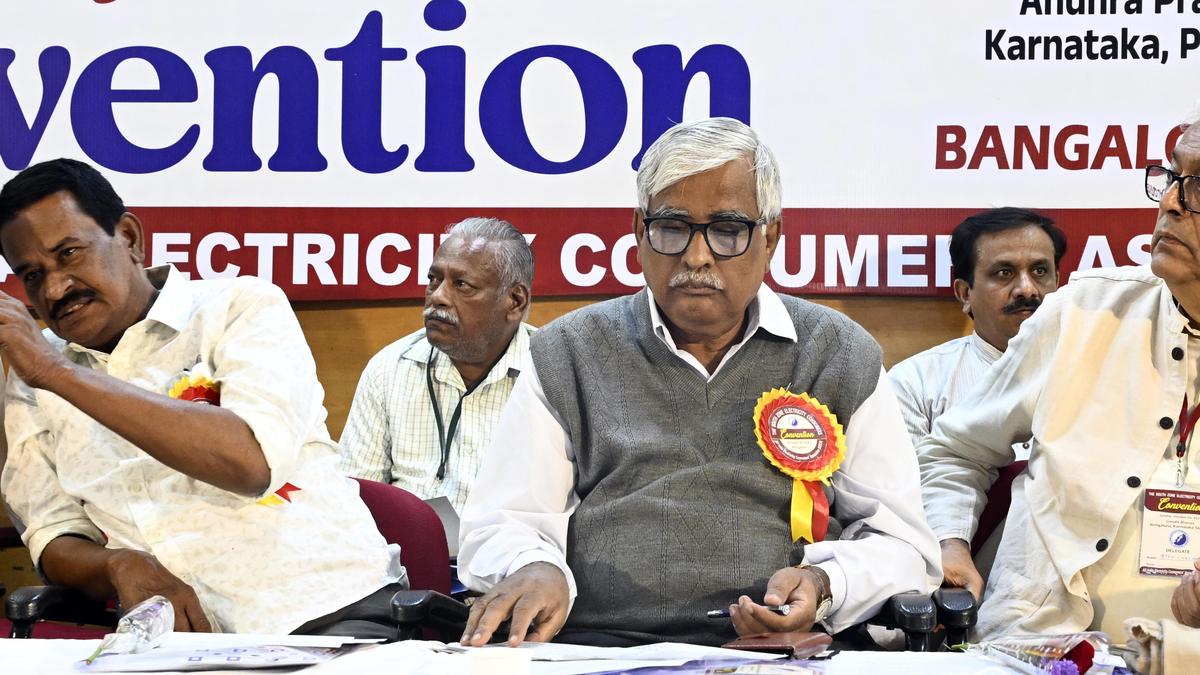


All India Electricity Consumers’ Association working president Samar Sinha and other delegates at the South Zone Electricity Consumers’ Convention at Gandhi Bhavan in Bengaluru on Sunday.
| Photo Credit: SUDHAKARA JAIN
Consumer groups from the southern region came together on Sunday to oppose what they termed as the Centre’s growing push to privatise the power sector and impose smart meters and ‘Time of Day’ (ToD) tariffs (where the price per unit of electricity varies according to the time for which it is used) across India.
Organised by the All India Electricity Consumers’ Association (AIECA), the South Zone Electricity Consumers’ Convention at Gandhi Bhavan in Bengaluru drew over 500 delegates, including engineers, consumer representatives, and activists from Andhra Pradesh, Telangana, Kerala, Karnataka, Puducherry, and Tamil Nadu. The event, held under the banner ‘Stop Privatisation of Electricity and Installation of Smart Meters’, was part of AIECA’s nationwide movement to defend electricity as a public service rather than a profit-making commodity.
AIECA president Swapan Ghosh said that over 50% of electricity generation in the country is now in private hands, a stark increase since the liberalisation era of the 1990s and deepened through subsequent amendments to the Electricity Act. Mr. Ghosh stated that privatisation has transformed electricity from a welfare service into a profit-driven market commodity.
Former IAS officer and social activist M.G. Devasahayam warned that current policies were forcing “cost-reflective tariffs” that remove cross-subsidies for farmers and households. He said that smart meters are being used as a coercive tool to justify tariff hikes, while the Centre’s push to sell public utility stakes to private companies turns a public good into a private one.
Samar Sinha, working president of AIECA, said that the 2025 amendment to the Electricity Act was designed to benefit corporates by forcing States to fund all subsidies from their own budgets, closing the chapter on consumer relief. “Distribution in all Union Territories, except Andaman and Nicobar, has already been handed over to private firms,” he said, calling for sustained united movements across India.
The convention passed a resolution demanding that the government stop privatisation of the power sector, halt installation of smart meters, withdraw the Time of Day (ToD) tariff, and roll back the 36-paise per unit surcharge and fixed charge hike in Karnataka.
Smart meters and pre-paid systems would enable dynamic pricing, benefiting only capitalists, AIECA vice-president K. Somashekar said, describing the ongoing privatisation as backdoor policy changes through administrative orders that threaten public accountability in the power sector.
The convention also accused political parties across the spectrum of enabling corporate control of energy resources. Electricity is a necessity, not a tradable good, and the government has no right to take it away from the people, the speakers said.
Published – October 26, 2025 07:57 pm IST