




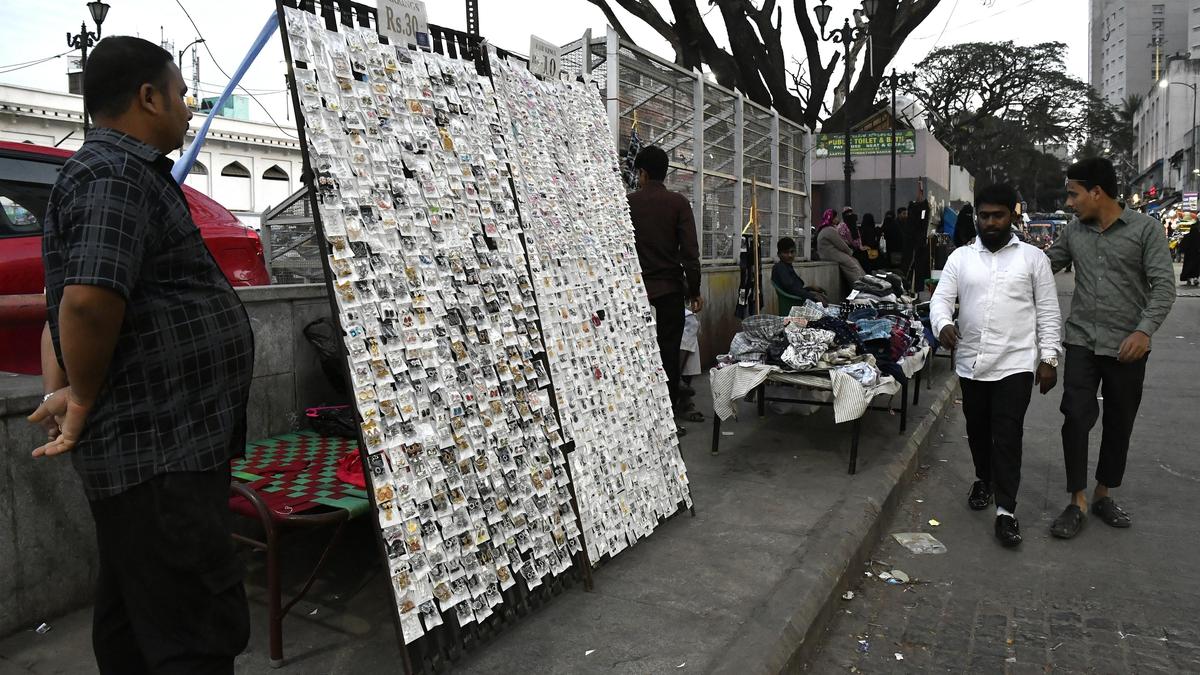

The Greater Bengaluru Authority (GBA) has directed all five city corporations to remove unauthorised street vendors obstructing pedestrian movement, with drives planned on weekends on the busiest stretches of each corporation.
The officials maintained that the action is meant to “improve walkability” and not an eviction exercise.
Drives underway
Drives have already taken place in several locations. In the North Corporation, vendors in Banaswadi were removed on November 22, while the Central Corporation carried out drives on M.G. Road and Indiranagar between November 20 and 22.
“Smaller vendors who were using minimal space were not disturbed. Those who had taken over entire stretches were shifted to an alternative spot around 200 metres away,” an official from the North Corporation said, adding that parallel action was being taken even against commercial outlets extending displays onto the pavement.
The officials maintained that relocation was always attempted within nearby areas so vendors can continue earning. They also point to operational difficulties, claiming many vendors commute daily from neighbouring districts without taking responsibility for waste generated.
Street vendors, however, argued that even when alternative spaces were shown, the administration’s reliance on a drastically reduced list of just 27,000 vendors was an attempt to limit the number of people legally protected under the Street Vendors (Protection of Livelihood and Regulation of Street Vending) Act, 2014.
The Bengaluru’s street vendor community estimated that the city has at least one lakh vendors, a number also reflected in PM-SVANidhi loan data and independent assessments. The GBA’s figure of 27,000, less than a third of that, has therefore created widespread unrest.
The vendor unions said the low count has ensured more “unauthorised” ones who can be removed without rehabilitation. “They are fixing vending zones only for those 27,000 people,” said Muniraju P., a vendor from Jayanagar.
2024 survey
The dispute stems from the erstwhile BBMP’s vendor survey conducted between September and December, 2024. The enumeration identified 27,000 vendors but did not issue a single ID card, a repeat, vendors said, of the 2017 exercise when thousands were excluded. “We were promised a transparent, systematic survey overseen by the Town Vending Committees (TVCs) as required under the Street Vendors Act. But again, many of us have been left out,” Mr. Muniraju said.
The officials argued that the reduced count was the result of rules, which allow only one vendor a family to be registered. They also claimed that the enumeration became unreliable because many people brought multiple family members and insisted all be included, making verification difficult.
The officials also cited safety and traffic concerns, saying vending can only be allowed on footpaths wider than 14 feet- a standard that vendor groups argued would rule out most streets in Bengaluru.
Demands for transparency
S. Rangaswamy, president of the Federation of Karnataka Street Vendors’ Association, argued that the Street Vendors (Protection of Livelihood and Regulation of Street Vending) Act, 2014, was designed to prevent arbitrary evictions. It mandates that vendors must be surveyed, issued identity cards, and protected from removal unless a decision is taken through the Town Vending Committee.
Vendor associations have repeatedly asked the authorities to release ward-wise lists so they can verify who has been included.
“No civic authority can evict a street vendor without a decision taken by the TVC,” Mr. Rangaswamy said, adding that the association has asked the government to issue ID cards based on Aadhaar and ration card records. Even migrant vendors are protected under the law. And before any eviction, basic infrastructure including toilets, drinking water, electricity, godowns, must be created at designated vending zones, he said.
Mr. Rangaswamy noted that the Supreme Court has repeatedly upheld the right to livelihood of street vendors, including in the landmark Hawkers’ Union vs BMC judgment, which ruled that no vendor can be removed without due process or rehabilitation.
Published – November 24, 2025 07:39 pm IST