




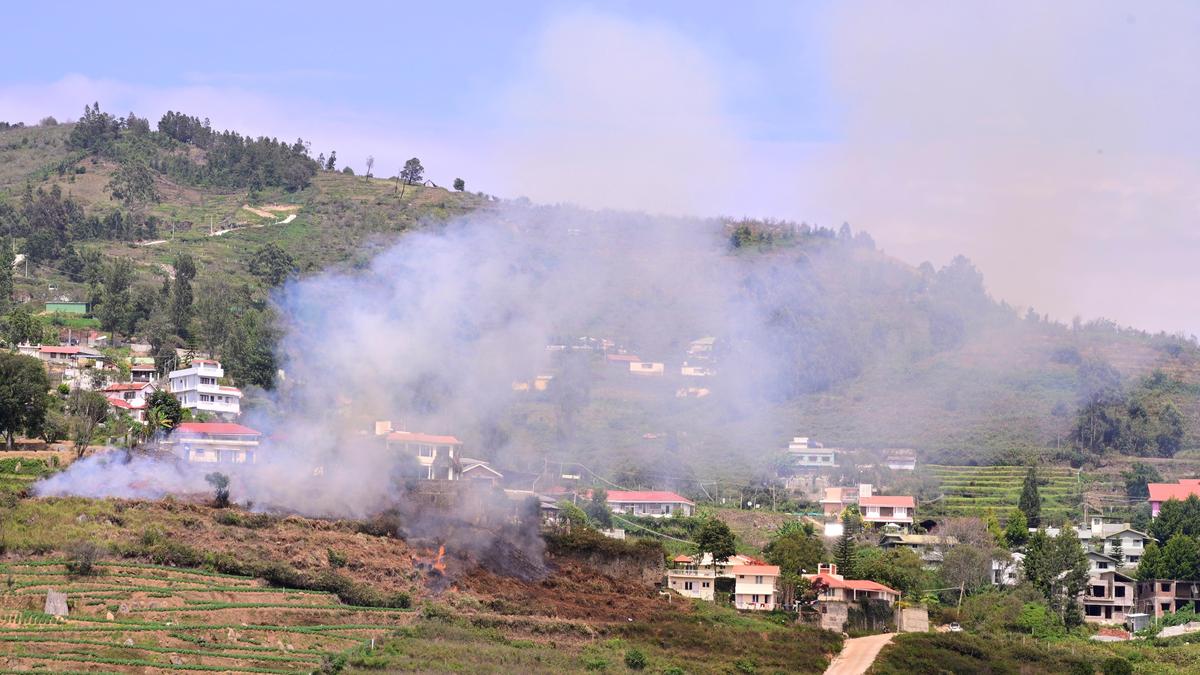

Stubble being burnt at a farm near Attuvampatti in Kodaikanal.
| Photo Credit: KARTHIKEYAN G
Though, stubble burning has not become a major issue in Kodaikanal hills like in the northern parts of India yet residents fear that if left unchecked it may affect the eco sensitive zones of Kodiakanal and Palani hills. Of late, wisps of smoke can be seen snaking up the peaks especially during November and December, when farmers in Kodaikanal after harvesting one crop clear the fields in order to get it ready for the next crop as the northeast monsoon brings in rains.
Raja, a carrot farmer in Kodaikanal, says that carrots are ready for harvest within 80 days. “Only when farmers are able to clear the fields fast, they can sow the carrot seeds so by the time the tourists come up the hills during the winter break, the carrots are ready for harvest,” he points out.
As terrace farming is the only option in the hills, use of machinery to clear stubble in the fields is impracticable. Due to manpower shortage there are less workers available to clear the stalks and other plant parts left in the field. Farmers think that the only way to clear the stubble is to burn it.
Mac Mohan, an environmental activist, says not many farmers in the hills have been educated on the ill-effects of burning, like for instance soil may get deprived of nutrients and also earthworms and microbes that help in soil fertility may die. “What is needed in Kodaikanal and Palani hills is a regulatory mechanism which should be formulated by including all the stakeholders. Stubble burning can be avoided in villages that lie in ecosensitive zones,” he points out.
Activists suggest going in for mulching the stubble, which would also be a good fertilizer. Palani, another farmer in the hills, who is cultivating cauliflower agrees that mulching does help the field. “Yes, but mulching is a long process. We are all small scale farmers and we do not have the luxury to keep a piece of land fallow so that the stubble gets decomposed. On what little land we have, we have to constantly cultivate in order to sustain ourselves,” he says and adds that burning is the only option for small-time farmers.
Activist Azad Reese from Kodaikanal says that for many years farmers have been setting fire to the stubble. “Their contention is that the ashes also help in regeneration of the soil. But of late as many farmlands lie adjacent to reserve forest areas, burning stubble cannot be advocated,” he says and adds that farmers whose lands lie in the grey zone, particularly near pristine shola forests should be sensitised to this practice.
District Forest Officer Yogesh Kumar Meena says that awareness campaigns have begun. “We hope that the farmers, especially those having lands near the forest areas, will refrain from burning stubble,” he says. Even a flying ember due to strong winds in the hills can ignite forest fire and cause extensive damage.
Due to the cold weather conditions prevailing in the hills, residents like Manikandan hope that this practice will slowly fade away. “Stubble burning releases gases that are trapped in the lower atmosphere due to the cold weather and this can impact visibility and also prove to be a health hazard during the tourist season,” he warns.
Published – November 08, 2025 06:48 pm IST