



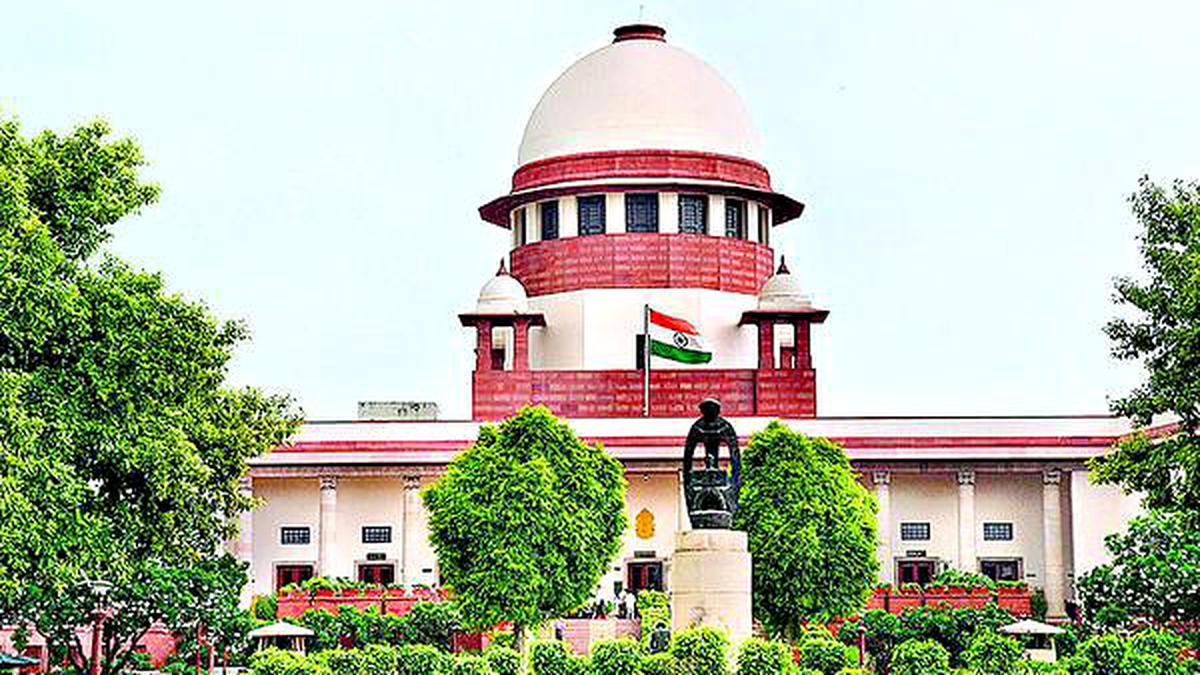

A view of the Supreme Court of India. File
| Photo Credit: The Hindu
The Supreme Court of India has decided to inquire into the circumstances of setting up private universities, the benefits bestowed on them by the Centre and State Governments and the standard of monitoring of their functioning by the University Grants Commission (UGC).
A Bench headed by Justice Ahsanuddin Amanullah sought the details from the Centre and States on the background and provisions of laws leading to the establishment of all private, non-government and deemed-to-be universities.

The court ordered the Centre, States and UGC to disclose steps taken to ensure that private universities make good their claim that they make good their promise to function on a ‘no profit, no loss’ basis.
“How and under what authority have the government(s) enforced this and ensured no diversion of funds towards anything unconnected with the educational institution, including salaries/expenses towards founders/family members and assets acquired by them?”
The Order was passed on the basis of a petition filed by a student, Ayesha Jain, represented by advocate Mohd. Fuzail Khan, against Amity University. Ms. Jain alleged that the university refused her request for a change of name in its rolls even though she had produced the required documents. She accused the university of harassment and taunts for changing her first name from a traditionally Hindu sounding ‘Khushi’ to ‘Ayesha’.
The apex court directed the court to disclose the sops granted by the governments, in the Centre or in the States, including the terms of allotment of land, preferential treatment and other ancillary benefits conferred on these private institutions.
“The government(s) should also furnish details of the memorandum of articles, aims and objectives of the societies and individuals running private universities.” The court order sought details, including their composition and mode of selection, of the managing committees or board of governors of these institutions.
“Full details of the personnel connected with the establishment/management of such universities shall be placed on record,” the recent Order said. The court, in addition, directed the UGC to disclose on oath its role vis-à-vis private institutions.
“It is made clear that the affidavit by the UGC shall cover what the statute/policy mandates as also the actual mechanism to monitor/oversee compliance by the institutions,” the order recorded.
The UGC’s details should cover the policy of admission of students, the process of recruitment of academic staff adopted by private universities and the regulatory checks that the government(s) have put in place to ensure that the terms and conditions were adhered strictly to. The court has also sought details from the Centre and States on the grievance redressal mechanisms in place, for students as well as faculty and staff in private universities. It has asked if minimum salaries as mandated by law are paid to them in these institutions.
The court has directed the Cabinet Secretary to the Government of India and all Chief Secretaries to the State Governments/Union Territory administrations to obtain and collate the information from Ministries and Departments functioning under their respective jurisdiction. The affidavits to be filed in court should be personally affirmed by them. The Chairman, UGC, would act likewise.
“There shall not be any delegation of such filings. Further, responsibility for every disclosure and its correctness shall rest with the deponents concerned,” the Supreme Court stressed. The case was listed for hearing next on January 8, 2026.
Published – November 27, 2025 11:30 am IST