




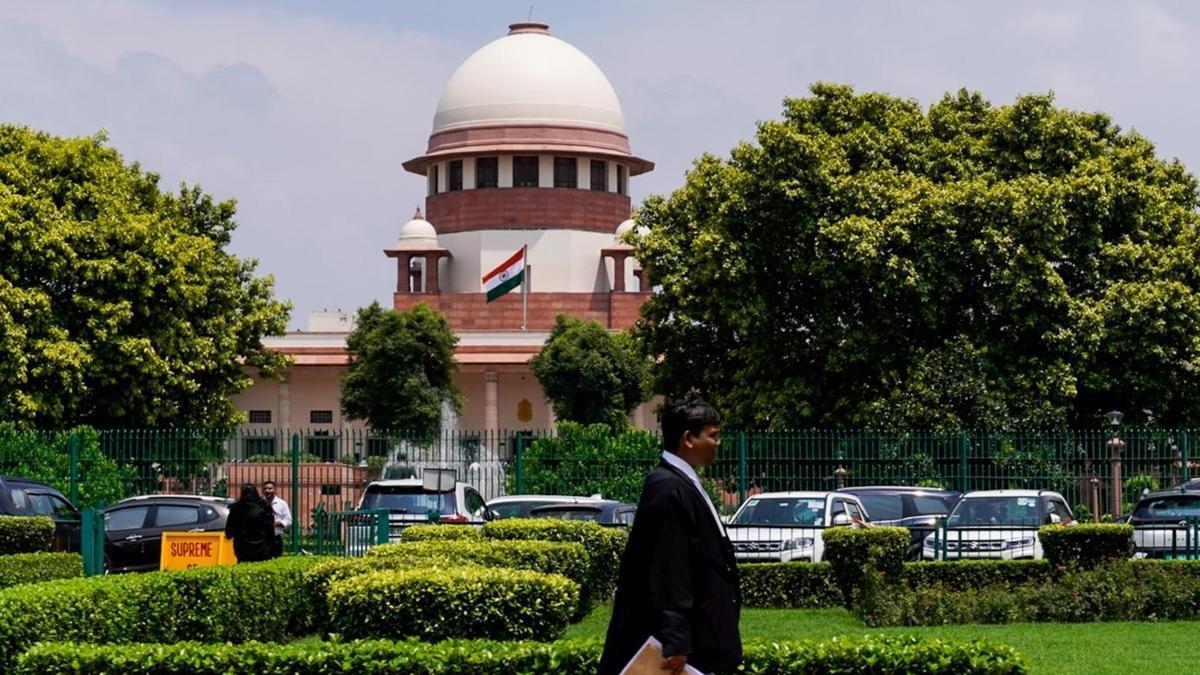
Supreme Court of India. File
| Photo Credit: The Hindu
The Supreme Court on Monday (November 24, 2025) agreed to examine a petition to stop cash donations of even up to ₹2000 to political parties for the sake of transparency, and to bring every political contribution, no matter what the amount, under the income tax regime.
A Bench of Justices Vikram Nath and Sandeep Mehta issued notice on the plea that the Election Commission of India (ECI) must not spare political parties from disclosing even cash donations up to ₹2000, and they should be made to divulge the complete details of their donors.

“Political parties must disclose the name and all other particulars of the person paying any amount of money to it and no amount can be received in cash so as to maintain transparency in the political funding,” the petition .
The petition has arraigned, besides the ECI, the Union government, Central Board of Direct Taxes and 13 political parties, including the Bharatiya Janata Party (BJP), Indian National Congress, Dravida Munnetra Kazhagam, Communist Party of India (Marxist), All India Trinamool Congress, Samajwadi Party, Aam Aadmi Party, as respondents.
The petition was filed by Khem Singh Bhati, represented by senior advocate Vijay Hansaria and filed through advocate Jayesh K. Unnikrishnan. It challenged the legality of clause (d) of Section 13A of the Income Tax Act, 1961. Section 13A is a special provision permitting tax exemption to political parties. Clause (d) of the provision allows parties to accept donations worth ₹2000 in cash.
“But no amount should be received in cash to maintain transparency in political funding,” the petition underscored.

The petitioner argued Section 13A(d) provided a loophole – a well-endowed anonymous contributor could divide a bulk donation to cash amounts up to ₹2000 each and use multiple fronts to pay a political party, especially with digital payments in vogue.
“Section 13A(d) of the Income Tax Act is violative of Article 19(1)(a) of the Constitution in as much as receipt of a huge amount of money in cash purportedly below ₹2000 violates the right to information of the voters about the source of funds of the political parties. The voters have the right to information of all the amounts received by the political parties to enable them to cast their votes with full knowledge of the donors and their antecedents,” it contended.
The Bench agreed to list the case after two or three weeks.
The petitioner also sought a mandamus to the ECI to scrutinise Form 24A contribution reports of recognised national and regional political parties, and require them to deposit the amount received by way of contributions for which the address and/or PAN number were not furnished.

Form 24A is a mandatory report submitted annually by political parties to the ECI to claim income tax exemption on voluntary contributions. It details contributions above ₹20,000 and is a measure to ensure transparency in political funding.
The plea has sought a direction to the ECI to issue notices to the defaulting political parties under paragraph 16A of the Election Symbol Order, 1968, as to why their reserved symbols should not be suspended or even withdrawn for failure to submit Form 24A contribution reports within the stipulated time. It said the accounts of political parties must be audited by independent auditors appointed by the ECI.
“An analysis of the audit reports and the contribution reports filed by the political parties shows that they are incomplete, delayed and lacking in material particulars,” the petition said.
It said CPI(M) filed its contribution report 43 days after the cut-off date of September 30, BJP after 42 days, Congress delayed by 27 days, etc. The plea submitted that the Form 24A reports, in the case of some parties, were incomplete. Addresses and PAN numbers of the donors and bank details were not mentioned.
“Almost all political parties have received large amounts of money as bank interest; however, the details of the deposits and particulars of the banks have not been mentioned. Many political parties have shown large amounts of money received towards fees and subscriptions without disclosing the name, address, PAN number and the amount paid,” the plea submitted.
Published – November 24, 2025 05:06 pm IST