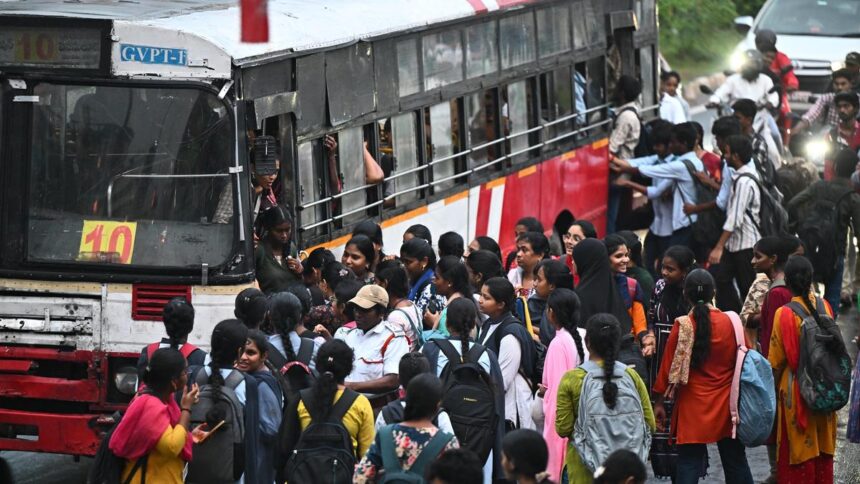




GUWAHATI Thousands of Tai Ahom people staged a torch rally in eastern Assam’s Moran town on Tuesday (October 28, 2025) evening, demanding Scheduled Tribe (ST) status for their community.
Moran, in the Dibrugarh district, is more than 400 km east of Guwahati.
The torch rally, organised by community-based organisations including the Tai Ahom Yuba Parishad, Assam (TAYPA) and the All-Tai Ahom Students’ Union (ATASU), follows similar demonstrations by organisations of other communities also demanding the ST status.
The Tai Ahoms are among six communities seeking ST status for more than two decades. The others are the Adivasi (loosely referred to as “tea tribes”, comprising approximately 95 ethnicities), Chutia, Koch-Rajbanshi, Matak, and Moran. They are currently in the Other Backward Class category.
They have been exerting pressure on the Bharatiya Janata Party-led government to fulfil the promise of granting them ST status made ahead of the 2014 Lok Sabha elections.
TAYPA president Diganta Tamuly said the Tai Ahoms would boycott the BJP ahead of the next Assembly polls, scheduled for May 2026, if it fails to deliver on its promises. “We have been waiting for more than a decade. The BJP will face severe backlash if their betrayal on the ST status issue continues,” he said.
The BJP had promised ST status for the six communities during Prime Minister Narendra Modi’s 2014 parliamentary election campaign in Assam.
The Ahoms, who have ruled large swathes of present-day Assam for six centuries, wield significant electoral influence in the eastern Assam districts of Charaideo, Dhemaji, Dibrugarh, Golaghat, Jorhat, Lakhimpur, Sivasagar, and Tinsukia. The Adivasis, comprising a tad less than 20% of Assam’s voters, are also a potent voting force in these districts and beyond.
Panel report
ST status has been a major issue in most elections in Assam since the Koch-Rajbanshis were temporarily on the tribal list in the 1990s. Their exclusion followed strong protests from the existing tribal groups, including the Bodos, Karbis, Mishings, and Rabhas.
Indicating that the government hopes to find a “middle path” to resolve the differences between the six communities seeking ST status and the existing ST groups, Chief Minister Himanta Biswa Sarma had advised the six communities to wait for the Group of Ministers report on the issue.
The report is likely to be tabled in the 126-member State Assembly on November 25.
The Coordinating Committee of Tribal Organisations of Assam (CCTOA), representing Assam’s tribes, has been opposing the move to grant ST status to the six “advanced ethnic groups”, warning that such a step would “destroy” Assam’s tribes by eating into the rights and privileges they currently enjoy.
The CCTOA cited historical examples, pointing out that the Ahoms ruled Assam for six centuries, the Chutias had their own kingdom before the Ahoms, and the Koch-Rajbanshis are a heterogeneous group with internal divisions apart from having ruled large areas of Assam, West Bengal, and present-day Bangladesh.
The All Assam Tribal Sangha maintained that the Adivasis, settled by British tea planters from central and eastern India, were not indigenous enough to merit ST status. It also pointed to “interstate complications” as hurdles in their “tribalisation”.
Published – October 29, 2025 11:20 am IST