



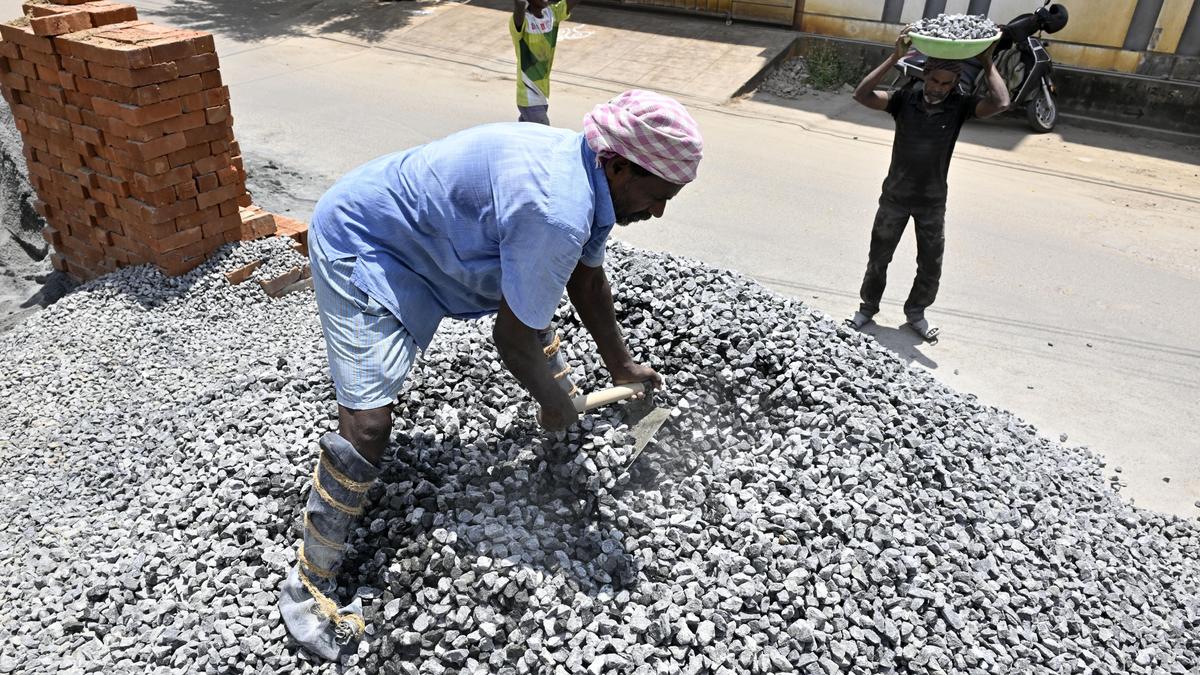

Currently, 18 unorganised workers’ welfare boards in Tamil Nadu are implementing schemes pertaining to education, marriage, accident disability, and pension, among others.
| Photo Credit: M. VEDHAN
With the Union government notifying the enforcement of the four Labour Codes all over the country, the Tamil Nadu government has found itself in a tight corner with regard to the Code on Social Security, as it has been entertaining reservations on the issue.
Ever since the Centre enacted the four Codes five years ago in the place of 29 laws, it had held discussions with the State government over the implementation of the Code on Social Security (CSS), 2020. But, no consensus was arrived at, according to a policymaker.
Of the four Codes, the State government, in April 2022, published draft rules for the three — the Code on Wages, 2019, the Industrial Relations Code, 2020, and the Occupational Safety, Health, and Working Conditions Code, 2020. As consultations with stakeholders have been held, the government can notify the final rules anytime now. Only in respect of the CSS, no draft rules have been framed so far.
Existing law
Fundamentally, the CSS does not give liberty to the State government to retain its existing law — the Tamil Nadu Manual Workers (Regulation of Employment and Conditions of Work) Act, 1982. But, the Unorganised Workers’ Social Security Act, 2008, one of the nine laws subsumed by the latest Code, had allowed States to have any corresponding law, providing welfare schemes more beneficial to the unorganised workers than those provided for them under it.
The main reason behind the State government’s reservation is that Tamil Nadu, being a “pioneer” in labour welfare measures for the unorganised sector, has been having 18 unorganised workers’ welfare boards, covering those engaged in 70 (manual) and 54 (construction) categories of works specified in the 1982 law. These boards are implementing a number of schemes pertaining to education, marriage, maternity, natural and accidental death, accident disability, and monthly and family pension.
The concern expressed by activists and trade unionists, apart from the State government, is that the present framework of schemes may get disturbed after implementation of the CSS. For example, in the Code, it is for the Union government to frame welfare schemes for unorganised workers in respect of life and disability cover, health and maternity benefits, old age protection, and education, while it is for the State governments to come up with schemes for provident fund, employment injury benefit, housing, educational schemes for children, upgrading skills of workers, funeral assistance, and old age homes.
This has raised questions over how to continue with the existing schemes of the State government and welfare boards in areas designated for the Union government. Besides, the possibility exists in respect of overlapping of certain functions, as stipulated by the Code. Notwithstanding the prevalence of challenges inherent in the implementation of the CSS, the Tamil Nadu government is particular that the interests of workers are safeguarded and strengthened, explains a senior official.
Published – November 23, 2025 12:07 am IST