




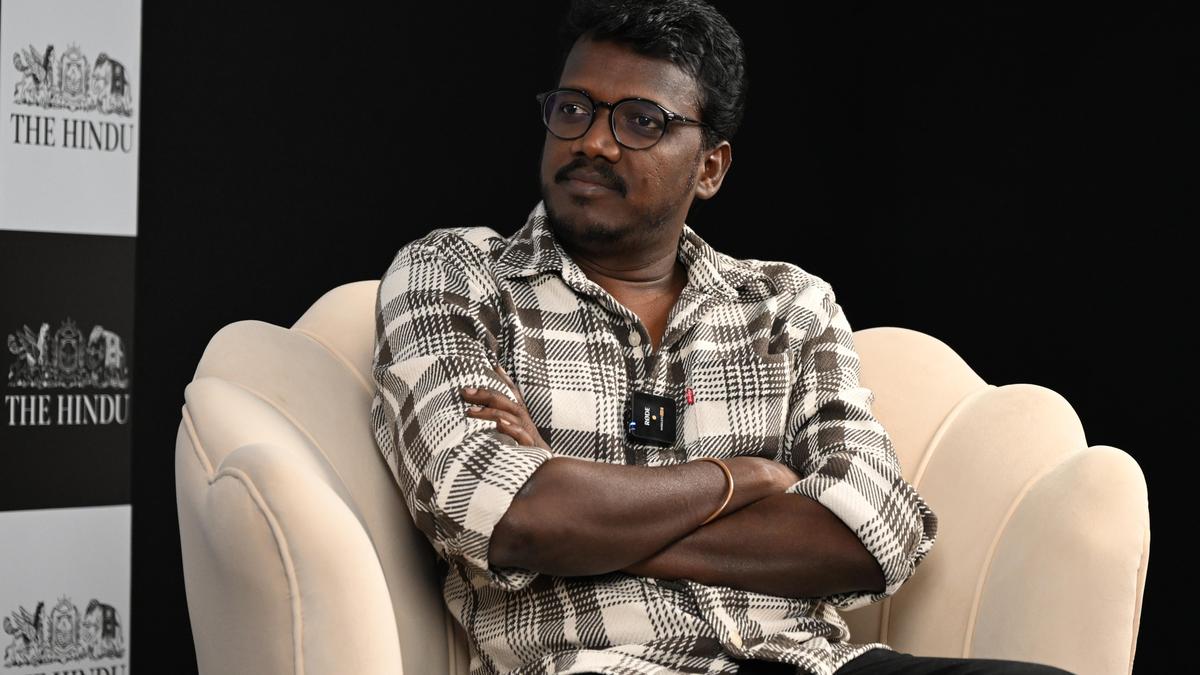

Acclaimed Tamil film director Mari Selvaraj on Wednesday said reading literature helped him understand where to draw creative boundaries. Tamil and Russian literature had a deep influence on his visual storytelling through his movies.
In a freewheeling conversation, moderated by B. Kolappan, Senior Deputy Editor, The Hindu, at the newspaper’s head office in Chennai, Mr. Selvaraj said he first read Chidambara Ragasiyam by Balachandran Sullikadu in Tamil and it left a deep impression. “While Russian literature taught me how to narrate, visualise a story, Tamil literature gave me the strength and rootedness to connect with my land and people. The combination of both shaped the visual language of my cinema.”
Politics and emotion
Reflecting on his formative years, Mr. Selvaraj said the political awareness and emotional sensitivity within his family deeply influenced him.
“My paternal uncle was a Communist. He would speak up for the problems faced by the people in our village, even when the same struggles existed in our own home. I saw him as a hero. From my father, I inherited emotional depth. My father’s pain and tears touched me deeply. I grew up watching these two figures — one driven by socio-political commitment and the other by emotion.”

He said the feminism in his movies was inspired by his mother and elder sister. “Though my father was an emotional person, my mother and elder sister stood in contrast to him. My mother daringly took several important decisions in the family,” he said.
Talking about the symbolic portrayal of B.R. Ambedkar, the architect of the Constitution of India, in his movies, the director recalled his childhood experiences and said photographs of Communist leaders on his school notebooks never provoked anyone. “But whenever there was a picture of Ambedkar on the cover, some people would tear it off. That left a mark on me. I began to feel that what happened to me also happened to Ambedkar, and there was a deep connection between our experiences,” he said.
Folk elements
To a question on the use of folk elements such as Naiyandi Melam, he said these were drawn from his life as a youngster from his village. “In my younger days, the Naiyandi Melam was all I heard. That sound became part of my joy and sorrow. It is not just my personal emotion. It is the sound that belongs to everyone from my land,” he said.
Speaking about the use of native dogs in his films, Mr. Selvaraj said in his village, parents would leave early for work and return late in the evening, sometimes staying away for days. “In such situations, dogs became companions for children and the elderly. Every household had them. So, whenever I think of my village, I cannot imagine its streets without dogs,” he said.
Violence and reality
Responding to criticism that his films contain excessive violence, Mr. Selvaraj said “What is often questioned as violence is, in fact, the truth within that violence. Many other films have much more violence but are celebrated. The violence in my films is criticised because it reflects reality. I try to show as little as possible, but I cannot avoid it because truth lies within it,” he said.
Asked whether individual success can advance a community, he said while one person’s victory could not represent an entire society’s progress, it could spark hope. “Through my art form, I am sustaining a dialogue with the people. In southern Tamil Nadu, political conversations through art had never happened before. This is the first time, and it has surprised many. It has opened up multiple discussions,” he added.
Casting Vadivelu
On casting actor Vadivelu in a serious role in his film Maamannan, the director said it was a decision inspired by his father.
“I never saw my father as a hero. My father used to sing devotional songs. Sometimes he would be moved to tears while singing. Audiences usually laughed when Vadivelu sir’s portrayal of comic characters was mocked or beaten on screen. In our lives, when we face the same pain, we cry. But when it happens to Vadivelu sir on screen, we laugh. I wondered what would happen if such a character was made to change,” he said.
He said he wanted to use Mr. Vadivelu, who had mostly played innocent or comic roles, to tell a story that carried depth and vulnerability. “That was the challenge. I had to make sure even his smallest gestures did not provoke laughter. During the shoot, I would look at the faces of my assistant directors and crew after each shot. If none of them smiled, I would know that the shot had worked,” he added.
Published – November 07, 2025 12:43 am IST