



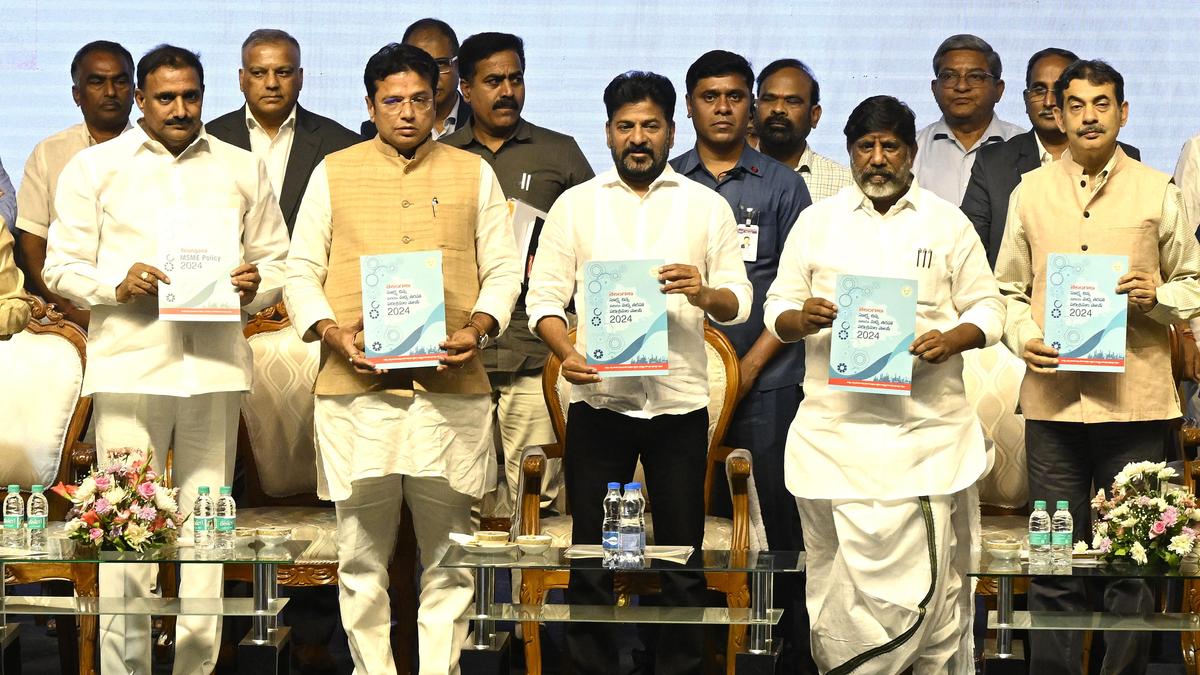

The government is committing to a 2030 timeline to launch TG-iPASS 2.0, which will be AI-based and provide fully automated approvals along with a lite module for startups and micro, small and medium enterprises.
| Photo Credit: RAMAKRISHNA G
From TG-iPass 2.0 or the next phase of faster, Artificial Intelligence-backed, fully automated approvals for industries to timely disbursal of incentives as well as measures to accelerate land sanction and boost local manufacturing ecosystem, the Congress government in the State has identified a clutch of core imperatives to position Telangana as an investment magnet.
Envisaged as part of Telangana Rising 2047 Vision document that is scheduled to be unveiled at a grand function next month, coinciding with two years of Chief Minister A. Revanth Reddy’s government, the imperatives or the enabling factors are set to bridge the gaps.
In doing so, the emphasis will be to consolidate Hyderabad’s status as a preferred location and build on the foundations of policy stability; world-class infrastructure; ease of doing business levels; robust innovation systems and superior quality of life for which the State is already well known.
The government is committing to a 2030 timeline to launch TG-iPASS 2.0, which will be AI-based and provide fully automated approvals along with a lite module for startups and micro, small and medium enterprises (MSMEs). It will also operationalise Nalgonda dry port and integrate it with logistics corridors by the decade.
Creation of an SME Information Exchange for transparent, data-driven credit access; launch of the T-GCC Academy and fintech-focused education programs to build and attract skilled talent; digitization of SHG repayment data and link with credit bureaus to expand formal finance; and setting up a Centre of Design Excellence in Hyderabad to embed design in governance, business and education are other some other aspects for which too the deadline will be 2030.
“As we move confidently towards $3 trillion GSDP milestone by 2047, we envision the next leap to position Telangana as a bold, high-trust, and people-centric investment magnet that converts capital, talent and ideas into livelihoods and upward mobility, the draft of the vision document showed.
Unified single window
On contours of TG-iPass 2.0, the government said TG-iPASS framework will be expanded to cover all sectors, integrating all departmental approvals into a unified single-window system with real-time tracking, accountability metrics and performance dashboards. Towards boosting MSMEs growth, the State will enable self-certification for the enterprises and reduce filing frequency by introducing consolidated returns and simplified annual compliance, lowering transaction costs and enhancing ease of operations.
Also, Telangana will move toward zero-touch, blockchain-enabled clearance workflows, achieving full automation by 2039, thereby reducing project cycle times and improving investor predictability. A unified compliance regime will consolidate all State levies, permissions and approvals into a single platform to eliminate duplication and deliver a seamless compliance experience.
For existing industrial units, the State government will institute a streamlined renewal and expansion approval process, offering fast-track clearances for capacity expansions, modernisation and diversification.
Flexible land-use
Faster sanctioning of land will be driven by digitisation of land records, GIS mapping and transparent zoning norms, ensuring clarity, accessibility and reduced uncertainty for industrial investors. The State envisages flexible land-use policies and cluster-based development with integrated infrastructure that will encourage startups, SMEs and sectoral innovation hubs across tier -II districts.
The government will promote component and ancillary manufacturing by encouraging local vendors to supply critical parts, thus reducing dependency on imports. Telangana will create innovation-driven industrial zones and streamlined exit mechanisms to ensure flexibility for businesses and promote smart industrial ecosystems, the draft document showed.
Published – November 25, 2025 08:52 pm IST