




What does a ₹5 lakh crore land pool really unlock for Telangana’s capital city — new economic growth or a sweetheart deal disguised as urban transformation? That question now hangs over the Hyderabad Industrial Land Transformation Policy (HILTP), a government proposal to convert thousands of acres of industrial land within and around the Outer Ring Road (ORR) into multi-use urban zones. The policy is being fast-tracked but the land it touches is among the most valuable in Greater Hyderabad, and that is exactly why the Opposition is sounding the alarm.
HILTP will enable conversion of industrial land to multi-zones, allowinsg a mix of residential, commercial, institutional and recreational uses along with technology parks. In return, the government expects substantial non-tax revenue through a development fee equivalent to 50% of cost on plots abutting 80-foot roads and 30% on those less than that width. Of the receipts, 25% will stay with the Telangana Industrial Infrastructure Corporation (TGIIC), and the balance will flow to the State treasury.

The government order frames the policy as a strategic intervention with profound and far-reaching economic, urban planning and environmental benefits, arguing that the ORR-region estates established 50 to 60 years ago have been swallowed by urban expansion and need repurposing.
The policy has been proposed at a time of financial strain, with the government seeking to shore up declining revenues this year. By October-end, Telangana’s receipts were ₹94,555 crore, which is just 41.16% of the ₹2.29 lakh crore budget target, with five months left in the fiscal. Borrowings and liabilities stood at ₹50,541 crore. With revenues slowing, land monetisation has emerged as a way to ease the squeeze.
The Opposition parties, however, see it as a major financial scandal in the making. According to their estimates, the policy impacts around 9,292 acres within and near the Greater Hyderabad Municipal Corporation limits, reportedly valued at around ₹5 lakh crore. Both the Bharat Rashtra Samiti (BRS) and the Bharatiya Janata Party (BJP) allege that the government has opted for conversion of the land to favour its “near and dear ones” rather than the State.
Valuation gaps stoke doubt
Their case rests on variations between valuation thresholds used for calculating the one-time development fee, especially in long-established industrial belts such as Nacharam, Mallapur, Cherlapally, Moula Ali, Uppal, Kukatpally, Jeedimetla, Balanagar, Sanathnagar, Medchal Kushaiguda, Gandhinagar, Patancheru, Pashamailaram, Ramachandrapuram, Katedan, Hayatnagar and Chandulal Baradari.
In Nacharam, the per square yard value fixed by TGIIC stands at ₹32,881 while the sub-registrar office (SRO) value is ₹21,000. In Moula Ali, TGIIC’s valuation is ₹46,895 per square yard as compared to ₹20,300 under SRO. Balanagar reflects a similar jump, where TGIIC’s rate is ₹52,523 per square yard while the SRO rate is ₹18,300. At Hayatnagar, TGIIC’s value is ₹54,340 per square metre against the SRO’s ₹12,200, nearly three times higher.
BRS leaders and former ministers K.T. Rama Rao and T. Harish Rao cite these gaps as proof that cheaper SRO values could be adopted to allow lands to be given away at throwaway prices.

Rama Rao argues that the land was originally acquired from people to create jobs and given to industries at very low rates by previous government. “But the Congress regime led by A.Revanth Reddy is now attempting to hand over 9,292 acres of land to private individuals. This is a huge financial irregularity in the making,” he has alleged.
Union Minister and senior BJP leader G. Kishan Reddy has accused Chief Minister Revanth Reddy of bypassing procedure in bringing out the HILTP, stating that there was no consultation with elected representatives, current landowners or workers still employed in functioning units. He questions relocating industries outside ORR without assessing the impact on workers’ families.
He points to a lack of any socioeconomic impact study on thousands of unskilled and semi-skilled workers who depended on the industrial estates for steady income.
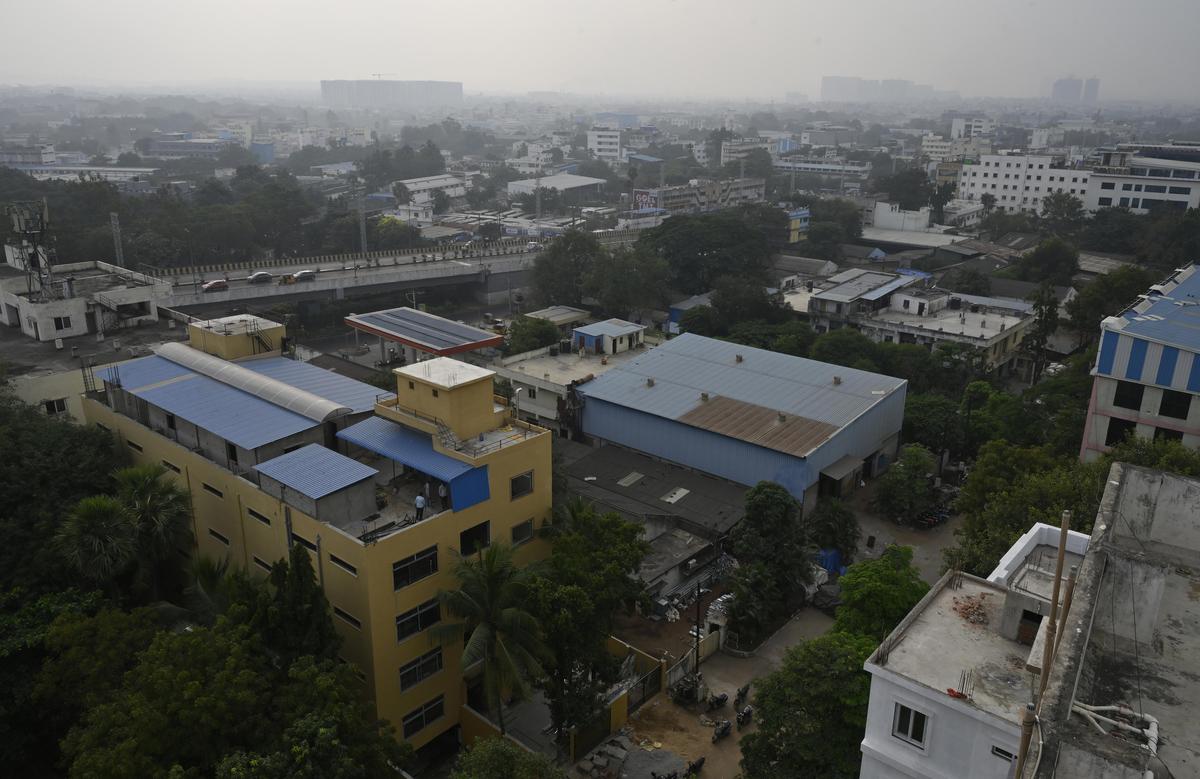
Sanathnagar today is a central node of Hyderabad with land prices nearing ₹100 crore an acre.
| Photo Credit:
NAGARA GOPAL
M. Padmanabha Reddy, president of non-profit Forum for Good Governance, says the concerns are not about workers’ employment as no industrial unit is presently operating there, but only about the cost at which the land will be transferred. “Let the Chief Minister put up the lands for auction,” he suggests, adding that the way the government’s approach is giving scope to a lot of “suspicion”.
Kishan Reddy also flags the absence of an expert committee to study the issue and make recommendations after consultation with stakeholders. The government constituted a panel only after the policy was announced and gave it just one week to submit a report. “This shows how unilaterally Revanth Reddy is taking decisions, reflecting the same tendencies of former Chief Minister K. Chandrasekhar Rao (of BRS) during his nine-year tenure,” Kishan Reddy says.
Government’s defense
The government contends the policy is long overdue. According to its order, decades-old industrial estates now sit inside the city’s dense core, creating environmental and socio-economic pressures. What were once peripheral clusters have, over the decades, been absorbed into Greater Hyderabad’s urban fabric.
Industrial hubs established in the 1970s — Uppal, Sanathnagar, Kukatpally, Nacharam, Hayatnagar and others — now lie at the heart of a rapidly expanding metropolitan region, a shift accelerated by the recent merger of 27 surrounding urban local bodies. Land values have surged accordingly, as industrial estates that once sat outside the city limits now fall within a high-demand zone for commercial real estate and large-format infrastructure.
Sanathnagar and Kukatpally are today central nodes with prices nearing ₹100 crore an acre. Hayatnagar, near the Ramoji Film City, and Uppal, just a few kilometres from the city centre, have seen prices rise beyond the reach of lower and middle-income families. Medchal’s merger into GHMC has only intensified this trend, where even the rates fixed by the TGIIC are lower than prevailing market prices.

The proposed conversion of these lands into mixed-use zones, ranging from residential, commercial and institutional to recreational, is expected to push growth in these belts to a new trajectory. With locations such as Sanathnagar, Balanagar, Kukatpally and Hayatnagar falling within accessible range of the metro rail network, rentals are likely to rise sharply, while land prices may surge, making it difficult for lower-income and middle-income families to afford even small plots for housing. Real estate developers and commercial operators are already positioning themselves for first-mover advantage as demand for premium parcels accelerates.
Neighbouring localities abutting these industrial belts, including Moula Ali, Miyapur and Vanasthalipuram, offer early evidence of this shift, having rapidly evolved into self-contained mini-cities with full amenities driven by housing demand and retail expansion.
The boom in commercial activity is expected to create opportunities for daily wage earners and former industrial workers who are currently relying on odd jobs to survive, but the stability of this transition remains uncertain. While the service-sector surge may offer short-term relief, it is unclear whether these new jobs can match the earnings, security and dignity that factory-floor employment provided for decades, raising important questions for policymakers about the future of low-income households in Hyderabad’s changing economic landscape.
Public policy expert D. Narasimha Reddy says the government’s order appears more like an administrative directive than a holistic, inclusive instrument. Three glaring gaps — no safety net for workers’ livelihoods, environmental protections and absence of a road map for relocation of current industries — are evident from the present policy, he points out.
‘Repurposing unviable land’
Against this backdrop, the government says the land faces two problems. Many industrial units have become unviable because of outdated technology, disrupted supply chains and rising compliance costs in dense urban settings. Many have already shut, leaving prime land underutilised and unproductive.

It argues that relocation of these industries is not new, citing G.O. 20 (2013) in undivided Andhra Pradesh, which mandated strategic shifting of polluting industries outside the ORR. For its part, the TGIIC is already developing modern, eco-friendly industrial parks to support the move. “The proposed HILTP is the logical and strategic next step to repurpose vacated underutilised lands within ORR, transforming them into productive and integrated urban spaces,” the government states in the policy.
Under the policy, all TGIIC industrial estates, parks, auto-nagars and standalone industrial units within and near ORR are eligible for conversion, paving the way for apartments, integrated townships, offices, retail centres, hotels, schools, hospitals, research centres, parks, sports facilities and cultural centres apart from technology campuses in alignment with the State’s GRID (Growth in Dispersion) policy.
As criticism by the Opposition mounted, the government sought to defend its stand, claiming the proposal to relocate industries within ORR limits was not new and that the issue was mooted by the governments of the erstwhile united Andhra Pradesh as part of efforts to make the city pollution free.
Deputy Chief Minister Mallu Bhatti Vikramarka and Ministers N. Uttam Kumar Reddy, D. Sridhar Babu and Jupalli Krishna Rao called the BRS’ charges “baseless” and accused it of mudslinging. “Rama Rao himself proposed shifting of 200 industrial parks from the ORR limits when he was minister between 2017 and 2022. Of those, 42 acres were converted from industrial to residential use during the BRS regime,” Uttam Reddy had pointed out.
They stress the land is not government-owned and was purchased by industrialists decades ago, and the change of land use formalises its new potential.
Beyond the political battle, officials are stunned by how the policy details leaked ahead of its formal announcement. Rama Rao’s early disclosure of SRO values and finer points has triggered an internal inquiry.
The government is reportedly preparing to release details of land deals during the previous regime, claiming that several were executed without any policy framework or Cabinet consent.