



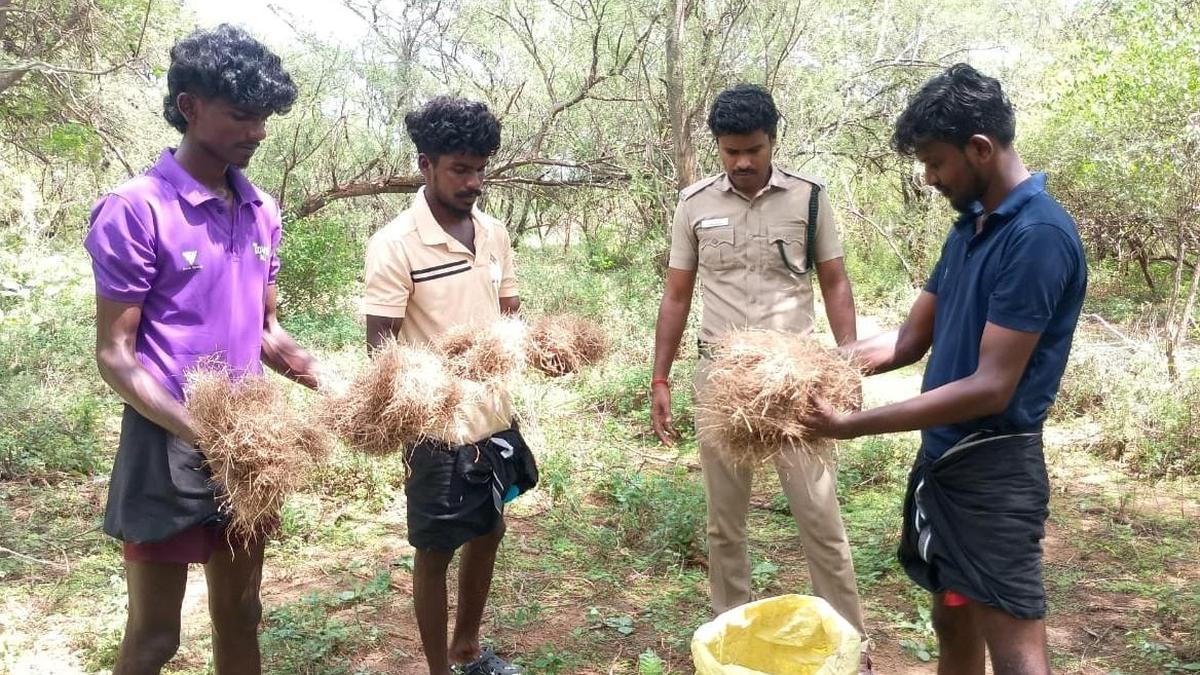

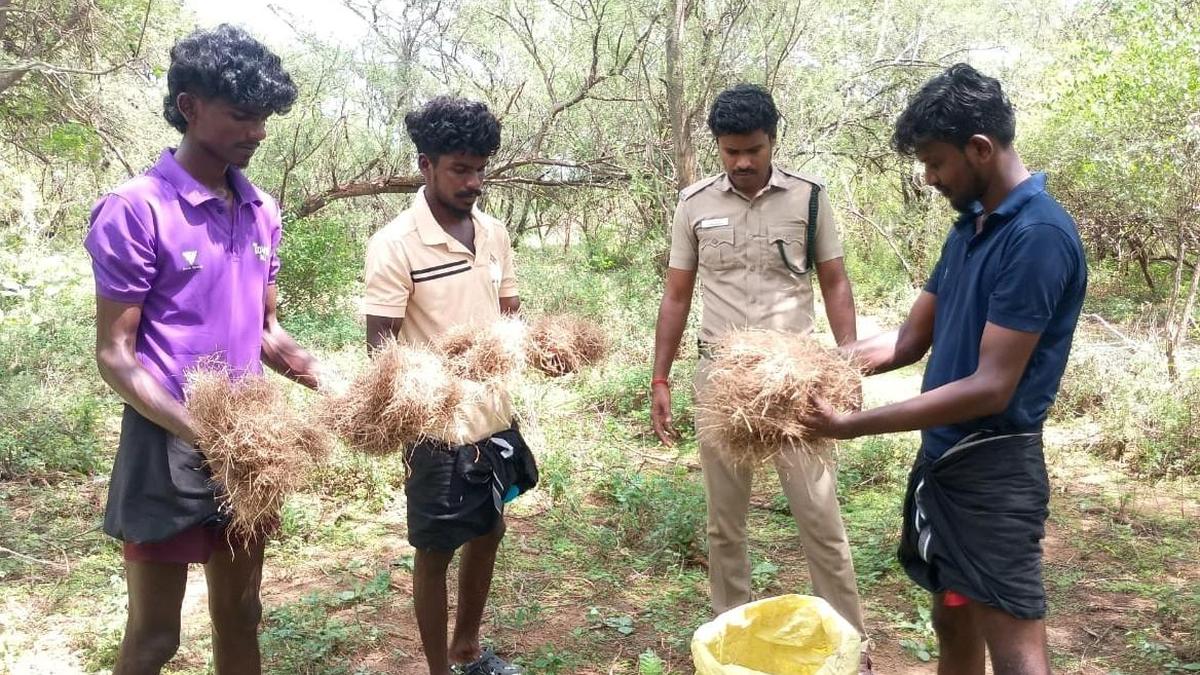
Personnel of Tenkasi Forest Division planting indigenous food sources preferred by the jumbos in an effort to prevent human-elephant conflict.
| Photo Credit: SPECIAL ARRANGEMENT
The Tenkasi District Forest Division has swung into action to address the growing human-elephant conflict in its jurisdiction.
The strategy focuses on sustainable forest management, habitat restoration, and community engagement to promote harmonious coexistence between humans and the wildlife. The key activities taken up by the department include native seed collection, large-scale reforestation, and the planting of indigenous elephant-preferred food sources.
Known for its rich biodiversity, Tenkasi district has been witnessing increased instances of human-elephant conflict in the recent past whenever the jumbos come out of the forest in search of food and water. The Tenkasi Forest Division, besides creating waterholes at vantage points within the forest to quench the wildlife’s thirst, has responded to this challenge by adopting sustainable and scientific initiatives aimed at restoring natural elephant habitats and reducing their reliance on human settlements for food.
As part of this multi-pronged strategy, Tenkasi Forest Division, supported by the Forest Genetic Division Research Wing, has taken several initiatives. The Forest Genetic Division Research Wing collected 50 kg of native seed grasses, liked by the elephants, for afforestation and habitat restoration, ensuring the planted species are natural to the local ecosystem.
Additionally, 3,500 teak trees have been planted in the exotic lantana removal area within the Puliyangudi Range that witnesses more elephant invasion into the ranches on forest boundary.
Moreover, native endemic wild seeded banana planting has been initiated using seeds specifically identified by the Forest Genetics Division. The Tenkasi forest division has collected these saplings from Coimbatore and reintroduced them in the wild as this food is much preferred by the elephants.
“These comprehensive initiatives are projected to yield the following key outcomes like reduced human-elephant conflict by minimising elephant forays into human settlements. Enhanced biodiversity and ecosystem services through the removal of invasive species and planting of native flora will be ensured. This initiative guarantees the conservation of endangered species by strengthening their core habitats. Above all, it encourages promotion of sustainable livelihoods for local communities through collaborative conservation efforts,” District Forest Officer of Tenkasi R. Rajmohan told The Hindu.
The farmers who have fields near the reserve forest fringes and the conservationists as well are happy with this initiative. “The Tenkasi Forest Division’s approach to conflict mitigation, which prioritises science-backed habitat restoration and active community involvement serves as a commendable model for conservation. This multi-faceted strategy is essential for achieving long-term harmonious coexistence between humans and wildlife,” conservationist Albert Rajendran, formerly Professor of Zoology, St. John’s College, Palayamkottai.
Published – November 04, 2025 07:25 pm IST