




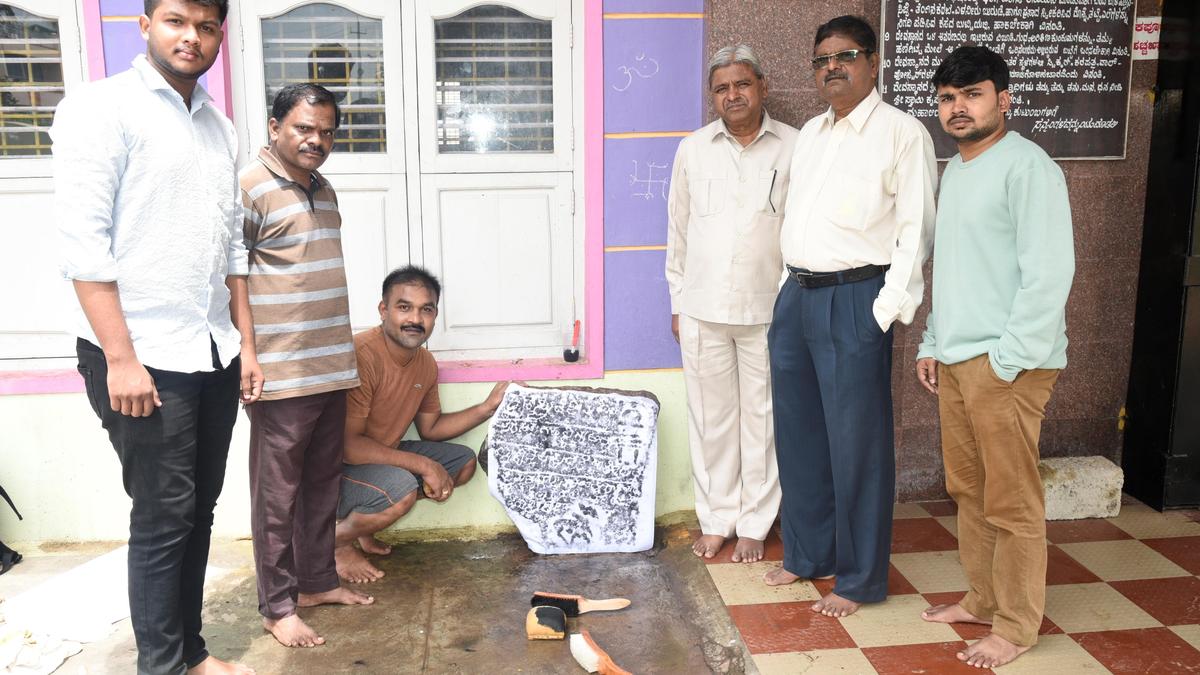
A tenth-century inscription dating back to the period of the Ganga dynasty was found inside the Mahalingeshwara Temple on the outskirts of Mysuru.
| Photo Credit: Special arrangement
A 10th-century inscription from the Ganga dynasty reign has been found inside the Mahalingeshwara Temple at Sardar Vallabhbhai Patel Nagar on the outskirts of Mysuru.
The inscription, dating back to the time of Butuga II, a ruler from the dynasty, was discovered on the wall to the right and faces east inside the temple. The six-line inscription was carved on white granite which is two feet wide and two-and-a-half feet tall.
“This inscription, dated 948 A.D., is inscribed in the Kannada script. It is believed that during the reign of Butuga II, his bodyguard, Maremma, may have donated the garden to the temple tax-free and entrusted its management to the village chief Vijaketa Gavunda. The full text of the inscription cannot be stated as it is corrupted. However, since the inscription references ‘Vijaketa Gavunda Dise’, it can be inferred that the management of the garden was entrusted to Vijaketa Gavunda, the chief of the village,” said a statement here.
Further, the embossed painting of the temple is symbolically engraved on the inscription, confirming that it was a donation related to the temple, the statement added. “Since the Shiva Linga in the Mahalingeshwara Temple, where the inscription was found, is in the Ganga architectural style and the inscription is from the Ganga period, it can be understood that this donation is related to the Mahalingeshwara temple,” the statement further said.
An embossed sculpture of a cow feeding its calf is also carved at the end of the inscription, which is 1,076 years old.
After retired Deputy Commissioner of Police Shivanna informed archaeologist Prof N.S. Rangaraju, the fieldwork to discover the ancient inscription was started by a team led by archaeological researcher Dr. Shashidhara C.A., and comprising junior researcher Dr. Mariswamy R. and photographer Ramesh Patel. The fieldwork was done with the co-operation of locals after securing necessary approval from Professor Shailendra Mohan, the Director of Central Institute of Indian Languages (CIIL), and N.M. Talawar, the Project Director of Centre of Excellence for Studies in Classical Kannada. Epigraphist Professor Devarakonda Reddy assisted in the reading of the inscription.
Published – November 06, 2025 08:39 pm IST