




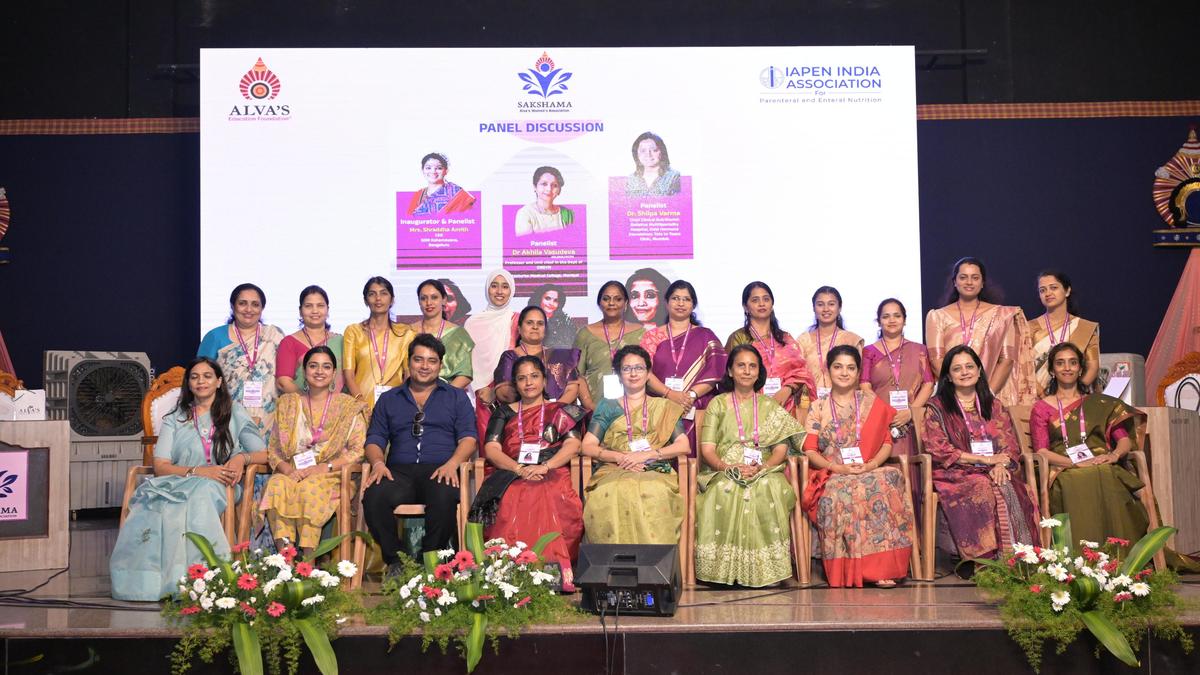

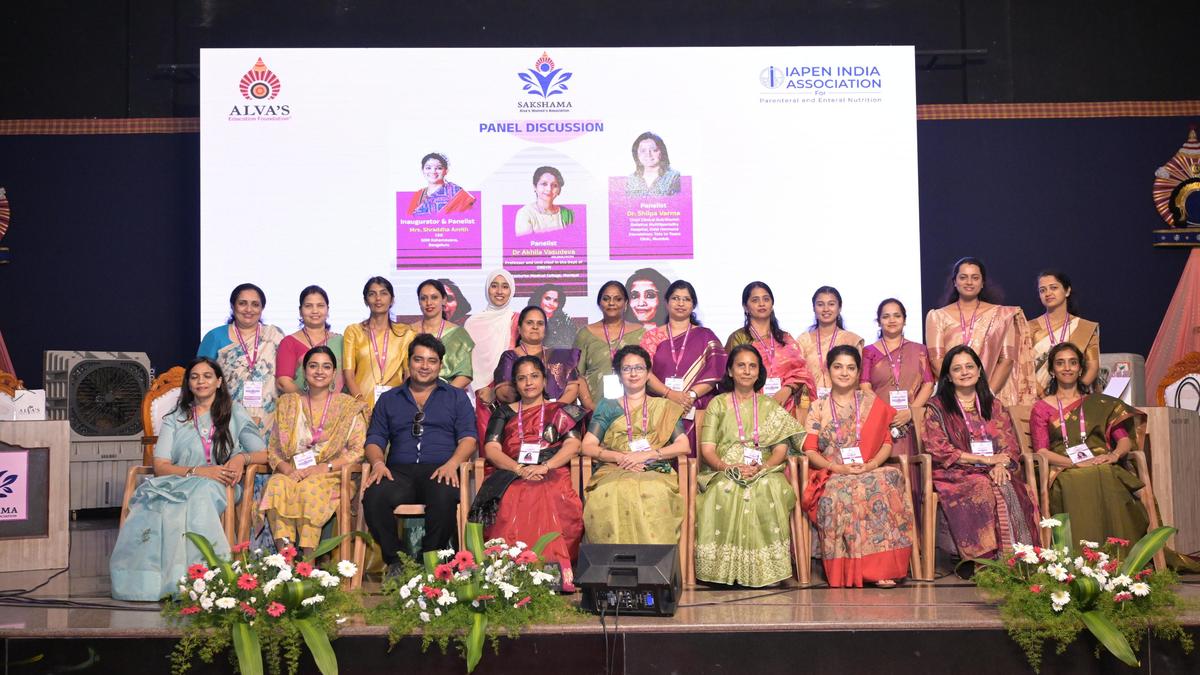
Vivek Alva, managing trustee of Alva’s Education Foundation, with panelists at ‘Nurture the Nurturer’, a national conclave on women’s health, at Moodbidri on November 27.
| Photo Credit: SPECIAL ARRANGEMENT
“If every household placed Ardhanarishvara at its centre, perhaps the subliminal message would be clear: We share this world as equals,” said M.Y. Manjula, Professor Emeritus at Christ University and retired professor in Psychology, SDM College (Autonomous), Ujire.
Ms. Manjula invoked the philosophical icon Ardhanarishvara, describing it as a symbol of equal energy and complementarity in her keynote address at ‘Nurture the Nurturer’, a national conclave on women’s health organised by Sakshama, Alva’s Women’s Association of Alva’s Education Foundation, and India Association for Parenteral and Enteral Nutrition, Mangaluru Chapter, at Moodbidri on November 27.
The union of Shiva and Parvati, she argued, is not just devotional art but a sociocultural reminder — one that challenges male superiority narratives. Revolving around patriarchy, cultural conditioning, and the psychological landscape of women across developmental stages, her talk was rooted in historical inquiry and lived social experiences. She urged institutions and families to recognise women as equal partners in society rather than secondary participants.
Stating that hormonal flux, restrictive social norms, misinformation, and body shaming create overwhelming emotional burdens for young girls, Ms. Manjula said, “Nature does not believe in monoculture. Just as the forests of the Western Ghats thrive in diversity, human bodies too come in many forms. Yet society demands uniformity from girls.” Citing research, she said nearly 50% of teenagers struggle with body image dissatisfaction, fuelled by idealised beauty standards and social comparison.
Dietary realignment
Shilpa Varma, chief clinical nutritionist, BelleVue Multispeciality Hospital, Mumbai, underlined the link between metabolic balance and hormonal regulation.
Iron-deficiency anaemia affects 60–70% of women, alongside deficiencies of Vitamin D, B12, iodine and Omega-3. “India is not food-scarce; our priorities of consumption are,“ she said, calling for dietary realignment from adolescence onward.
Stating that hormonal maturation forms the foundation of a woman’s reproductive health, the Obstetrics & Gynecology Head of Department at Manipal Kasturba Medical College, Manipal, cautioned against the growing trend of mislabelling pubertal irregular periods as polycystic ovary syndrome. Irregular cycles in the first two years of menstruation are normal.
Shraddha Amith, Chief Executive Officer of Kshemavana Bengaluru, said the compulsion for women to adopt masculine attributes in professional spaces to gain legitimacy has increased stress, anxiety, and role conflict. She said women remain under-represented in leadership, with about 15% holding top corporate roles globally despite academic excellence. Though paid menstrual leave appears progressive, it may further reinforce assumptions of workplace inefficiency, she said.
Vivek Alva, managing trustee of Alva’s Education Foundation, Archana Prabath, president of Sakshama, and others were present.
Published – November 29, 2025 06:31 pm IST