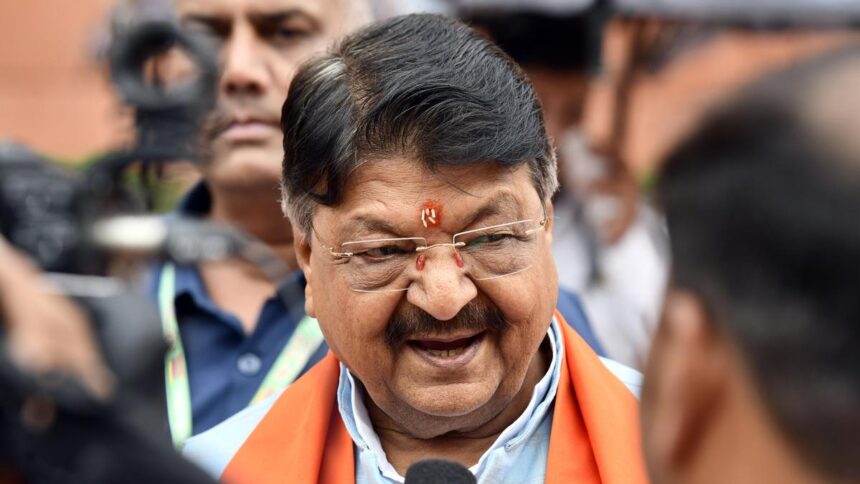





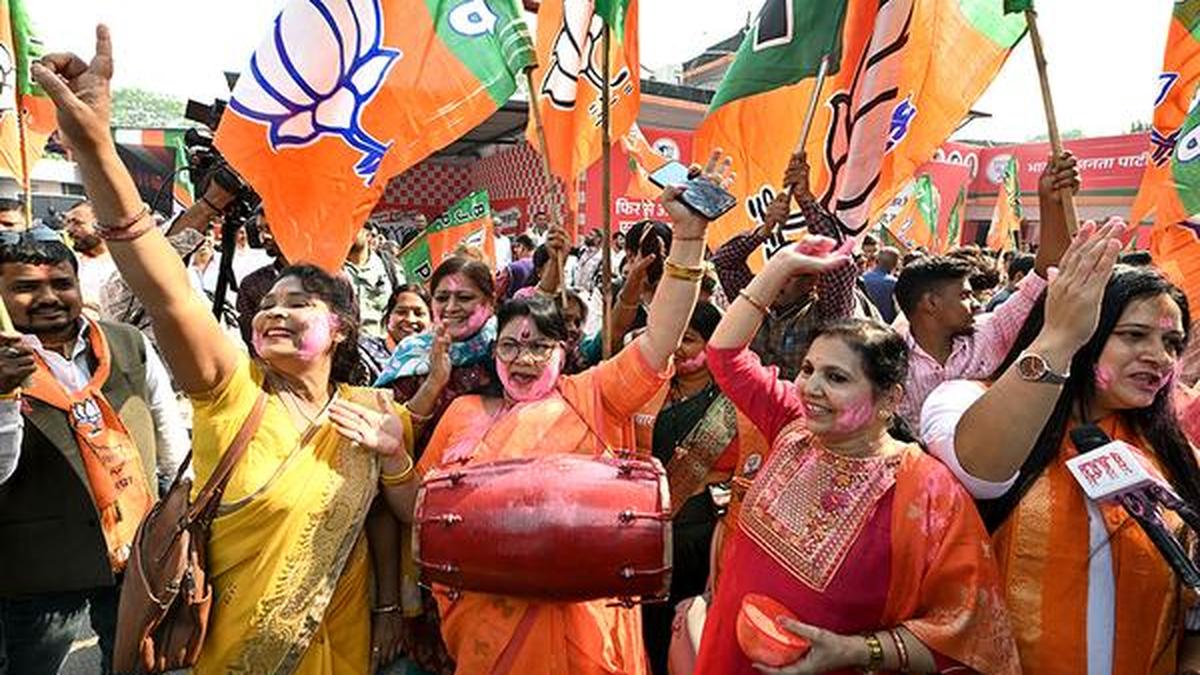
BJP supporters celebrating after the massive victory of the NDA, at the party office in Patna.
| Photo Credit: MOORTHY RV
The landslide victory of the National Democratic Alliance (NDA) in the 2025 Bihar Assembly elections has created a perception that the voters have risen above caste and class considerations while exercising their franchise. This perception requires careful assessment based on evidence.
One reason for this perception is that the NDA managed to win a large number of seats with a sizeable share of Muslim voters and also seats in a significant number of Scheduled Caste (SC) reserved constituencies. As a result, some people believe that the Muslim vote and the Dalit vote has shifted in favour of the NDA.
It is important to understand that a party manages to win seats with a large concentration of voters of particular communities on account of two factors: one, of the people of those communities voting for the party or the alliance in a big way; and two, of counter-mobilisation — people of non-dominant groups in that constituency voting for that party or alliance in large numbers. In Bihar, while the NDA benefited from the support of voters of a particular community in some Assembly constituencies, it also benefited from the mobilisation of voters of non-dominant communities in those constituencies.
An analysis of survey data (using PollsMap data) suggests that while Muslims and Yadavs were polarised in favour of the Mahagatbandhan (MGB), there was also a counter mobilisation of a large number of voters of other castes/communities in favour of the NDA’s candidates. This also helped the NDA candidates win from Muslim-dominated seats.
In this election, the Yadavs remained slightly less polarised in favour of the MGB compared to the 2020 Assembly elections. Among the Yadavs, 74% voted in favour of the MGB, while only 19% voted for NDA candidates. During the 2020 Assembly elections, 84% of the Yadavs had voted for the MGB.
Similarly, there was some decline in Muslim support for the MGB as well. Nearly 70% of the Muslim voters voted for the MGB, while 7% voted for the NDA. During the 2020 Assembly elections, 76% of Muslims had voted for the MGB.
In this election, the All India Majlis-e-Ittehadul Muslimeen (AIMIM) garnered 9% of the Muslim vote; this could have contributed to the decline in Muslim votes for the MGB. This appeared especially the case in constituencies where Muslims constituted more than 35% of the total voters. The Muslim vote was instrumental in the AIMIM winning five Muslim-dominated Assembly seats. A possible coming together of the AIMIM with the MGB may have resulted in preventing the split in the Muslim vote. But except these two communities, the MGB was unable to mobilise the voters of any other community.
The voters of other communities remained sharply polarised in favour of the NDA. Among the upper caste voters, 67% voted for the NDA, while 9% voted for the MGB. The upper caste votes were more sharply polarised in favour of the NDA in 2025 compared to 2020, when 54% of them had voted for the NDA.
Except for the Yadavs, all the other Other Backward Castes (OBCs) favoured the NDA in a big way. Among the dominant Kurmi and Koeri castes, to which Nitish Kumar and Upendra Kushwaha belong, respectively, 71% voted for the NDA and just 13% voted for the MGB. Among the ‘lower’ OBCs, 68% voted for the NDA and 18% voted for the MGB. The Vikasheel Insan Party (VIP) joined the MGB; this appeared to have only marginally helped the alliance in mobilising the ‘lower’ OBC voters.
It was not surprising that 60% Dalits voted for the NDA as two regional parties with a sizeable support base among Dalit groups — the Lok Janshakti Party (LJP) and the Hindustan Awam Morcha (HAM) — were constituents of the NDA. A little over one fourth (28%) of Dalits voted for the MGB. Overall, among all the major castes/communities, nearly 70% mobilised in favour of the alliance which they voted for.
The below chart shows the distributions of votes between the major parties/ alliances across various caste and community groups in 2020 and 2025.
Class played a role in shaping the NDA’s victory. What seems to have worked in favour of the NDA was that it made significant inroads among the economically well-off section of voters — the upper class and the middle class. The NDA took a big lead over the MGB among the upper class and middle class voters. Among these voters, 58% voted for the NDA, while a little over one third chose the MGB. During the 2020 Assembly elections, only 38% of the upper class and 36% of the middle class had voted for the NDA. This time, the NDA thus attracted more voters from the middle and upper classes than it did in 2020, helping it establish a convincing lead over the MGB. Among the economically poor voters, both the NDA and MGB got around four of every 10 (38%) votes, respectively. Among the lower income class, 44% voted for the NDA while 41% voted for the MGB.
The below chart shows the distributions of votes between the major parties/ alliances across major economic groups.
A combination of both class and caste/community helped the NDA get a massive lead of nearly 10% points over the MGB. The NDA had the support of a broader social coalition of ‘upper’ and ‘lower’ communities that propped it up well. On the other hand, the MGB had the support mostly of Yadavs and Muslims, although it was competitive among the poor and low-income groups.
Sanjay Kumar is a professor and political analyst. Views expressed are personal

Published – November 21, 2025 07:00 am IST