




A resounding political victory often poses the question whether there was a game-changer. To argue that the victory resulted from a fortuitous combination of many factors appears less attractive. Analysts are tempted to search for game-changers so that a dramatic-looking outcome can be explained by equally dramatic looking new formulation. The victors, on their part, need the big story because such a story feeds into a narrative that can help them beyond the immediate terrain of the electoral victory. In the recently held Assembly election in Bihar, which resulted in the National Democratic Alliance (NDA) winning nearly half the votes polled and bagging nearly 90% of the seats in the Assembly, this State election appears to be a case where some key factors must have produced this scale of victory.
The new combination
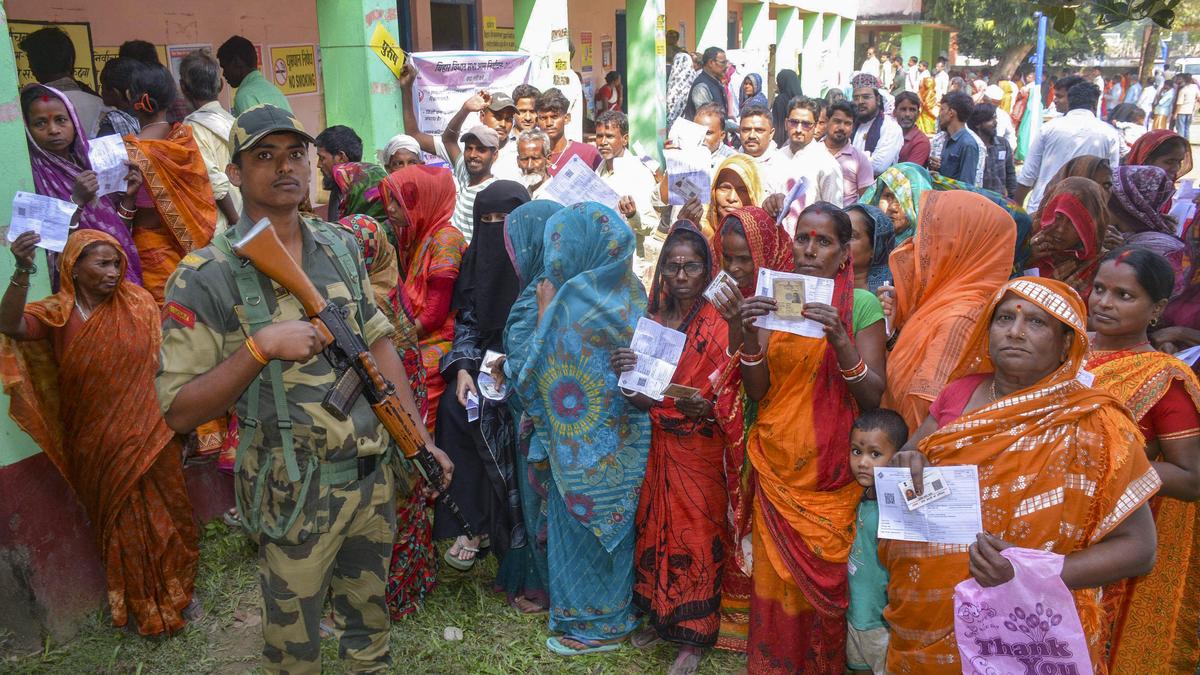
With the Opposition taking exception to the last-minute scheme for the benefit of women which had been devised by the State government and cash transfers taking place right around the time when the actual campaigns kicked off, the women’s vote stands out as the key factor that gave the NDA its massive victory. The fact that women outnumbered men in terms of voter turnout, has added more plausibility to this argument. Another factor, according to at least some circles, is the young voter. Their overwhelming support, it is asserted, helped the NDA register this dramatic victory. Indeed, the Rashtriya Janata Dal (RJD) too did promise a government job for every household but many believe that the Bharatiya Janata Party (BJP)’s pitch for one crore government jobs was what stole the day.
2025 Bihar Assembly election results
Along with the promise of one crore lakhpati didis (women with an income of ₹1 lakh per annum), this slogan must have resonated among voters. Or so it is argued. This has led to the claim that a new MY combination — which is Mahila and Yuva, as opposed to the dependence of some Opposition parties on Muslim and Yadav votes — became the foundation of the NDA’s victory in Bihar.
The argument appears persuasive and attractive. Persuasive because one is stunned by the scale of victory and by the fact that the NDA and Nitish Kumar of the Janata Dal (United), or JD(U), in particular have managed to comfortably exorcise the proverbial ghost of anti-incumbency. It is attractive too, because it not only gives a smart answer to how the NDA won. It also potentially inaugurates a new language of the political analysis of Bihar — and other elections too — that instead of caste/community, promises and performance determine electoral outcomes. But how accurate is this argument about the MY vote being the game-changer?
First, a small reminder about the turnout of women. Yes, there is a huge difference of nearly nine percentage points that marked the gap between female and male turnout. In itself, this is something quite extraordinary. But if we look at Bihar’s Assembly turnout data for the past decade and a half, we notice that the turnout of women has always been higher in percentage terms when compared to that of men. In 2015, it was comparable to what happened this time — 7% higher than men.
Those who have observed Bihar for long have been pointing out that besides all other things, male migration (and consequent absence from voting) is a crucial factor producing this skew. But even if we were to concede that the turnout among women was higher as a result of greater mobilisation, awareness and agency among women voters, this factor is at least not new to 2025.
Second, do we have adequate evidence that more women voted for the NDA than men so that this massive tide could be explained away? To be sure, more women than men did vote for the NDA: data of a PollsMap survey which this writer had access to, shows that as against 46% supporting the NDA among male voters, almost 48% among women said they voted for NDA. For the Mahagatbandhan, this share was 39% and 37%, respectively. So, the NDA did enjoy a gender advantage. It is not clear, however, whether there was a singular factor producing the victory.
Third, survey data from 2015 suggest that the NDA (which did not include JD(U) then) had a gender disadvantage because it polled 2% less votes among women than among men. In 2020, when the JD(U) had joined the NDA, the NDA polled 1% more votes among women than men. In other words, in all likelihood, the JD(U) brings a little more women voters to the alliance that it joins. Ironically, while the JD(U) fetches more women votes, the BJP happens to be the more popular party overall — when asked which party they would have voted for had there been no alliances, 37% reported that they would have voted for the BJP. The JD(U) would have been a loser without the BJP, but the BJP gains women votes through the JD(U).
On young voters
Unemployment was reported by a very large proportion of the electorate as the most important problem facing the State. Therefore, a party or alliance that promised to address this issue would surely have had an advantage. With its promise of one crore government jobs, did the NDA reap the harvest of youth vote? Here too, the story is a bit complicated.
Among the voters below 25 years of age, the NDA polled nearly 50% of the vote. Among those in the age group of 26-35 years, the NDA got support from 45%. But curiously, in 2015, when the Mahagatbandhan won, the NDA had a comparative advantage among voters under 25 years. In 2020, when it won, ironically, it had slightly less support among this age cohort (35%) than its overall support (37%). So, the political choices of the youth are somewhat fluid and unlikely to easily transform the scale of a party’s victory.
The issue of voter behaviour
More specifically, even though the young may be expected to vote more for a new party, for the Opposition or for the more aggressive campaigner, it is not clear if, in India, there is a youth constituency that often behaves in one particular way.
The more sobering part is that whether it is women or youth, their vote choices align broadly with the vote choice of the class and the community that they belong to. In other words, if a particular class group or community is less likely to vote for NDA, then women or young voters from that social section too are less likely to have voted for the NDA. In the Bihar Assembly elections 2025, the upper and middle classes and upper castes voted for the NDA on a massive scale. Correspondingly, the women and the youth among them voted for the NDA in similarly large proportions.
This resonates with the question which scholars such as Rajeshwari Deshpande have been raising about women’s vote: do women vote necessarily differently from the community they belong to? Or does their voting pattern get shaped by the factor of caste/community?
The rhetoric of there being a game-changer is useful for both the politician and the analyst. But, Bihar 2025 underscores a very fundamental concern about positing uniqueness in the gender factor (and now in the age factor) as having bypassed the class-caste factors.
To put it conservatively, we can say that women’s vote and a limited surge among young voters surely helped the NDA. The question whether ‘MY vote turned the tide’, however, requires a more careful analysis of many other factors.
Suhas Palshikar is a retired professor of political science based in Pune
Published – November 21, 2025 12:16 am IST