




In the face of relentless opposition and sloganeering by BJP legislators in the West Bengal Assembly on September 4 during a debate on a resolution condemning the alleged targeting of migrant workers from the State in different parts of the country, Chief Minister and Trinamool Congress (TMC) chief Mamata Banerjee expressed her desire that MLAs from parties other than the BJP should occupy the Opposition benches after next year’s Assembly poll.
Ms. Banerjee was alluding to the CPI(M)-led Left Front and the Congress, which currently have no representation in the Assembly. The remarks, which come less than a year before the crucial election, assume a lot of political significance.
During her first two terms as Chief Minister (2011-2016 and 2016-2021), Ms. Banerjee faced legislators from the Left Front and the Congress on the Opposition benches. CPI(M)’s Surya Kanta Mishra served as the Leader of the Opposition (LoP) from 2011 to 2016, while Congress’s Abdul Mannan held the position from 2016 to 2021.
However, they were not as aggressive, relentless, and unsparing in their criticism as current LoP and Nandigram legislator Suvendu Adhikari, who rose to political prominence in the TMC under Ms. Banerjee’s leadership before defecting to the BJP in December 2020.
Through her remarks, the Chief Minister acknowledged the significance of the third force in West Bengal politics and expressed her wish that the Left Front and the Congress achieve significant representation in the Assembly. By calling for a larger political space for the two parties, she appears to be wanting to split the Opposition vote, thereby easing her own party’s path in the Assembly poll.
The rise of Hindutva forces in the State towards the end of the last decade led to a shift in the State’s political landscape, with the CPI(M) and the Congress rapidly losing their Opposition space to the BJP. This decline was evident in the 2019 Lok Sabha election, where the BJP’s vote share surged to an all-time high of 40% while the CPI(M) and the Congress’s vote share was reduced to single digits. This trend persisted, with both parties witnessing a decline in their vote share in every subsequent election, making polls in the State a largely bipolar contest between the TMC and the BJP.
For the 2021 Assembly election, the CPI(M) and the Congress formed an alliance with the Indian Secular Front (ISF), a local political party. However, this move failed to yield any political benefits for them. Currently, ISF legislator Nawsad Siddique is the sole MLA in the Assembly who is neither from the TMC nor the BJP.
Ms. Banerjee is not the only one speaking about a third political force in the State. In his first public speech on July 3 after taking over as the State BJP chief, Samik Bhattacharya appealed to supporters of Left parties to set aside ideological differences and unite to defeat the TMC in the 2026 poll. He hinted that the Left parties could occupy the Opposition space once the TMC is ousted from power.
Contrasting strategies
The TMC wants the CPI(M) and the Congress to eat into a portion of the Hindu votes, potentially preventing polarisation that could benefit the BJP. In contrast, BJP leaders seem to be counting on the CPI(M) and the Congress to take away a chunk of the Muslim votes and dent the TMC’s electoral prospects.
The 2024 Lok Sabha poll results in West Bengal indicated that in nearly a third of the constituencies [14 out of 42 seats], the combined votes of the Left Front and the Congress candidates exceeded the winning margin. In a couple of seats in north Bengal, the splitting of votes between the Left parties and the Congress appears to have dented the TMC’s prospects in a dozen constituencies. In south Bengal, the Left and the Congress secured more votes than the margin of victory of the TMC over the BJP.
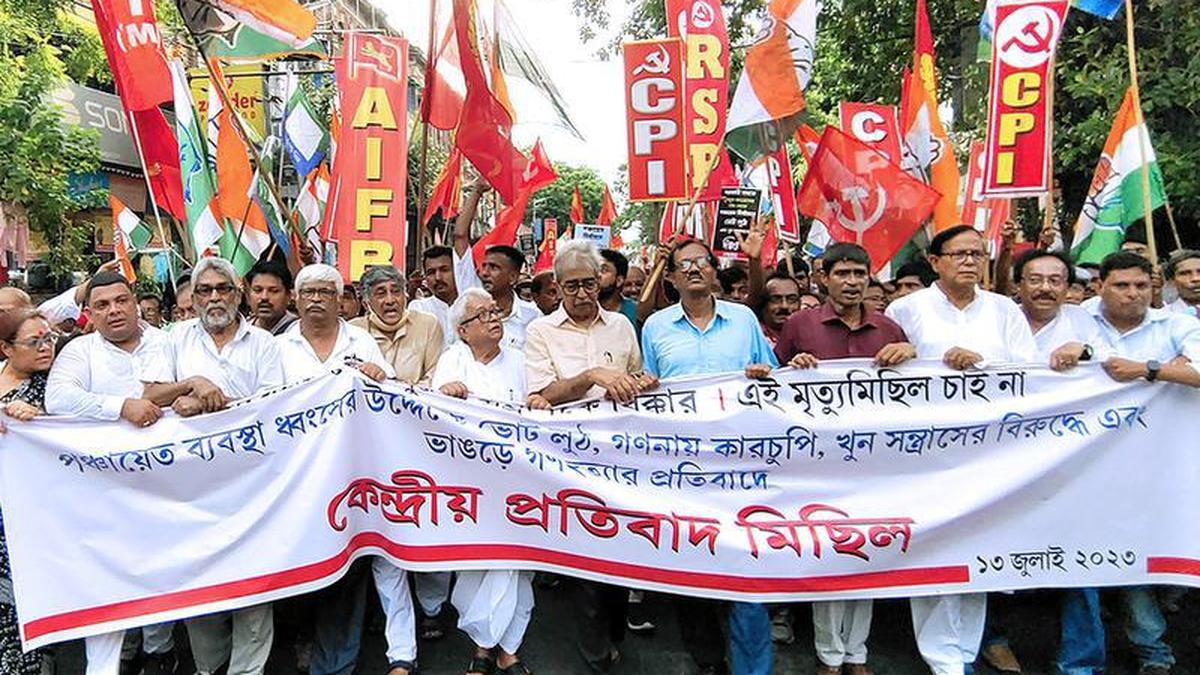
Mr. Adhikari has on several occasions urged people not to “waste their vote” on Left parties, instead advocating for voting for either the BJP or the TMC. Therefore, despite having no representation in the Assembly, the CPI(M) and the Congress remain a relevant political force in the State. Their presence is crucial not only for electoral purposes but also for driving people’s movements, trade unions, workers’ rights, and civil society campaigns. Thus, a robust third political force, comprising a strong CPI(M) and the Congress, is essential for the people of the State.
There is an urgent need to shift the debate away from communal politics and instead focus on pressing issues like job creation, agrarian distress, migration, flight of capital, and industrialisation. This makes the third alternative more relevant than ever in West Bengal’s politics.
The leadership of the CPI(M) and the Congress acknowledge that “rising religious polarisation” is the biggest challenge facing the people of the State.
To make an impact, the leaders and supporters of the two parties will have to seize the opportunity during the poll and make their presence felt both in the Assembly and on the streets.
Published – September 09, 2025 12:52 am IST