




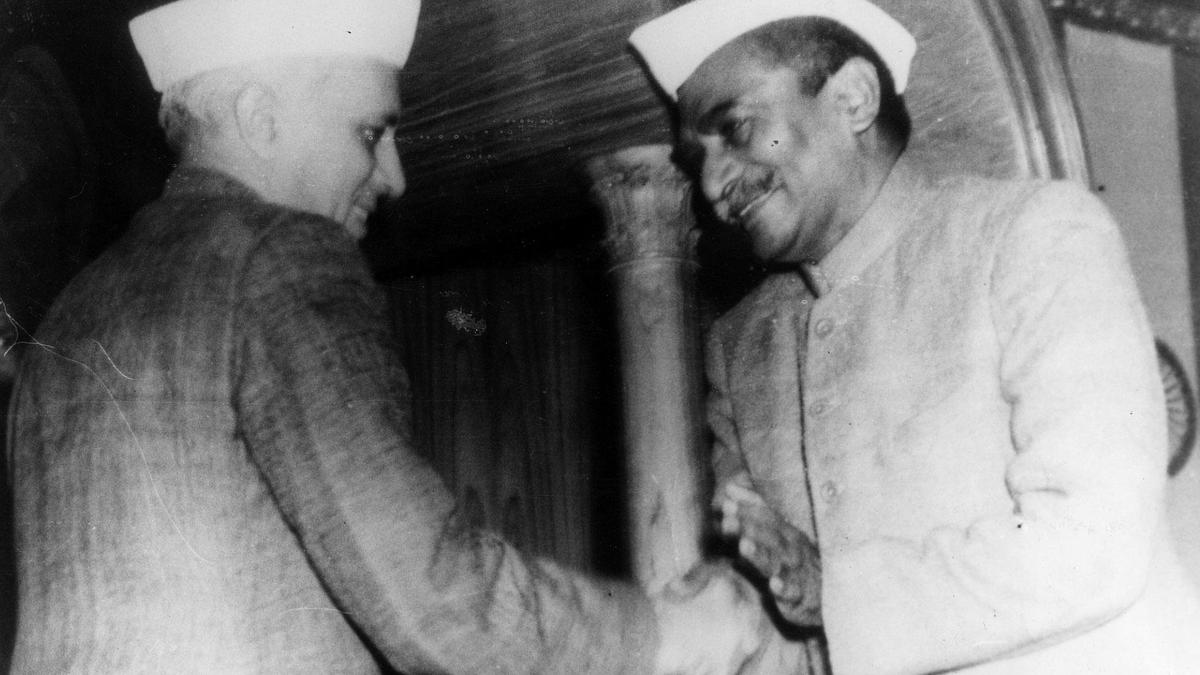

“It is perfectly possible to pervert the Constitution, without changing its form, by merely changing the form of the administration and to make it inconsistent and opposed to the spirit of the Constitution,” Excerpts from the speech delivered by B.R. Ambedkar on November 4, 1948
While the basic structure of the Constitution still resonates with the principles of democracy, federalism and secularism, the warning given by Ambedkar in a speech in the Constituent Assembly seems to become more and more relevant today. Our Constitution has been amended 105 times within 75 years of its adoption. Since the verdict of the apex court in the Kesavananda Bharati v. State of Kerala case (1973), the power of Parliament has been limited.
The Supreme Court in this landmark decision clarified that Parliament has no power to make amendments that touch the basic structure of the Constitution. Interestingly, the restriction placed on Parliament to amend the Constitution through this judgment is the most disturbing factor for the rulers of the day.
The Constitution stands as a stumbling block for them to implement their hidden agendas. It is even more pertinent that the judgment came from a 13-member Constitution Bench, which indirectly means that the overruling of this larger Bench decision cannot be expected in the near future.
This can be inferred as the precise reason why the government is using its administrative tools and institutional mechanisms to change the basic structure of the Constitution and of the country from a secular, democratic, federal republic to an authoritarian Hindu Rashtra. In fact, such a situation was foreseen even by the Constitution framers, which is quite visible when one attempts to traverse the Constituent Assembly Debates.
The debates and conflicts within the Constituent Assembly primarily revolved around two different cultural streams. On the one hand, there were representatives advocating for a secular and pluralistic India, which encompassed its diverse cultural aspects and historical heritage. On the other hand, the Hindutva faction asserted that Indian culture is fundamentally rooted in religion. These two contrasting perspectives highlighted a fundamental ideological divide regarding the nature and identity of the Indian state. While proponents of secularism and pluralism emphasised the coexistence of multiple religious, linguistic, and cultural identities within India, the Hindutva faction promoted the idea of a more homogeneous cultural and religious identity. These differences in ideology and understanding of Indian culture played a significant role in shaping the discussions and deliberations within the Constituent Assembly.
Indeed, the latter group within the Constituent Assembly sought to redefine nationhood along religious lines. They argued that religion should form the foundational basis of the future state apparatus. In contrast, advocates for the idea of a secular state asserted that the edifice of Indian statehood is built on secularism, fraternity and pluralism. Fundamentally, one needs to understand that the concepts of secularism and pluralism have been subject to reinterpretation and redefinition since the origin of the ideal. The term “secularism” originated during the French Revolution and was initially referred to as “irreligious morality”.
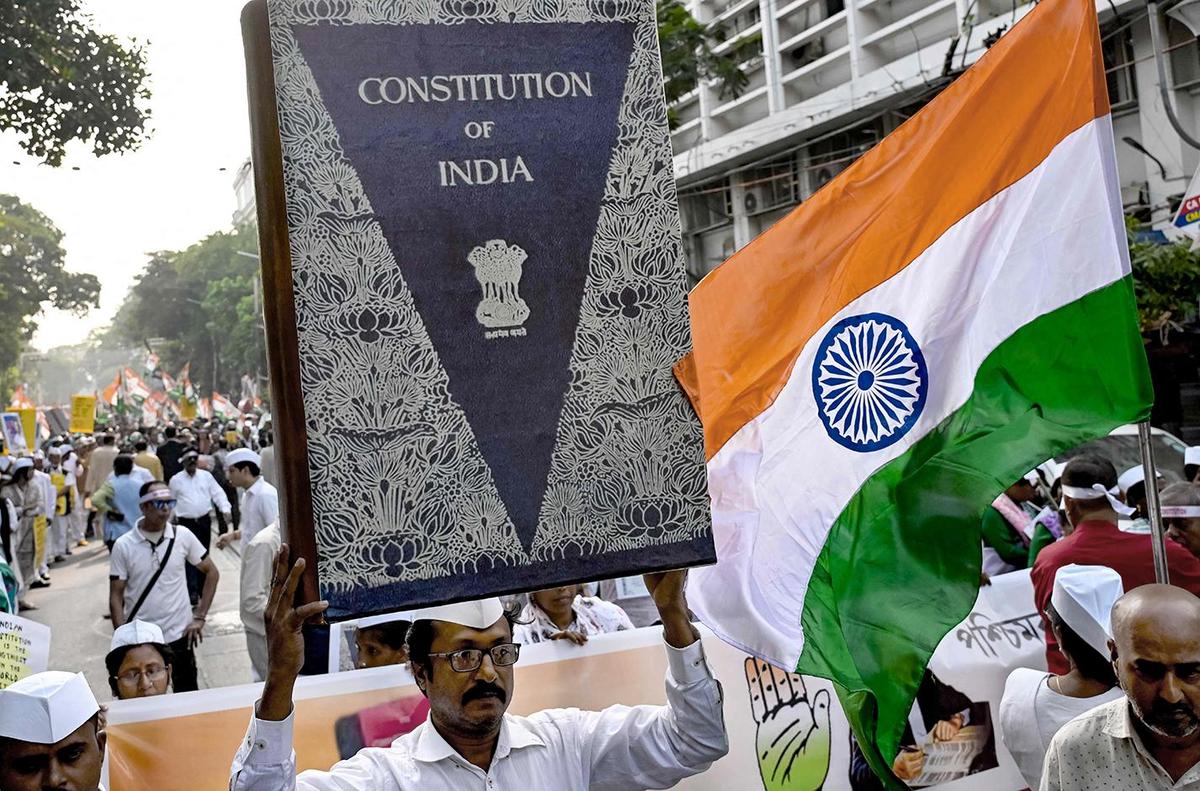
75th Constitution Day in Kolkata on November 26, 2024. File
| Photo Credit:
AFP
During the deliberations of the Constituent Assembly, Jawaharlal Nehru and other Left-leaning members emphasised the non-interference of religion in government affairs. On the other hand, a few, such as S. Radhakrishnan, proposed equal treatment of all religions. The conflict between these two approaches became apparent during discussions on key provisions within the Constitution.
However, it is important to note that the primary contention was between the contrasting ideas of secularism and religiosity. The debates surrounding the role of religion in shaping the state and governance structure reflected this underlying conflict between those advocating for a secular approach and those favouring a more religious orientation.
The Preamble of the Constitution begins with the beautiful words “We the people”, which is how the Preamble of the Constitution of the United States of America also starts. However, the import of these words at the time of their adoption in their respective constitutional schemes was different. The word “we” in the American Constitution in 1787, when it was adopted, did not include women, Black people, or the poor.
It is quite interesting to note that it was only after nearly three-quarters of a century, that is, in 1868, that citizenship was granted to African Americans through the 14th Amendment. But, due to the prevailing racism at the time, the amendment did not grant them voting rights.
The U.S. Constitution was amended again in 1870 through the 15th Amendment to prohibit the denial of voting rights based on race or colour. But that by itself did not ensure voting rights for the African Americans in the States that had enacted the “grandfather clause”, which denied voting rights to the descendants of the slaves who hadn’t voted. The clause was struck down by the U.S. Supreme Court in 1915. However, women had to wait longer to find their place in the “we” of the American Constitution.
On August 18, 1920, the 19th Amendment was passed, granting voting rights to women in the U.S. Paradoxically, despite these constitutional changes, the poor, including African Americans and women, had to wait until the abolition of the poll tax to cast their votes. The poll tax was a prerequisite for voting rights. The struggle for voting rights for all citizens of America saw many sacrifices, especially during the Civil Rights Movement led by Martin Luther King Jr. The 24th Amendment in 1964 banned poll taxes, and the Voting Rights Act of 1965 finally ensured voting rights for African Americans.
Interestingly, it took 178 years to include all citizens, irrespective of race, wealth, and gender, into the fold of “we” of the Constitution of America in practice. The “we” in the U.S. Constitution evolved through struggles, parliamentary and judicial interventions.
An inclusive idea
In striking contrast, the “we” embedded in the Preamble of the Indian Constitution has been inclusive from the very beginning. It included people from all religions, languages, genders, castes, classes, creeds, ethnicities, and economic backgrounds. As Ambedkar pointed out: “Everyone has the right to one vote in a democracy. Every vote has equal value, regardless of who cast it.”
However, today, the inclusive “we” is being transformed into an exclusive “we”, meant for certain sections. While the “we” in the U.S. Constitution has evolved with the passage of time, the “we” in the Indian Constitution is being narrowed down by administrative and legislative actions. In the inclusive “we”, citizenship is a right for all, as clarified under Article 5 of the Constitution. During the debate on the citizenship for those who returned to India from Pakistan after the Partition, Nehru made it clear that religion should not be a factor in determining citizenship.
But the amendment proposed by C.D. Deshmukh sought to grant citizenship on the basis of religious affiliation. The amendment proposed by him stated: “That every person who is a Hindu or a Sikh and is not a citizen of any other State shall be entitled to be a citizen of India”. Further, Deshmukh explained. “If the Muslims want an exclusive place for themselves called Pakistan, why should not Hindus and Sikhs have India as their home? We are not debarring others from getting citizenship here. We merely say that we have no other country to look to for acquiring citizenship rights, and therefore we, the Hindus and the Sikhs, so long as we follow the respective religions, should have the right of citizenship in India and should be entitled to retain such citizenship so long as we acquire no other.”
When everyone, including the current Prime Minister, expresses the view that there is no other homeland for Hindus, it takes one back to the argument put forth by Deshmukh so many years ago. But this argument was not accepted by the Constituent Assembly. “All rules and regulations will be equally applicable to Hindus, Muslims, Sikhs and others. No particular law can be made for you Hindus, Muslims or Christians,” Nehru stressed while intervening in the discussion on articles about citizenship held at the Constituent Assembly on August 10-12, 1949.
But interestingly, according to the Citizenship (Amendment) Act, 2019, “religion” has become a criterion for citizenship. Applications to obtain Indian citizenship are being accepted from people from the neighbouring countries belonging to all faiths, excluding Islam. Undoubtedly, this amendment narrows the “we” embedded in our Constitution’s Preamble. Recent cases, such as the drive by the Election Commission in Bihar to “clean up” the voters’ list, can also be seen as examples or attempts to narrow the “we” in the Constitution.
Debate on Preamble
However, it needs to be understood that the decision to begin the Preamble with the words “We the people” was not an easy exercise undertaken without due forethought. The secular and Hindutva factions debated it extensively. During this process, a conflict arose between the two perspectives. H.V. Kamath proposed an amendment suggesting that the Constitution should begin with the phrase “In the name of God”. He emphasised the significance of religion and reiterated the arguments he had made during the discussions about religious beliefs. Some raised concerns over which deity should take precedence.
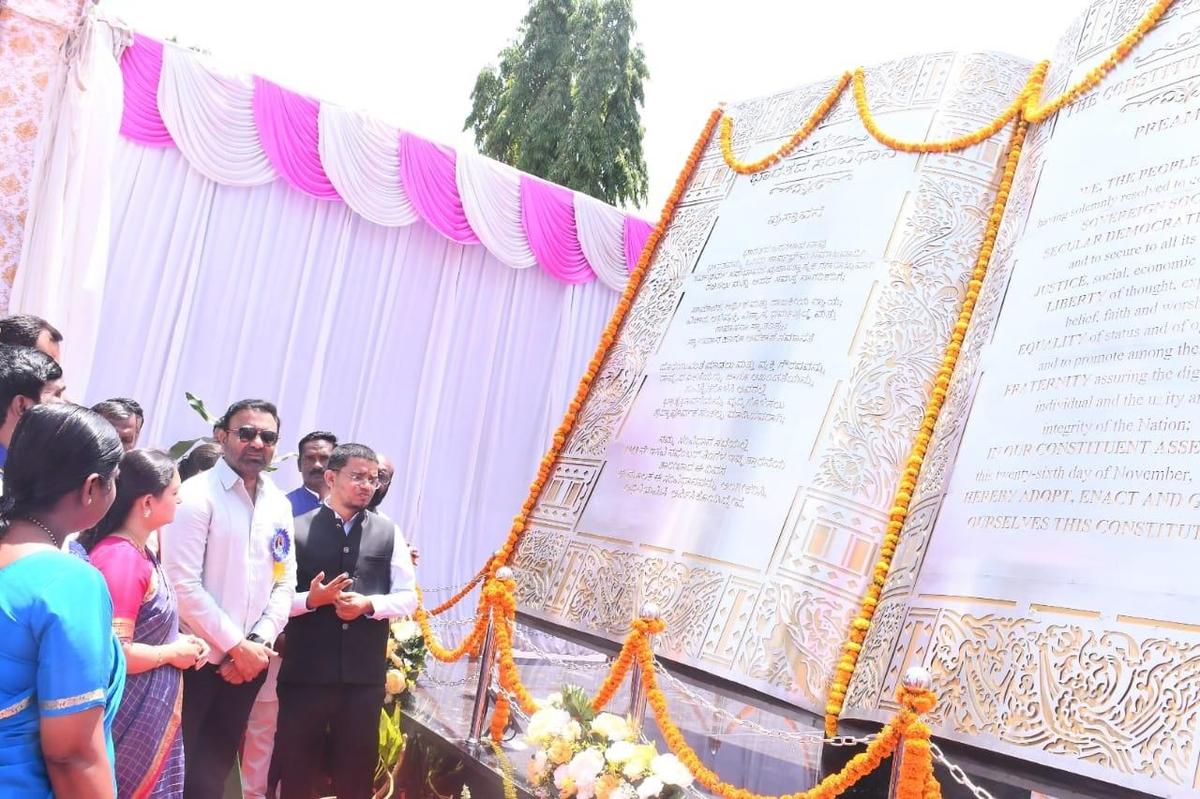
A metal replica of the Constitution being unveiled in Dharwad, Karnataka, to commemorate the 134th birth anniversary of Dr. B.R. Ambedkar. File
| Photo Credit:
The Hindu
Shibban Lal Saxena and Govind Malaviya proposed comparable amendments, suggesting that the Preamble should commence with the words: “By the grace of the Supreme Being, lord of the universe, called by different names by different peoples of the world”. Others, like H.N. Kunzru, expressed their concerns in parochial terms.
Rajendra Prasad, the Chairman of the Constituent Assembly, raised a legitimate concern about how the Constitution could begin in the name of God. He requested the members to withdraw their amendments. Kamath did not cede to the multiple pleas made by the members to withdraw his proposal. Thus, “In the name of God” was put to a vote. As per official records, the final tally stood thus — 68 opposed and 41 in support. So his proposal was outvoted. This outcome outrightly proves the contrasting perspectives between the founding fathers on the character of the nation.
The debates and the outcome of the Constituent Assembly are a clear indicator that secularism is part of the basic structure of the Constitution and determines the character of the country. However, the attempt to turn India into a religious country is continuing and strengthening. People with affiliations towards the communalist ideologies argued that secularism shouldn’t be included in the Preamble, as it was voted out initially and was only included later.
But, the fact is that an amendment to include secularism alone was never introduced in the Assembly. The amendment introduced by Brajeswar Prasad from Bihar proposed the inclusion of secularism among many other terms. In fact, Prasad suggested these words: “to constitute India into a secular, cooperative commonwealth to establish a socialist order and to secure to all its citizens”.
Despite the Assembly’s stance on its impracticality, the acceptance of secularism as a fundamental principle was clear. Kamath, who fought against it himself and opposed secularism, later acknowledged during the discussion on freedom of religion that, “Of course, we accept India as a secular state. But it is neither a Godless state nor a non-religious state.”
Members, including Kamath, were resistant to the idea of an entirely religion-free state even when the word “secularism” was accepted in the discussions. In effect, they accepted the word secularism, but misinterpreted the idea behind it entirely.
Dr. S. Radhakrishnan, while highlighting the purpose of the Constitution, emphasised that “Modern states are built upon the foundation of secularism rather than religion. The era of religious states had come to an end and it was the time for nationalism”. The idea that, rather than strengthening the religious identity, the identity as a citizen must be strengthened arose in that period itself.
Different perspectives were shared in the discussions surrounding religion and secularism, which have since been debated extensively. This includes various dimensions, like whether secularism implies a secular state or the absence of a relationship between the government and the state. In European countries, secularism has been considered a precondition for democracy. Additionally, freedom of dissent is held as a right concerning religious beliefs, and all rights to equality are rooted in the principle of equal rights in religion.
Many individuals argued that secularism is a vital precondition for sustaining democracy in India. B. Shiva Rao, a Constituent Assembly member and former correspondent of The Hindu, who later went on to become a Rajya Sabha member, opined that the proper functioning of democracy is possible only if communalism is eradicated from society. However, Kamath, who earlier argued that the introduction to the Constitution should start in the name of God, later claimed, in a debate on the freedom of religion, that India should not be a religious nation.
“The country should not have an official religion. We must declare that India is a secular country. But it is not a godless, secular, or anti-religious country,” he said. Kamath also pointed out that all religions represent the same idea. “‘Aham Brahmasmi (I am Brahma)’ and ‘Ana’l Haqq (I am truth)’ declare that ‘my father and I are the same’ and there is no otherness when different religions speak,” he said. When someone asked the 19th-century Hindu sage Ramana Maharshi about treating a stranger, he responded by saying, “There are no strangers,” and his response was based on the above principle.
Historians such as Irfan Habib have argued that “the classical definition of understanding secularism was not applied in India, and it prepared the ground for communalism. Ideologically, we have rejected the international perspective of secularism”.
“My father and Nehru used the word secularism like it was used in the French Revolution, implying that religion should not interfere with the state. Even though the term ‘secularism’ did not exist during the French Revolution, the phenomenon existed,” he remarks.
The word “secularism” was first used in 1851 by an English newspaper editor, George Jacob Holyoake, who defined it as a “non-religious morality”. He stated that secularism is related to the welfare of the people in society, which was a scientific definition of the term. However, it was Radhakrishnan’s interpretation of secularism that set the stage for the emergence of communalism.
“All religions must be treated with equal tolerance,” he said while arguing that religion is inseparable from the state. “There is no abstract religion; however, in practice, when all religions are treated equally, religion often leads to interference with the state,” he said.
The debate within the Constituent Assembly revolved around three contrasting perspectives on secularism. The first viewpoint aligned with the classical view that religion must not interfere in government affairs. However, it cannot be said that it has developed into secular morality, as mentioned earlier by Habib.
The second perspective, which is yet to be analysed, posits that the state should not interfere with religion. The third perspective emphasises the importance of equal respect for all religions. This approach advocates for treating all religions impartially and, according to them, with equal respect within the framework of secularism.
No special protection for religion: Nehru
According to the second perspective, offered by K.M. Munshi, “Indians are deeply religious people. At the same time, there is a historical legacy of religious tolerance. The broader view of Hinduism is that all religions lead to one God. In this view, too, our country should not have an official religion. At the same time, the inflexible distinction between religion and state is impossible, as in the United States. Some argued that religious education should be given as part of giving equal respect to all religions.” Kamath raised the issue in the Assembly and advocated that the government should offer spiritual education to all citizens.
Jawaharlal Nehru declared in the Constituent Assembly that no religion should be given special protection. “I understand that the government does not allow anyone to discriminate in the name of religion or community. Its essence is that no religion will have the patronage of the state. The government will not officially declare any religion or specifically protect any religion. No religion will be excluded or promoted as part of it.
No citizen of the country will be given special consideration based on religion.” This position is reflected in different Articles of the Constitution, ensuring freedom of religion and belief, equal treatment of all religions, neutrality in governance, secular legal systems,
freedom of expression and education that is free from religious influences. But nowadays, all these features are diminishing through administrative and legislative actions.
In his historic speech on November 25, 1949, Ambedkar said, “Democracy in India is only a top-dressing on an Indian soil which is essentially undemocratic.” According to his perspective, the pre-capitalist caste system is not mature enough to transform into a democratic system. During the deliberations, various perspectives also arose regarding parliamentary democracy. By summarising the debates, Nehru said, “We reached a consensus on the question of the presidential system or parliamentary system.
By agreeing upon a parliamentary system, the power is vested with Parliament and Cabinet, certainly not in the President.” Thus, we have continued to follow the parliamentary democratic system despite being confronted with several challenges in the past decades. But the biggest challenge was posed to the very idea of a parliamentary democracy. Earlier, in such scenarios, the Supreme Court was counted upon to play a crucial role by delivering judgments that upheld the parliamentary structure. The Supreme Court judgement in the 1975 Shamsher Singh, State of Tamil Nadu vs Governor of Tamil Nadu & Anr, underscoring the democratic underpinnings of the country, is of seminal importance even today.
According to the landmark judgment: “Wherever the satisfaction of the President or Governor is required for the utilisation of power, it is not their personal satisfaction. But it is the satisfaction elicited from the knowledge of the Constitution based on the parliamentary system. It means that the cabinet, which helps and advises the President or Governor, is the one that enjoys this satisfaction.” The Supreme Court also made a rebuke alongside emphasising that, “The Constitution will not let the Governor form a parallel executive system against the advice of the cabinet.”
Recently, the apex court in State of Tamil Nadu vs Governor of Tamil Nadu & Anr (2025), by fixing a time limit for the President and Governors to give assent to the Bills passed by the elected Parliament and Legislative Assemblies, the Supreme Court upheld the parliamentary character of the democratic system.
Basic structure of Constitution
While writing these observations, as is known to all, Parliament is being adjourned due to the protests by the Opposition against the so-called purification of the voters’ list of Bihar. The conduct of the Election Commission has raised several serious concerns. A one-man-centred executive and an executive-controlled parliamentary system are against the concept of the Constitution. Ambedkar had warned of this danger in his last speech in the Constituent Assembly: “In India, Bhakti or what may be called the path of devotion or hero-worship plays a part in politics unequalled in magnitude to the part it plays in the politics of any other country in the world. In politics, Bhakti or hero-worship is a sure road to degradation and to eventual dictatorship.” Whether hero worship has transformed our democracy into a dictatorship is a relevant question today.
Federalism is also a principle that forms part of the basic structure of the Constitution. But now the administrative system has become more centralised. The legislative powers of Parliament and Assemblies are specified in three lists in the Seventh Schedule under Article 246 of the Constitution. However, in contemporary times, we can find the legislative power of Parliament being extended to those subjects in which States have legislative competence. Under the garb of determination of academic standards under Entry 65 of List I, attempts are being made to bring universities established by States under the control of the Union government.
The University Grants Commission is being used as an indirect weapon by the Centre in this regard to dismantle the federal system and diminish the role of the State governments. At this juncture, it is worthwhile to recollect the debate and intervening remarks on Entry 65 in the Union List by Ambedkar: “Take, for instance, the B.A. degree examination, which is conducted by different universities in India. Now, most provinces and the Centre, when advertising for candidates, merely say that they should be a graduate of a university.
Now, suppose the Madras University says that a candidate for the B.A. Examination, if he obtained 15 per cent of the total marks, shall be deemed to have passed that examination; and suppose the Bihar University says that a candidate who has obtained 20 per cent of marks shall be deemed to have passed the B.A. Degree examination; and some other university fixes some other standard, then it would be quite a chaotic condition, and the expression that is usually used, that the candidate should be a graduate, I think, would be meaningless.”
While the intent of the Constitution framers is very clear that this power is limited, the present scenario is that the Union government is wrestling for unlimited power to control the higher education system of the States. Similarly, in financial matters, the Centre is choking the Opposition-ruled States by not providing sufficient budgetary allocation and by putting fetters on their borrowing limits. According to the Constitution, Hindi and English are considered official languages.
These days, we can also observe unconstitutional attempts by the Union government to impose Hindi as a national language, which is unconstitutional. It needs to be understood that the national language is entirely different from the official language. Even though Hindi and English are recognised as official languages by the Constitution, it can be found that English is the only language for the Supreme Court, High Courts, Parliament, and for official communication between the Union and States, and between States.
Despite this, the Union government is insisting that only Hindi be used for all official communications, which is against the intent of the Constitution. We frequently use the term ‘Central government’; however, in the Constitution, the usage is not the Central government, but the Union government. The Constitution has conceived the Union government as a constitutional organ that coordinates with different States or regional units to act in unity and thereby ensure the progress of the nation.
Attempts are being made to subvert the Constitution through unconstitutional practices without amending the Constitution. Article 1 of the Constitution was adopted after intense debates. Presently, the name ‘India’ is being deliberately omitted while Article 1 remains in effect. Using only “Bharat” is unconstitutional as it is a stage in the journey to attain “Hindustan”. According to Article 93 of the Constitution, the Lok Sabha should elect the Speaker and the Deputy Speaker from among its members. However, the Supreme Court itself is currently considering the serious issue that the Deputy Speaker has not been elected even though the term of the current Lok Sabha is coming to an end. Thus, Article 93 remains on paper but is being disregarded in practice.
The possibility of the democratic republic devolving into an authoritarian regime was highlighted by Ambedkar in the Constituent Assembly, when he observed: “If Hindu Raj does become a fact, it will no doubt be the greatest calamity for this country. No matter what Hindus say, Hindustan is a menace to liberty, equality and fraternity. On that account, it is incompatible with democracy. Hindu Raj must be prevented at any cost.”
One can see that the attempts to undermine the basic principles embedded in the basic structure of the Constitution are planned and manufactured. The protection of the Constitution in its essence is the major struggle of the day. As aptly remarked by Ambedkar: “When there was no way left for constitutional methods for achieving economic and social objectives, there was a great deal of justification for unconstitutional methods. But where constitutional methods are open, there can be no justification for unconstitutional methods.”
For this, one has to read the Constitution in conjunction with its historical formation and articulate ways and means to protect it lest it withers away.
P. Rajeeve is the Minister for Law and Industries, Government of Kerala, a former Rajya Sabha member,1a recipient of the Sansad Ratna Award for outstanding contributions to Parliament, and a member of the CPI(M) Central Committee.