

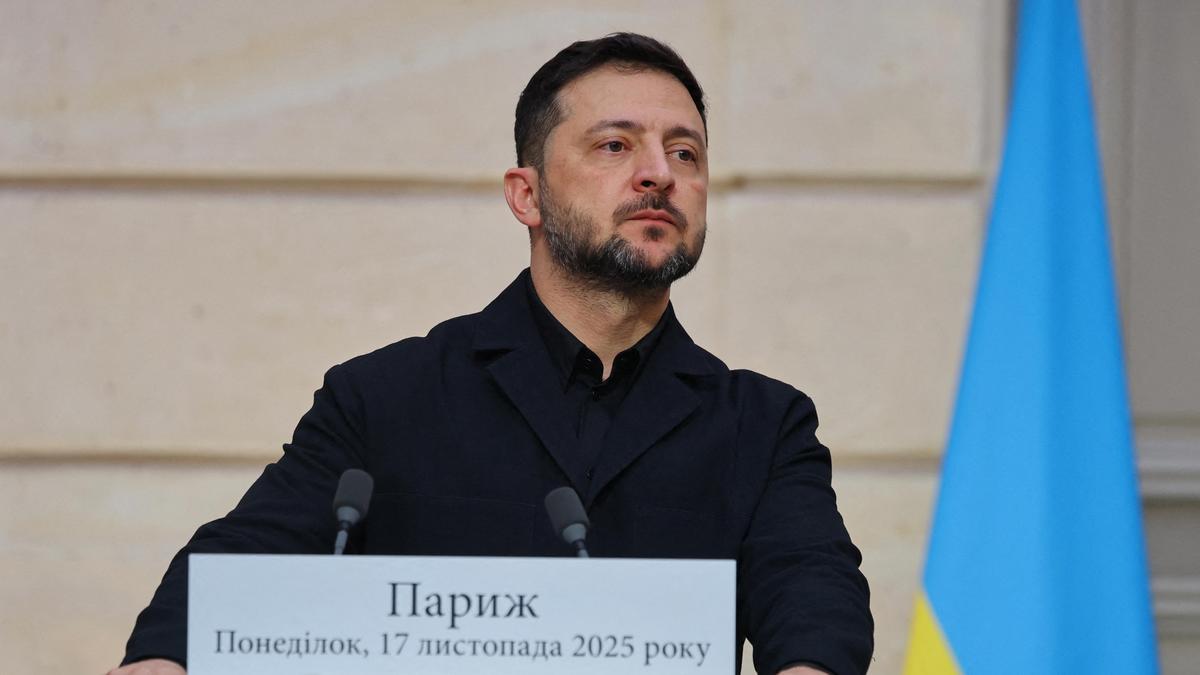

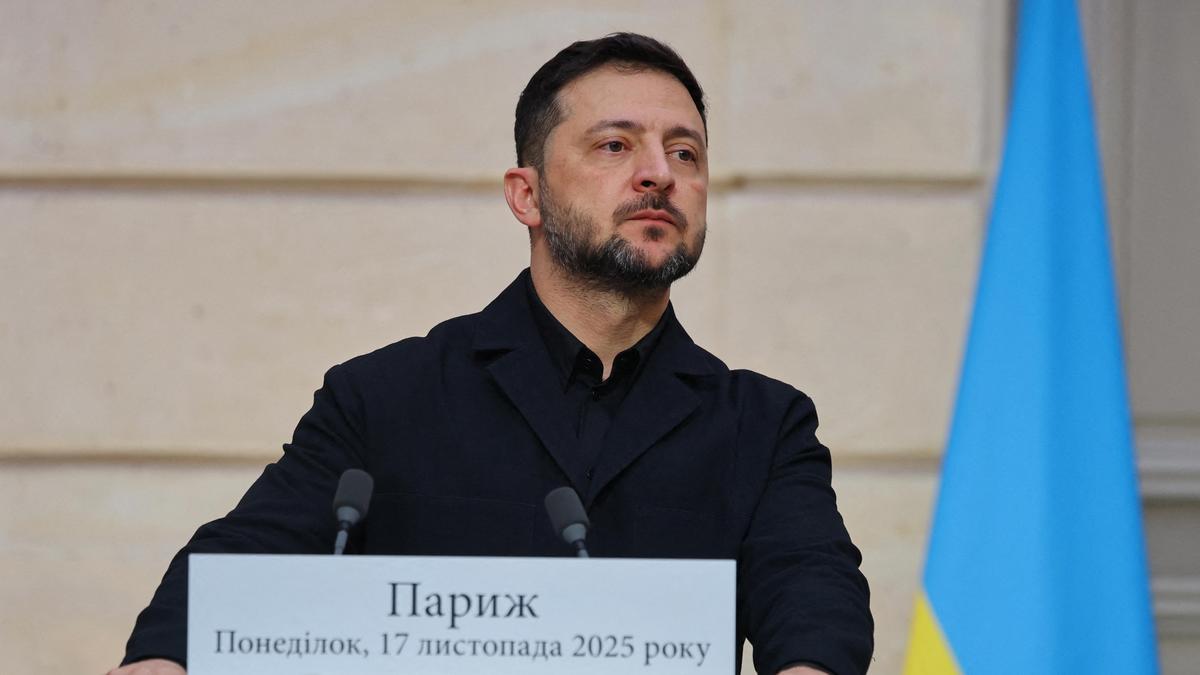
Ukrainian President Volodymyr Zelenskyy, attends a joint press conference with French President Emmanuel Macron at the Elysee Palace in Paris, Monday, Nov. 17, 2025. (Sarah Meyssonnier, Pool Photo via AP)
| Photo Credit: Sarah Meyssonnier
(This article is part of the View From India newsletter curated by The Hindu’s foreign affairs experts. To get the newsletter in your inbox every Monday, subscribe here.)
US President Donald Trump’s peace plan for Ukraine has 28 points aimed at bringing the long-drawn conflict to an end, but Ukrainian President Volodymyr Zelenskyy says the proposal puts the country in a spot, where it must make a “very difficult choice”, between dignity and a key partner.
Mr. Trump, whose team drafted the proposal in consultation with Russian officials, has said he expects a response from Ukraine by November 26,2025. Well over three years since Russian President Vladimir Putin launched the invasion of Ukraine on February 24, 2022, why does the “peace plan” pose a hard challenge for Ukraine? Why is President Zelenskyy wary of the plan despite the loss of lives and large-scale destruction in his country? Read this profile by Stanly Johny to understand what the plan entails, and why the proposal makes Ukraine very uncomfortable. Effectively, the plan asks Kyiv to cede territory to Russia — Russia now controls more than 20% of Ukraine’s pre-2014 territory —scale down its military, by capping its armed forces at 6,00,000 personnel and by giving up long-range weapons, and to formally renounce its bid to join NATO. It rules out any European peacekeeping presence or sanctions on Russia for its alleged war crimes.
While the Trump plan apparently seeks to address both Russia’s security concerns and Ukraine’s demand for security guarantees, at a fundamental level, it acknowledges the facts on the ground which favour Moscow. AsThe Hindu’s editorial today points out, several elements of the Trump plan mirror Russia’s long-standing demands, including the halt of NATO’s eastward expansion, prompting some commentators to describe the peace plan a “gift to Putin”. Although imperfect, “Mr. Trump’s plan at least offers a structured framework for dialogue, involving the U.S., Europe, NATO, Ukraine and Russia,” it notes, underscoring the need for trust-building at a time when the post-Cold War European security order lies in tatters. “A peace deal must address this lack of trust and seek to build a new security equilibrium in the region, addressing Europe’s fears and Russia’s concerns,” it further says.
Also read this explainer from earlier this year, that puts the Russia-Ukraine war and Mr. Trump’s recent intervention in context.
In the latest development in this connection, the US and Ukraine have said they had created an “updated and refined peace framework” to end the war with Russia — based on an alternative proposal made by European countries — after a meeting between US Secretary of State Marco Rubio late and a Ukrainian delegation led by Volodymyr Zelenskyy’s chief of staff Andriy Yermak late Sunday in Switzerland. Further details are awaited.
Mockery of a ceasefire
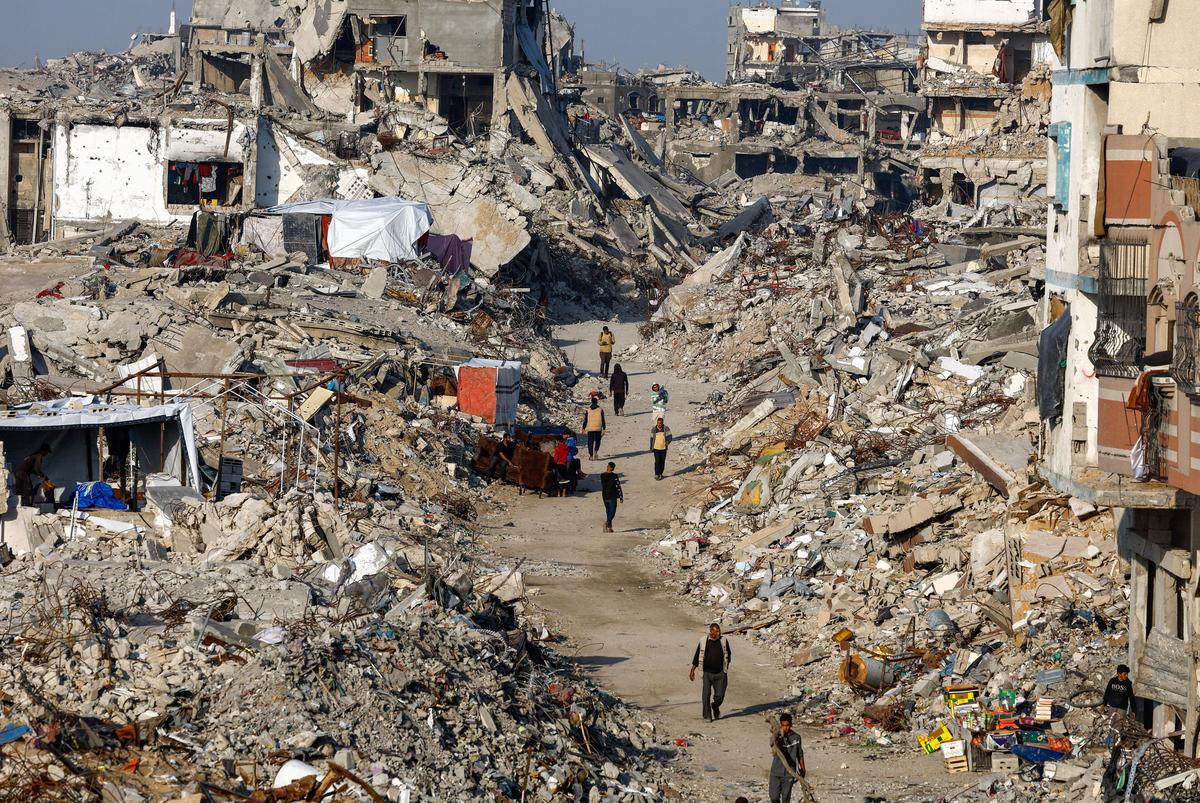
Palestinians walk among piles of rubble and damaged buildings, amid a ceasefire between Israel and Hamas, in the northern Gaza Strip November 19, 2025. REUTERS/Mahmoud Issa
| Photo Credit:
MAHMOUD ISSA
Meanwhile, Israel has been blatantly violating the ceasefire — the U.S.-brokered ceasefire took effect on October 10, 2025 — in Gaza multiple times, killing dozens and injuring hundreds, according to multiple reports from the ground. Hospitals in Gaza are yet again running out of critical supplies amid Israel’s new wave of airstrikes.
What does a ceasefire really mean in this context, and what are the prospects for peace when the perpetrator faces no consequence? As our recent editorial contended, Israeli Prime Minister Banjamin Netanyahu is making a mockery of the ceasefire agreement and Mr. Trump should know his efforts to bring in peace mean little, as long as Israel continues its genocide in Gaza, killing Palestinian civilians day after day with impunity.
Top five stories we are reading this week:
- COP30 ends with president’s commitment to end deforestation, ‘transition away’ from fossil fuels – Jacob Koshy reports; Also watch: Is COP30 an inflection point in the fight against climate change?
- Bangladesh seeks Hasina’s extradition, sends letter – Kallol Bhattacherjee reports
- To deter migration, U.K. proposes new rules for settlement – Sriram Lakshman reports
- Sri Lanka President Dissanayake assures Tamil party of action on Constitution, PC polls next year
- The new direction for India should be toward Asia, writes Mukul Sanwal
Published – November 24, 2025 02:44 pm IST