





Researchers from the Advanced Institute for Wildlife Conservation, Chennai along with the Tamil Nadu Forest Department have enumerated the presence of more than 10,000 thriving Terminalia arjuna (known as ‘neer maruthu’ in Tamil) trees in the Moyar river valley of the Mudumalai Tiger Reserve (MTR).
The trees serve as a nesting site for the critically endangered White-rumped vulture (Gyps bengalensis) in the region, and it is hoped that the study will provide valuable insights for conservation initiatives to help planners assist the vulture populations in expanding into habitats surrounding MTR, from where they have either diminished or disappeared entirely.

The work, funded by the Mudumalai Tiger Conservation Foundation, Udhagamandalam was carried out during 2024 along the long and winding stretch of the main Moyar river, and also covered several of its tributaries – Avarallah, Bhoodhipatti, Edakkarapallam, lyanmathi, Kakkanallah, Kedarallah, Kokkalthuraihallah, Konamasipatti, Mukurthipallam, Poochapallam, Segurallah, Siriyurallah and Varapallam streams. Along with the enumeration of the Arjuna trees (Terminalia arjuna) in Mudumalai Tiger Reserve, the girth, height and the regeneration status of the tree species were also noted.
Healthy presence
Researchers S. Iyanar, Malavika S. Nair and Thirumurugan Vedagiri noted the presence of 10,127 trees along the 77.6 kilometre stretch of river in MTR. Of these, around 93 per cent of the trees were found to be alive and thriving along the river-course, indicating a healthy population. Mortality was observed in only 7% of T. arjuna trees, which is low in ecological terms, researchers stated. Also, these trees hold a rich biomass (93,589.6 tons) and carbon stock (46,794.8 tons) in the landscape, they added.
A short publication of the findings of the team, titled ‘Status and ecological significance of Terminalia arjuna, a keystone species in the riparian forest of Moyar River Valley in Mudumalai Tiger Reserve, Southern India,’ and authored by researchers including S. Iyanar, V. Thirumurgan et al, was published in 2025 in the Journal of Wildlife Sciences.
The researcher said the largest number of trees were found in Segur and Masinagudi ranges. “The number of trees in various size classes showed significant variation amongst the forest ranges,” the authors note, adding that trees in Masinagudi, Segur, and Theppakadu ranges “indicated a healthy, regenerating forest with a considerable number of young trees. “In contrast, NES and Singara ranges showed a decline in the presence of smaller size class trees indicating that these areas have slow recruitment and possible hindrance in the establishment of young trees.”
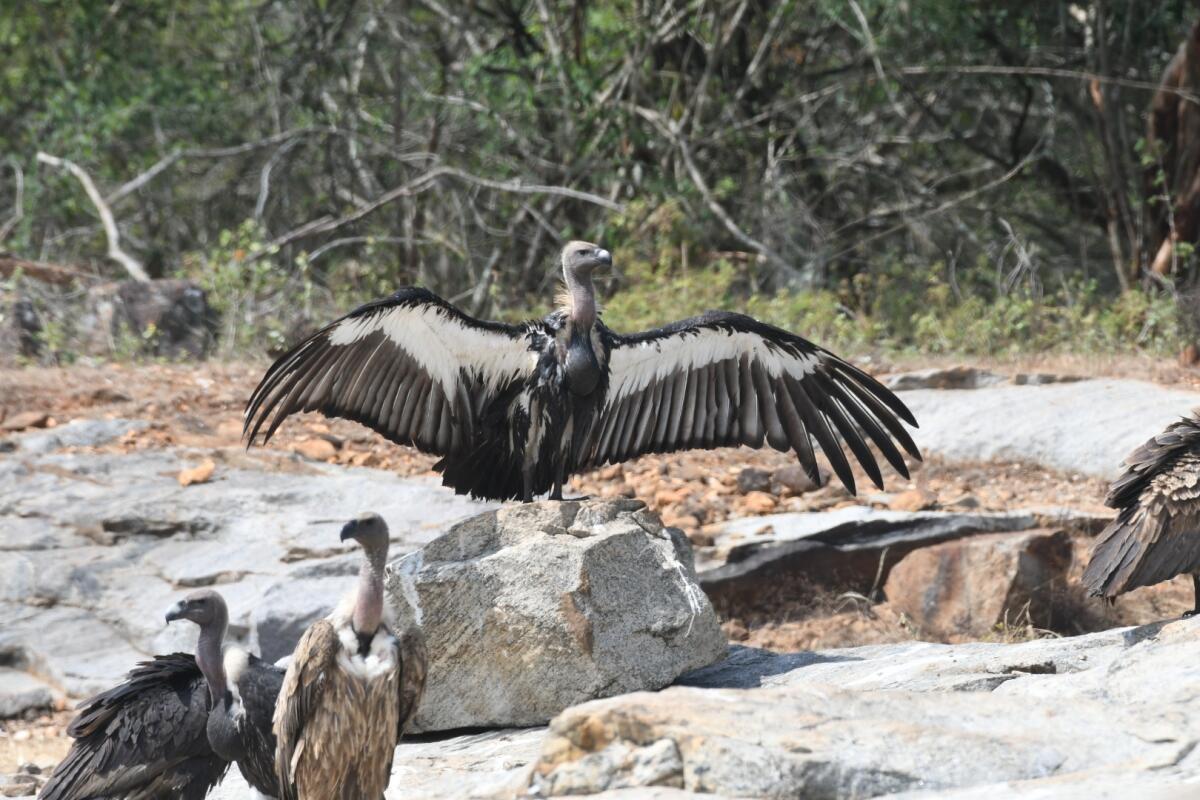
White-rumped vultures at the Mudumalai Tiger Reserve in Udhagamandalam, Tamil Nadu. File
| Photo Credit:
M. Sathyamoorthy
Speaking to The Hindu, Thirumurugan Vedagiri, one of the lead authors of the paper and project coordinator from the Advanced Institute for Wildlife Conservation, said that the Moyar valley is one of the strongholds for Terminalia arjuna and this bodes well for the recovery of the highly endangered White-rumped vulture.
A haven
Researchers noted the presence of 56 nests of White-rumped vultures and 157 nests of Malabar giant squirrels in the trees. The trees also have ecological associations with other native plant species as well as animals, with tigers and leopards using the trees to sharpen their claws and other species like marsh crocodiles, elephants and deer using the shade from the trees to rest and bask. Sloth bears too depend on the trees as termites often build large mounds near them, the researchers note.
Mr. Thirumurugan added vultures prefer to nest in trees that have large crowns. “There is one tree in the region with a crown radius of 700 centimetres, where vultures are known to nest every year. Ensuring that these trees are protected from any pressures will help the vulture populations in the long-run,” he added.
R. Kiruba Shankar, Field Director of MTR, said the forest department was working towards actively encouraging the re-establishment of native flora within the tiger reserve through an ambitious plan of eliminating two of the region’s key invasive species – Senna spectabilis and Prosopis juliflora entirely from the landscape by the end of 2026. “We hope that these efforts will lead to further expansion of native flora species through the reserve, ensuring more habitat availability for species such as the White-rumped vulture,” said Mr. Shankar.
Published – November 09, 2025 05:30 pm IST