


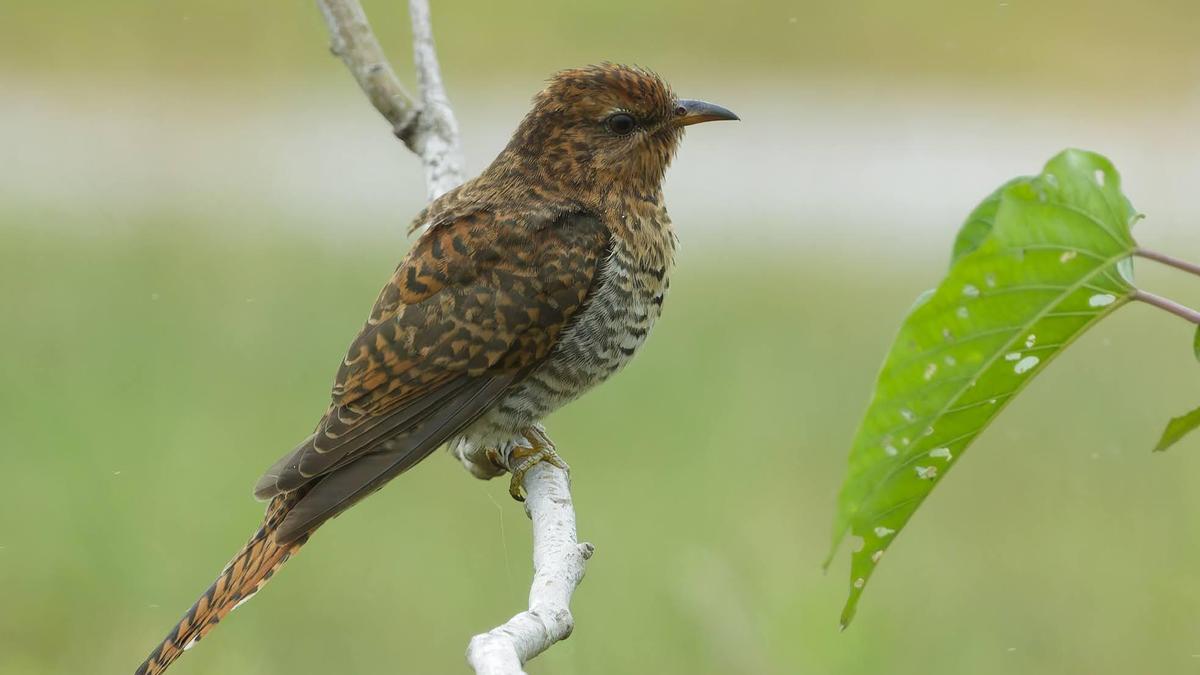

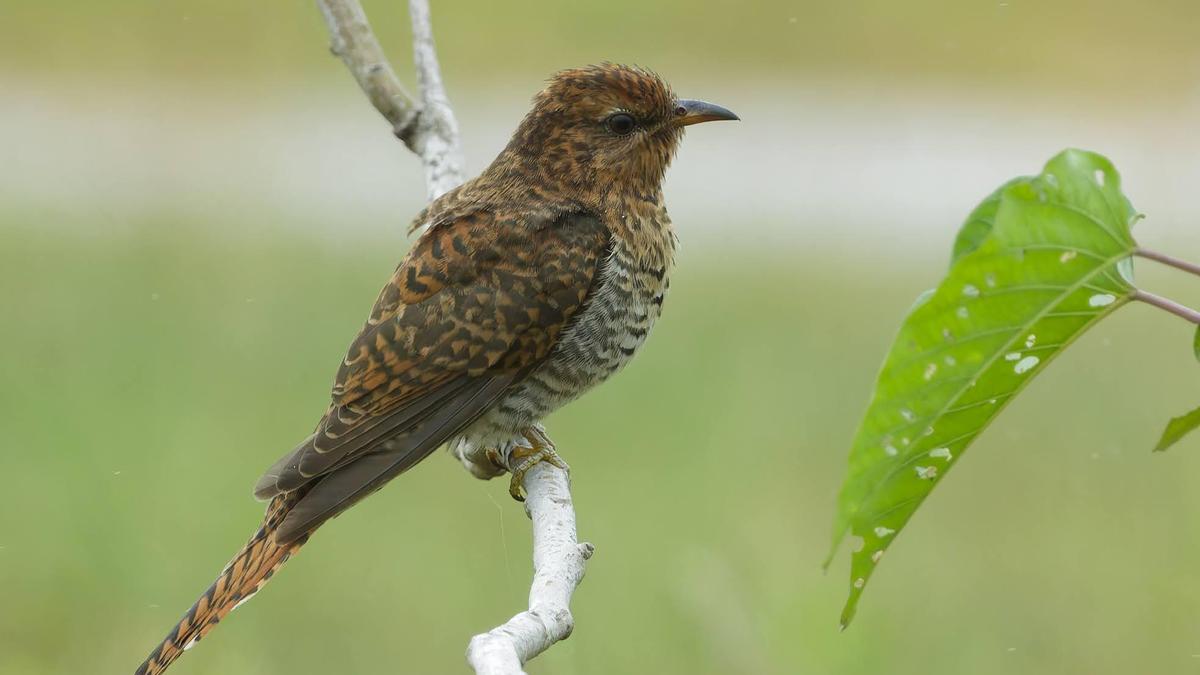
A Plaintive cuckoo at Odiyur lake on November 30, 2025., documented by Amoggh Vjay Chatty.
| Photo Credit: Amoggh Vjay Chatty
No rap on the knuckles probably for Amoggh Vjay Chatty if caught talking with his classmates while seated at his flip-top desk and the teacher is scrawling on the board. After all, he was born “Chatty”. The human world might be forgiving if Amoggh uttered a word where silence is demanded, his unmissable surname coming to his rescue, making light of the situation, but the wild would not be. The Grade 10 student of PSBB Millennium school in Semmancherry obviously has to shush himself while in the bush looking for birds, which he does in his leisure with two other Chattys — parents Sriram Chatty and Radhika Chatty.
On November 30, the three Chattys were looking for birds far from their hearth. The destination was the sprawling Odiyur lake on East Coast Road (near Paramankeni) on the way to Puducherry. The birding group was actually larger with a non-Chatty in it. And the day ended up belonging to one of the Chattys — Amoggh — and the non-Chatty, Aaditya S Rajesh, a Grade 11 student of
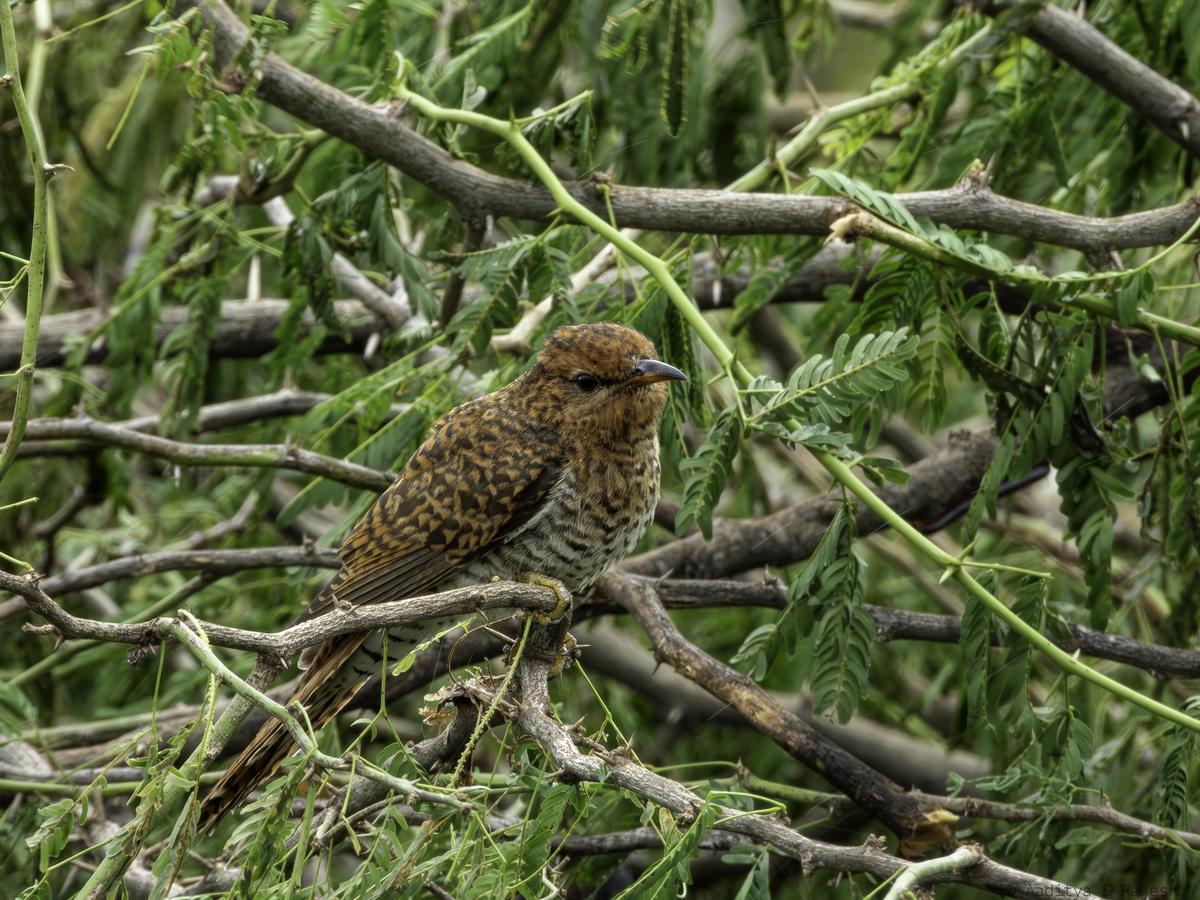
A Plaintive cuckoo at Odiyur lake on November 30, 2025 documented by Aaditya S Rajesh.
| Photo Credit:
Aaditya S Rajesh
The senior Chattys had their wheels all to themselves. Being peers Amoggh (15) and Aaditya (16) had flocked together in another set of wheels. “Aaditya had hired a driver for his car; Aaditya’s parents did not accompany us,” notes Amoggh. Aaditya wears uniform different from Amoggh’s to school, studying in Grade 11 at Maharishi Vidya Mandir Senior Secondary school in Chetpet. During weekends, the boys have a common uniform, birding camouflage fatigues. Both Aaditya are members of Madras Naturalists Society and introduced early to birding by their families.
The purpose of the visit to Odiyur lake was to watch pelagic birds. Amid the repeating patterns of life are plans re-scripting themselves, throwing up highlights diametrically opposite to what was foreseen. And one needs to be thankful for that. Amoggh and Aaditya are. There were sightings of pelagics, but what dominated the boys’ excited chatter on the way back to Chennai was a land-lubber of a bird — a Plaintive cuckoo, which had no business poking around Odaiyur lake, in fact, in any part of South India. In India, this bird is meant to be seen in its north-eastern parts, until a “Jonathan Livingstone Seagull” among them shows up in an unexpected patch.
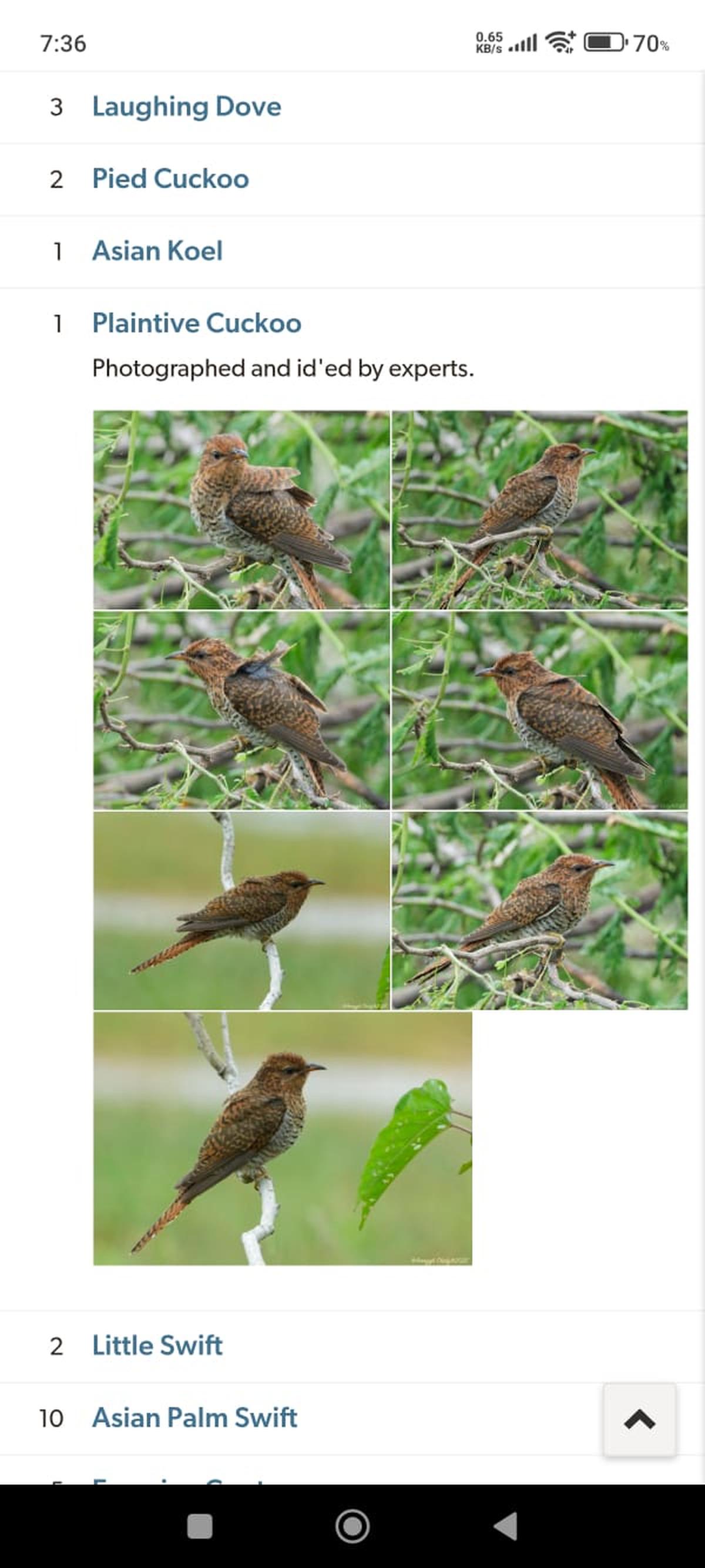
Record of the November 30 sighting of Plaintive cuckoo at Odiyur lake on eBird.
| Photo Credit:
Special arrangement
It was a joint sighting with both boys documenting the female Plaintive cuckoo with their cameras. The bird was first seen through the window of a moving car. It was perched on a shrub by the Odaiyur lake. With the car stopped and parked, the duo started clicking away, capturing it even as it shifted perches in the shrubs.
The feathers were unlike anything else they had seen before, but they did not have a name for it. Amoggh says it was ID-ed as Plaintive cuckoo through a couple of online birding groups. “The experts consulted are Sunil Kumar Unni from Chennai; Adesh Shivkar from Mumbai; and Ashwin V. from Bengaluru,” Amoggh notes. The record is up on eBird.
Umesh Mani, a seasoned birder and a member of Madras Naturalists Society, on the rarity of Plaintive cuckoo in these parts: “Plaintive cuckoo is a bird of the North-east, and rarely seen down South — the books show only occasional records. I have seen it just once earlier in Chennai, some 10-12 years back. It is definitely rare here, although I think that could partly be due to the fact that it may be easily confused with the hepatic morph of the Grey-bellied cuckoo (which is quite often seen here), especially if the underparts are not seen clearly.”
There was a time when the Grey-bellied cuckoo was considered a Plaintive cuckoo’s “cousin”, being viewed as a subspecies. It is a long time since the Grey-bellied cuckoo was jettisoned from the Plaintive cuckoo family, and accorded separate family status.
In their identification notes, the experts pointedly discussed features differentiating this female Plaintive cuckoo from a female Grey-bellied cuckoo.
Ashwin observed: “The main thing is the barred tail. And generally stronger barring throughout, including on the throat and breast. Also more rufous on the throat and breast than Grey-bellied.”
Amoggh shares the observations made by Sunil and Adesh: “The tail has dark barrings and underparts less white, that points to a female (rufous) Plaintive Cuckoo. Grey-bellied has a cleaner tail and more white underparts. Also, grey bellied doesn’t have the rufous wash on throat (above breast), whereas this bird does.”
Published – December 04, 2025 12:10 pm IST