



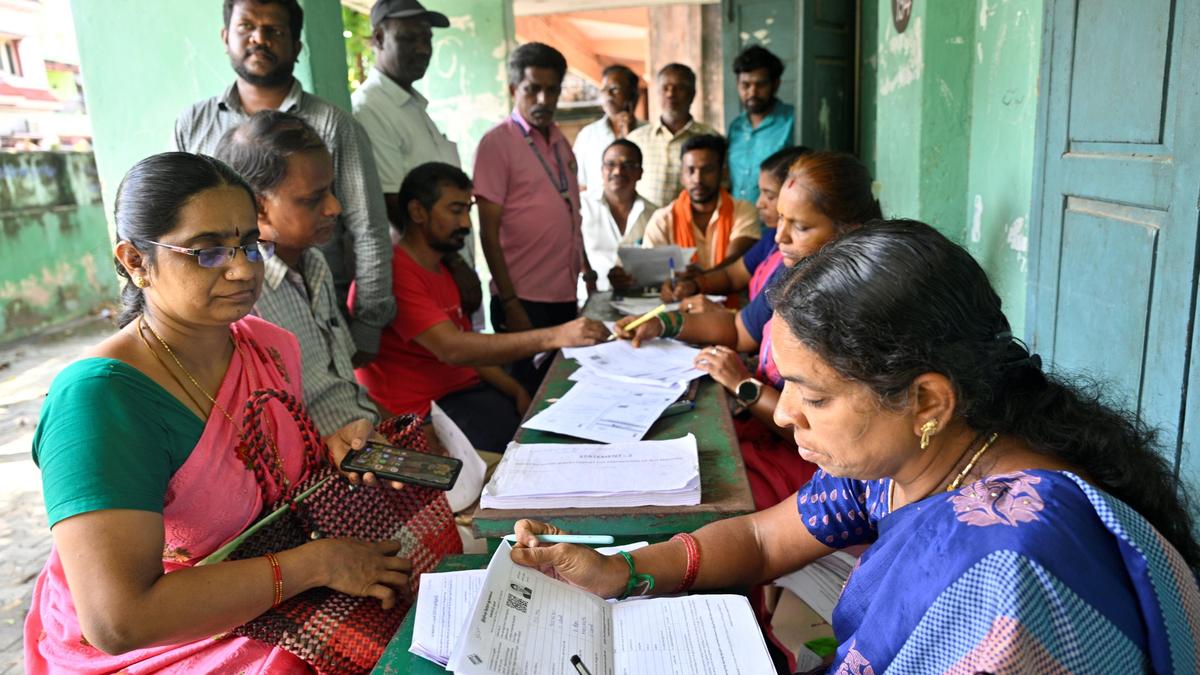

Mangalam (name changed), a Booth Level Officer (BLO) from Erode, has no time to spare for herself. It was 9 p.m. when she explained her role as a BLO. “They have told me that I need to upload the details of 100 forms today. I’m not sure how it can be done. I’m trying my best, but it’s exhausting,” said the 54-year-old.
As many as 68,467 BLOs, who are Anganwadi workers, midday meal assistants, teachers, and revenue staff, among others, have been deputed across Tamil Nadu to complete the Election Commission of India’s (EC) Special Intensive Revision (SIR) of electoral rolls, which is due on December 4.
The second phase of the SIR began on November 4 in nine states and three Union Territories, including Kerala, Tamil Nadu, West Bengal, and Puducherry, which are set to go to polls in 2026. According to the EC, there are 6,41,14,587 electors in Tamil Nadu and every BLO has at least 1,000 voters in their ward. It’s a race against time for them to complete the process while managing their regular employment. The only two words every BLO has used to describe the exercise — “mana ulaichal” (mentally taxing).
A long process
The SIR process begins with the enumeration phase during which the BLO will visit every household and provide the enumeration forms. The electorate will be asked to establish a link with the past SIR, which was conducted between 2002 and 2005. The filled forms will have to be submitted to the BLO, who will also return to collect them. According to the EC, a BLO should make three attempts to reach the electors. Their duties also include identifying duplicate or deceased entries, checking for migration or transfer, and verifying spelling and personal details.

In theory, the job sounds simple: distributing and collecting voter enumeration forms for the 1,500 voters in their respective wards. However, in reality the exercise is not quite as straightforward since it doesn’t account for voters being absent, BLOs primary jobs, network connection, and, above all, the time taken to visit each house.
An Anganwadi worker in Kumbakonam, who was carrying out SIR work, attempted to end her life on November 18 allegedly due to the heavy workload. In Kerala’s Kannur district, a BLO ended her life allegedly due to work pressure. In many States such as Kerala, Gujarat and Rajasthan, where the SIR is being conducted, there have been rising reports of BLOs attempting their life owing to the enormous work pressure.
Pramila (name changed), a teacher on BLO duty in Thoothukudi, said: “It takes a minimum of 20 minutes to explain to the voter about the form, the details required, and to inform them that the form must be filled when I come to collect them in two days. But most of them don’t fill it up for fear of getting the details wrong, so when I return, I fill their form too, not just collect it.”
‘Hurried exercise’
Roshni (name changed), a BLO in Thoothukudi pointed out that they were given daily targets to accomplish. “Sometimes it’s 100 forms that are to be distributed or 200 forms to be collected. It’’ just not possible. A day’s training to complete so many items with no clarity. Mistakes are going to occur in this hurried exercise.”
She recalled how in the weekly meeting when an Anganwadi worker did not meet the assigned target, the in-charge supervisor shouted at her in disrespectful language. “She could not upload the forms as her phone ran out of internet data and, hence, could not meet her target. The official threatened to take action against her in her daily job,” Ms. Roshni added.
The women, who have been deputed as BLOs, have had to juggle household chores and regular jobs with their SIR work. In addition, they also have to map out their routes, work out safety measures, and figure out ways to meet their daily needs.
“I don’t even know which day of the week it is. I haven’t even interacted with my family. We are called for SIR work from 7 a.m. to 10 p.m. even on weekends. Every day, it’s difficult as we are demanded to distribute 100-200 forms per day, missing mealtimes, which is just not realistic,” says A. Punitha, a teacher on BLO duty in Thoothukudi.
Punitha’s assigned ward is close by to her home so she lugs around 2,000 forms to distribute to her 900 electors. She, however, can only go once the school ends for the day, i.e., after 4 p.m since they haven’t been relieved from their teacher role for this work. “It’s a village. I’m scared for my safety in the evenings as most men would be drinking. Nobody lets us inside their houses to explain. So, my husband comes along to help with me for my safety and also helps carry the forms. He takes time off from his job for this,” she added. She wraps up her SIR work by 8.30 p.m. and returns home having distributed a maximum of 50 forms and finds the demand to work until 10 p.m. unrealistic.
Ms. Mangalam also had to plan where she could use the toilet as nobody let her inside the house nor where there any clean toilets available. “I’d just make sure not to drink as much water. But the work requires a lot of leg work. A few days, I could not find any toilets. But thankfully, I found another teacher in my ward, and I have been using her house’s toilet for the past few days,” she added.
‘Risk to health’
Senior consultant physician and diabetologist Jaichitra Suresh pointed out that missing mealtimes, not going to the toilet, and not drinking would lead to urinary tract infection and dehydration. “Adequate oral fluids and breaks are essential to manage work the entire day. The continuous work without caring for the needs of the body will increase blood pressure, sugar levels would go haywire, and sleep patterns will be affected,” she added.
Though the SIR work is to be completed in a month, Dr. Jaichitra pointed out that it would definitely affect the body. “The increased level of work from walking will cause strain and bodyache. The stress from the work will also affect their menstrual cycle. If the body is not used to this kind of work, they will have negative health effects,” she added.
After the Kumbakonam incident, Rani S., Tiruchi district secretary of the All India Federation of Anganwadi Workers and Helpers, decided that things had to change. “All of us are under stress. We have not been given adequate training or resources, such as mobile phones, to upload the forms. There is also no support for travel or understanding from our regular jobs. How are we supposed to just take it?” she asked.
Better work conditions
Therefore, they protested for better hours and proper places with connectivity to upload details, which has been granted now. “There was an Anganwadi helper who was deputed with no proper mobile phones to conduct the exercise nor could she read properly. We held a protest and got her replaced,” she added.
In Coimbatore, midday meal worker A. Latha made it clear that women would leave at 6 p.m. “Nobody can guarantee our safety. Now that the officials have relaxed and explained that we can instead hold camps until 7 p.m. We wrap up around 6 p.m. to travel back home,” said the 44-year-old. Moreover, she pointed out that they had to deal with the voters’ frustration on finding details. “As we are the face of it and helping them, many find it difficult to find the link. They get frustrated and shout at us or threaten us,” she said.
As this job takes up their entire lives, Ms. Latha said that she had to explain to the supervisors at her school and district office to take it easy on them if they miss recording the logbooks regarding the preparation of meals. “So far, they have been kind and haven’t questioned us regarding these delays,” she said, but fears that this might change eventually.
Ms. Punitha is exhausted just recounting her day. “There is no respite from this work. I am questioned by my family, my workplace colleagues, my students’ parents, and the EC officials regarding my work. I don’t feel fully present anywhere to complete my job with satisfaction,” she added.
Noting that if there was much more manpower, Dr. Jaichitra said that there could have been a rotational basis of workers involved as they would get a break from the work to take rest and recuperate. “When they are suddenly given this much work they will not know how to manage. If they know that this would be the routine, they could plan ahead and take better care of themselves,” she added.
Despite repeated attempts, the Chief Electoral Officer, Tamil Nadu could not be reached.
(Assistance for overcoming suicidal thoughts is available on the State’s health helpline 104, Tele-MANAS 14416. and Sneha’s suicide prevention helpline 044-24640050)