




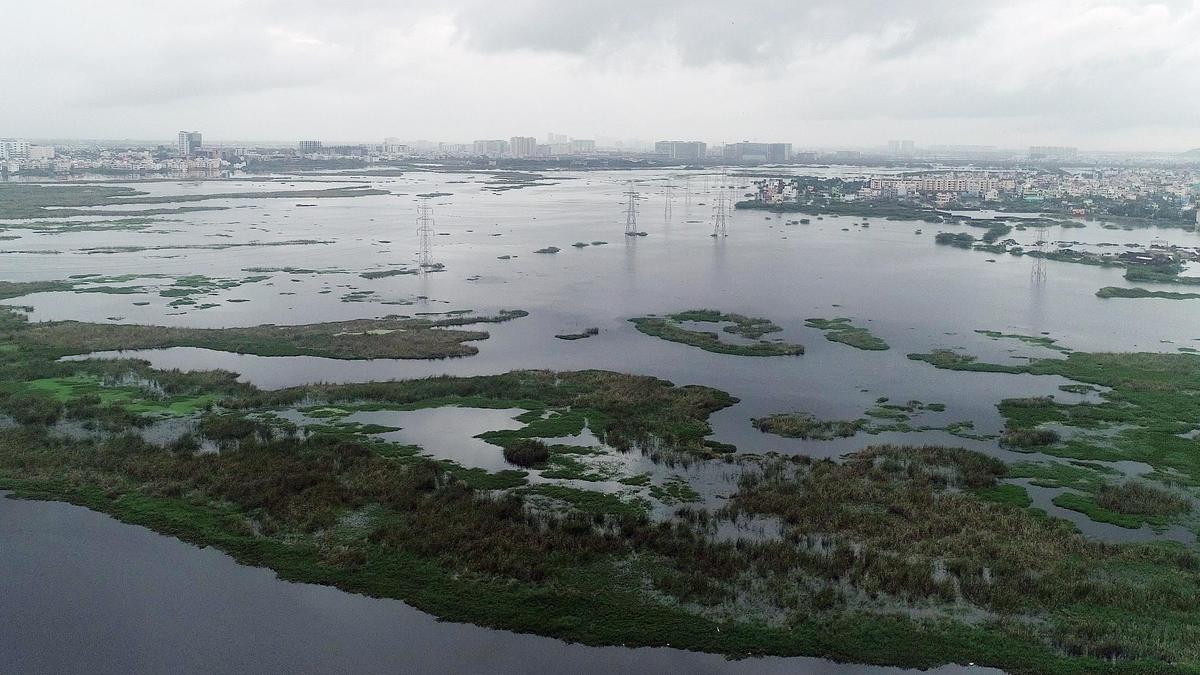

In the wake of a real estate project that has come up allegedly inside the Pallikaranai marshland — one of Chennai’s most ecologically sensitive zones and a Ramsar-notified wetland — questions have surfaced about how large projects obtain environmental approvals. Public perception about who grants clearances is rather murky, and not always accurate, while the actual process is layered and well documented in the law of the land.
The Brigade Group’s housing project, which, according to the non-governmental organisation Arappor Iyakkam, obtained clearances despite being inside the limits of the protected site, has turned the spotlight on the system that decides when and how such permissions are granted.
Under the Environment Impact Assessment (EIA) Notification, 2006, issued under the Environment (Protection) Act, any project that could significantly alter land use or affect air, water, or ecosystems must obtain prior Environmental Clearance (EC). This includes large housing projects, industrial estates, power plants, mines, and infrastructure such as ports, airports, and highways. For instance, any residential or commercial development with a built-up area of 20,000 square metres or more requires clearance before construction.
Approval process
Projects are categorised based on their size and impact. Category A projects — usually large or located in sensitive areas such as national parks or coastal zones — are appraised at the national level by the Ministry of Environment, Forest and Climate Change (MoEF&CC). Smaller Category B projects are cleared at the state level by the State Environment Impact Assessment Authority (SEIAA), which relies on the technical assessment of its State Expert Appraisal Committee (SEAC).
The process begins with the submission of project details, followed by screening and scoping by the appraisal committee to decide the studies required. A detailed Environmental Impact Assessment (EIA) report is then prepared, and a public hearing is conducted in the proposed project area. The committee reviews the findings and submits its recommendation, after which the SEIAA or the MoEF&CC issues the final clearance, often with conditions such as waste management, flood mitigation measures or maintaining green cover.
Approving authority for environmental clearance
Environmental clearances are usually valid for seven years and must be renewed if the project is delayed. In the case of large housing projects like the one near Pallikaranai, SEIAA–Tamil Nadu is the approving authority. The SEIAA is headed by a senior environmental expert or retired bureaucrat nominated by the State government and notified by the Centre, along with two other members who evaluate proposals based on technical and ecological considerations.
CRZ clearance
For projects near the coast, the Coastal Regulation Zone (CRZ) Notification, 2019, applies. It regulates activities within 500 metres from the High Tide Line and along tidal water bodies such as creeks and estuaries. Projects such as resorts, ports, pipelines, roads, and power plants within these areas need CRZ clearance.
The State Coastal Zone Management Authority (SCZMA) — in Tamil Nadu’s case, the TNSCZMA — examines the location of the project and determines whether it falls within the regulated coastal zone using approved maps. The proposal is then sent to the MoEF&CC for final approval if it involves major construction or lies in the most sensitive CRZ-I category. In the Pallikaranai case, CRZ rules are not directly applicable since the wetland lies inland, but for developments along Chennai’s coast, such clearances are mandatory.
Forest clearance process
Projects involving forest land require prior approval under the Forest (Conservation) Act, 1980. Any diversion of land recorded as forest — whether reserve forest, protected forest, or deemed forest — must be cleared by the union government before being used for non-forest purposes. The proponent must submit the proposal to the State Forest Department along with land details and a compensatory afforestation plan.
After State-level scrutiny, the proposal is sent to the MoEF&CC’s Forest Conservation Division. Projects involving smaller areas (up to 40 hectares) are usually cleared by the ministry’s regional office, while larger or ecologically sensitive proposals are decided by the union ministry itself. Only after such clearance can forest land be legally diverted for other uses.
Separately, construction and reclamation are prohibited within wetlands and Ramsar sites under the Wetlands (Conservation and Management) Rules, 2017. Any project proposed within or near such areas must be referred to the State Wetland Authority and the MoEF&CC for scrutiny.
These layers of approval are meant to ensure that development does not compromise ecological stability or worsen the risk of flooding and habitat loss. But gaps in mapping, interpretation of rules, and overlapping jurisdictions often lead to ambiguities in implementation.
Published – November 11, 2025 07:31 pm IST