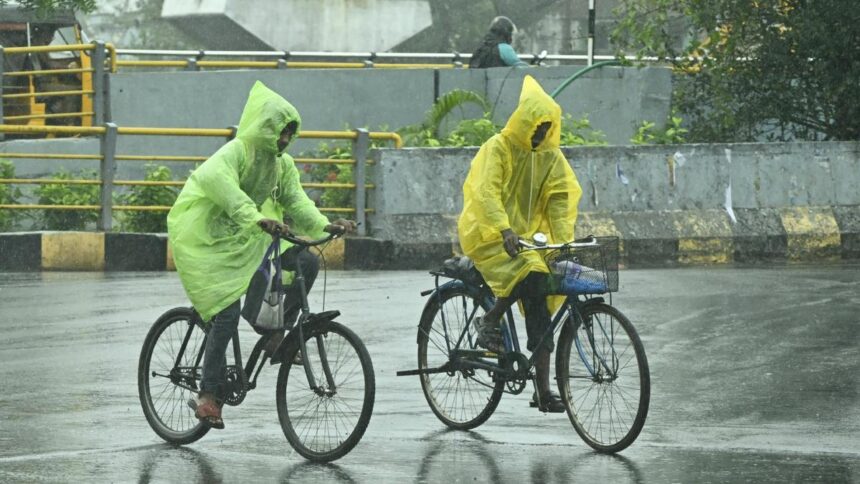




In the third week of April 1942, many parts of South India were in for a surprise as a storm brought forth heavy rain. Around the same time, Madras was at the centre of a political activity that took the country by storm.
Convened at the behest of C. Rajagopalachari (CR) or Rajaji, the Congress Legislature Party (CLP) met on April 23 at Hindi Prachar Sabha in T. Nagar. Apart from CR, a galaxy of leaders of the south — T. Praksam, B. Gopala Reddi, Bulusu Sambamurti, A. Kaleswara Rao, T.S.S. Rajan, P. Subbaroyan, K. Kamaraj, and M. Bakthavatsalam — was in attendance. The meeting adopted two resolutions that jolted the grand old party. The essence of the two motions was a call to the national leadership of the Congress to join hands with the Muslim League.
U.S. stepping into the war
CR was not the Premier of the Madras Presidency then. He and seven other Premiers quit their posts in October 1939 after the Congress took a stand on the Second World War. CR was convinced of the need for the Congress and the Muslim League to join hands in the wake of a number of international and domestic events. By April 1942, the war, which began in September 1939, gained greater momentum, with the United States drawn into it in December 1941 when Japan bombed Pearl Harbour, a U.S. naval base in Oahu, Hawaii. In a few months, Japan overran Southeast Asian nations, including the Philippines, Malaysia, and Myanmar, apart from the strategic Andaman and Nicobar Islands, which had been part of the British India. On Easter Sunday (April 5, 1942), Japan targetted Colombo, Sri Lanka, an event anticipated by British Prime Minister Winston Churchill, who had included Madras and Calcutta in his list of cities likely to be attacked by Japan. The next day, the mainland of India bore the brunt of the inaugural round of air raids of the Asian country, when harbours in Visakhapatnam and Kakinada (now in Andhra Pradesh but then in the Madras Presidency) were hit. Four days later, in a communiqué of April 11, the Madras government advised residents to leave the city.
More or less the same time, British statesman Stafford Cripps was sent to New Delhi to secure the cooperation of India’s political parties — the Congress and the Muslim League — for the war efforts and hold talks on granting independence. However, his mission failed. The Muslim League, at its conference held in Lahore in March 1940, formally made a demand for creation of Pakistan. It was against this backdrop that the CLP adopted the two resolutions. The meeting took place days before the All India Congress Committee (AICC) session in Allahabad (now Prayagraj). Alluding to Japan advancing towards India, the Madras legislators urged the AICC to “choose the lesser evil [between the enemy power, Japan, and the Muslim League]” and acknowledge the League’s claim for separation, according to a report of The Hindu on April 24, 1942. They also suggested a consultation with the League for the formation of a national government to meet the emergency. Through another resolution, the CLP requested the AICC for permission to form a popular government in the Presidency along with the League.
‘Hindu Mahasabha roused’
The CLP meeting lasted six hours from the noon. This newspaper reported that the first motion was carried, with 37 members voting for and six against. Three remained neutral. The second resolution was favoured by 39 and opposed by two, with five keeping their position neutral.
All hell broke loose, with CR being seen as the villain of the piece. The Hindu, in its detailed coverage on April 29 on the reaction to the resolution, mentioned that his suggestion had “hardly any support inside the Congress High Command and has roused the fierce antagonism of the Hindu Mahasabha”.
Rajmohan Gandhi, in his biography The Rajaji Story: 1937-1942, records that Mahatma Gandhi, after a two-hour talk with CR at Sevagram Ashram in Wardha (in Maharashtra), stated that he was “wholly opposed to him [CR]”. Vallabhbhai Patel was “furious”, while Jawaharlal Nehru called CR’s move “undesirable” and Abdul Kalam Azad, who was the AICC chief during 1940-46, said he was “greatly astonished”. The Allahabad session had, expectedly, rejected CR’s proposal for collaboration with the Muslim League. Kamaraj, then president of the Tamil Nadu Congress Committee, issued a show-cause notice to CR, seeking an explanation as to why disciplinary action should not be taken against him for running a “propaganda counter to Congress resolutions”, writes Rajmohan Gandhi. CR quit the party and the Assembly, though he wrote to the TNCC chief, “I do seek to convert the Congress from its present attitude.” Later, the CLP met again to rescind the two controversial resolutions. This time, it fell in line with the position of the national leadership.
No game changer
It was another matter that based on CR’s settlement formula and his discussions with Muslim League leader Mohammed Ali Jinnah, Mahatma Gandhi held a series of meetings with Jinnah during September 9-27, 1944, at the latter’s residence in Malabar Hills, Mumbai. Rajmohan Gandhi writes that they met 14 times and recorded their conversations in a series of letters that contained more than 15,000 words. But the talks ended in failure. Writing about the formula years later, veteran constitutional expert H.M. Seervai, in his book Partition of India-Legend and Reality, states that had the formula been accepted by the two parties, this “would have resulted in some sort of partition between Hindu and Muslim India”. The Madras CLP’s resolutions might have been acclaimed as the game changer. However, history showed that it was not to be.
Published – November 21, 2025 05:30 am IST