



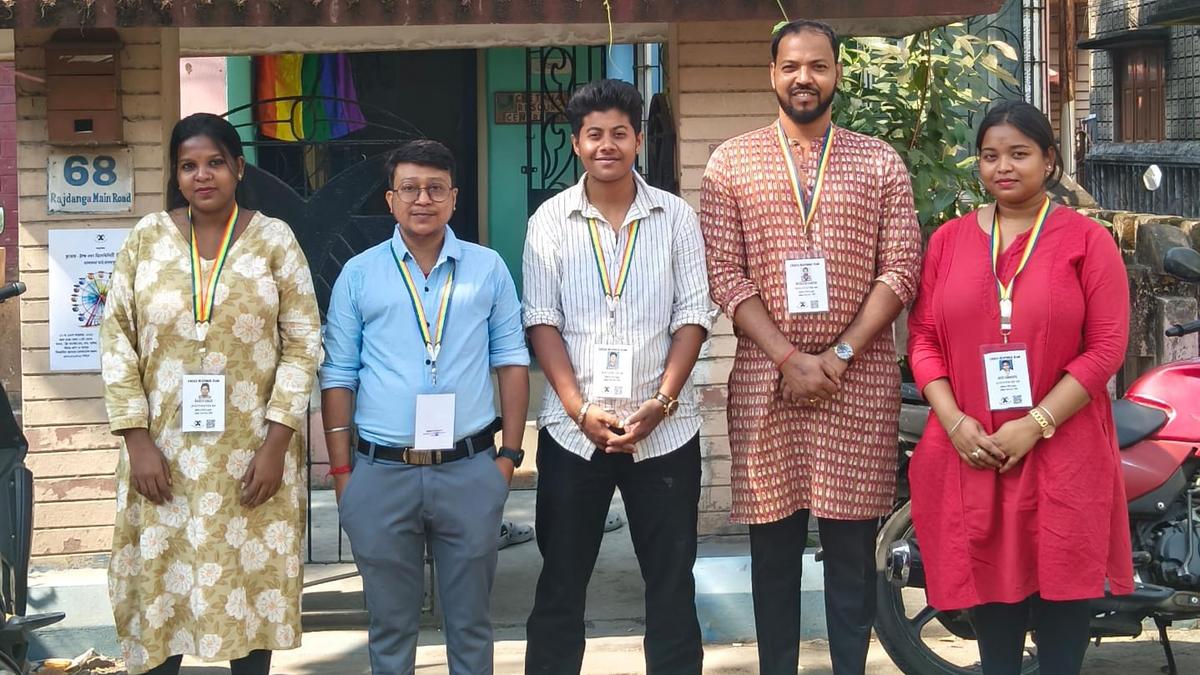


Transgender and queer community members (Left to Right) – Kabita, Ishan, Kiaan, Deba, and Mou, are some of the many people who remain worried about proving their identity during the ongoing SIR process in West Bengal.
| Photo Credit: Special Arrangement
As the Special Intensive Revision (SIR) of electoral rolls continues in West Bengal, the transgender community has found themselves in for an array of problems as they struggle to prove their identity during door-to-door verification as many have not visited home in years.

The Election Commission does not accept the transgender card provided by the central government as proof of identity. However, that is the only proof of identity which many transgender people within the community have.
“We have all lost our sense of home once in life. This anxiety about SIR and the process to prove our identity is making us feel that anxiety once again. Most of us are living in a constant state of trauma,” Koyel Ghosh, the managing trustee of Sappho for Equality told The Hindu. There are over 250-300 people who are associated with them, and most of them have been unable to fill up the SIR enumeration form.
However, when asked, the officials at the West Bengal Election Commission office, they did not have a clear idea of how the transgender community can address these problems. Officials said that any disputes regarding such issues will be taken up in hearings and resolved there.

But the worry that grips the transgender community over the SIR issue is far deeper. “If we are not people of this country. Then who are we? Our parents do not want us, our country does not want, where are we supposed to go?” Kiaan, a 25-year-old transman asked.
Many like Kiaan who are in the process of transition or have already transitioned are facing another set of problems, where even if they do have older identity cards, their faces, genders, and names do not match with their previous identity before the transition.
This issue already creates a threat for the trans persons who have left home and are trying work and stay in rented apartments far away from their threatening homes. Many have been thrown out of work, many have faced threats at their rented homes, with landlords asking questions like, “Why are you starting to have hair on your face?” added Ishan, a 40-year-old transman.

“My partner lost both her parents as a child. Lived on the roadside shanties when she grew up. That shanty has also been demolished with time. Where and how will she get proof of her previous residence and proof of her ancestors?” Ishan is worried. He added that both him and his partner have been spending sleepless nights as they remain tense about their uncertain future, even as they struggle to take care of the present and build a life in the community outside of their own threatening natal homes.
“The Constitution of India says it’s ‘We the people of India’… We are also people of India, we include us, but the government makes no space for us or tries to accommodate us in the SIR process, when it is about our basic rights as citizens of this country,” Koyel asked as they try to offer solace to many of their peers who are struggling with constant anxiety of the SIR process. Many fear they have to step back into the natal family homes which never accepted them for who they are and disowned them for their identity and partner preferences.
Kabita, a 24-year-old queer woman, stepped out of her home 4 years back and has not been back since then. Her documents were burned by her family when she tried to leave home for her independence and safety. Her family was physically violent towards her. They even beat up the four people from Sappho for Equality (a trans-queer rights organisation), who went to retrieve Kabita from her home.
“How will I prove my identity now? My family is asking me to come back home for verification. I feel it is a trap and they are using the SIR process as a bait to get me back home so they can lock me up and probably abuse me further,” Kabita said.
Kiaan also pointed out that many hijra community members who have been given away at birth because of their transgender identity have it even more difficult because 90% of them do not know who their parents are or where they were born.
“They face so much abuse and violence just to survive on the streets or in the hijra homes. Their condition is worse than ours in some ways,” Kiaan questioned.
A common thought that echoes through the community is about how they will prove their identity, when an identity crisis has been haunting them from the beginning of their lives?
Published – November 28, 2025 12:02 am IST