



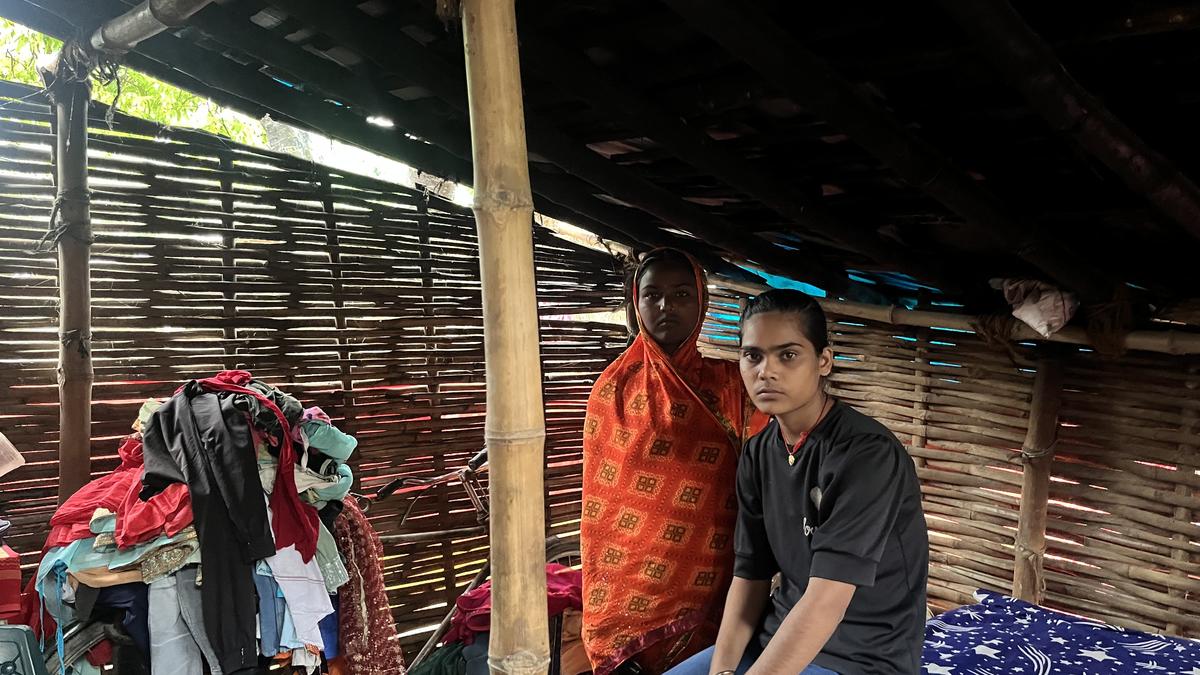

Manika Gaji village, located deep inside Muzaffarpur, is a labyrinth of weathered brick structures thatched with palm leaves and bordered by earth and puddles. Manisha gingerly navigates the messy slush to get into her ‘study’: an enclosure of woven bamboo sheets, sectioned off from the main quarters.
It is in this enclosure that her father Rajkishor Paswan killed himself on a cold, damp morning on the last day of 2024, unable to repay the debt he had procured from a microfinance company. When Geeta Devi, Ms. Manisha’s mother, saw her husband’s corpse hanging from a bamboo pole supporting the room’s tin roof, she disentangled it and used the same rope to hang herself on a nearby lichi tree.
In election-bound Bihar, this is not an isolated case of harassment by microfinance companies (MFCs) driving one couple to suicide. A report by microfinance self-regulatory body Sa-Dhan said Bihar had ₹57,712 crore worth of microfinance loans outstanding as of March 2025. MFCs’ coercive repayment practices have forced families in remote hamlets to flee homes or end lives, yet this deepening debt-crisis is not an election talking point, for either the ruling or Opposition coalitions. Bihar’s second and final phase of polling will take place on November 11.
‘Where is the outrage?’
In nearby Sakra Wajid village, Biswanath Das terms MFC loans a “debt trap”. He asks: “Why are loans being disbursed without any scrutiny?” His younger brother Shivnath and his wife Bhukti Devi died by suicide in March 2024, after they defaulted on their monthly loan repayments. Neighbours furnished a grim account of the couple’s last days: “Somedays, they [MFC agents] dragged their cattle, somedays, they smashed their utensils.” Their son has since ‘disappeared’.
“The government must assess one’s repaying capacity or be willing to write loans off,” says Mr. Das, the bereaved brother. “Why isn’t there any public or media outrage over this institutionalised harassment even as electioneering is in full swing?” he asks.
The cost of ambition
Ms. Manisha, who now lives with her elder brother and sister-in-law, wants to get a job with the police or the Railways. She is pursuing her B.A. at Shyamnandan Sahay College in Muzaffarpur and has also enrolled at a coaching institute in the nearby Musahri sub-division.
It is difficult to imagine someone devotedly pursuing a career in her squalid surroundings, but Ms. Manisha says she will not be “another slogging woman of her hamlet, lacking agency and exposed to domestic violence”. She isn’t an exception. Her friend Asha Kumari gives tuitions to schoolchildren to raise money for her education, while resisting peer pressure to marry.
But financing their studies is still a challenge. “It takes a couple of thousands every month,” Ms. Manisha sighs, her eyes on the bamboo pole where her father ended his life.
‘No help arrived’
Activists Vimlesh and Rani Prasad facilitated Ms. Manisha’s meeting with Priyanka Gandhi when the Congress leader held a mahila samvad in Patna on September 26. “She was very amiable. She asked her associate to look into my matter,” recalled Ms. Manisha. “But no help arrived.”
It was in 2023 that Ms. Geeta Devi first took a loan from an MFC. Her younger son’s wedding was approaching, and Ms. Manisha needed books and accessories. Her husband was a construction labourer, working for a measly ₹450 a day. It was difficult to find more than 10 or 12 days of work, capping his monthly income at around ₹5,000.
The Bihar caste survey conducted in 2023 found that 94 lakh families in the State survive on ₹6,000 or less a month. India’s microfinance system started with networks of self-help groups focused on financial inclusion, later evolving into Grameen Bank-inspired models for women, which have now turned into non-banking financial companies.
Debt cycle
Unable to repay a loan taken from one MFC, women tend to borrow from another, trapping themselves further. Ms. Manisha’s sister-in-law Veena Devi gives a measure of their poverty: “We make ₹170 a day working in the fields.” Factory work is seldom available. A savoury manufacturer once set up a unit in the Bela industrial area, “but transportation was a challenge. He paid ₹5,000 a month, of which ₹1,500 were spent on reserving an autorickshaw,” she says.
Without jobs, even generous handouts can get swallowed up by the endless debt cycle. Villagers say that when Chief Minister Nitish Kumar disbursed ₹10,000 last month to members of the Jeevika women’s self-help groups in a scheme launched just before the Assembly election, MFC agents pressured them to repay their EMIs with it. “The police is not doing anything to stop MFC personnel’s bratty behaviour,” alleges Mr. Prasad.
Despite this situation, it is not rare to find voters who complain of failed crops and soaring food prices, stuck in debt traps, but still voicing their staunch support for “Modi ji and Nitish ji”. Government doles and the deep penetration of Hindu nationalist sentiment in Bihar’s hinterland may have insulated Mr. Kumar’s 20-year-old government from its epitaph.
Anando Bhakto is a journalist covering politics
Published – November 09, 2025 08:02 pm IST