



A flawed foundation can never produce a strong system — whether in science, engineering, governance, or IT. Faulty datasets always yield unreliable results, and electoral roll revision is no exception; broken base data cannot generate integrity, no matter how many procedures are added. Only a modern, accurate foundation can sustain a credible electoral system.
This is precisely the problem with the ongoing Special Intensive Revision (SIR), which relies on the legacy rolls of 2002 to 2004 which were created entirely on paper through manual, error-prone processes when India was entering its digital era. It is astonishing that the Election Commission of India (EC) still relies on these outdated records today, despite India being an IT powerhouse and the Commission itself operating one of the world’s most advanced electoral systems, ECINet.
This regression has erased decades of digital progress, forcing SIR 2.0 to operate on outdated methods and unreliable, unverifiable data. An exercise meant to produce clean and updated voter rolls has instead pushed the country into a prolonged crisis lasting months.
A glimpse at the legacy rolls
The past SIRs functioned mainly as routine summary revisions, focusing on deletions such as removing voters who had shifted, died, or become ineligible, and adding those who had moved or reached voting age. It was executed casually, with little effort to update or correct records.
Therefore, the resulting rolls contain incomplete, ambiguous, and missing information, with standards varying across States and constituencies. Some of the common issues include entries showing only first and middle names without last names, missing EPIC or house numbers, and widespread spelling errors, for example, Agarwal/Agraval, Rakesh/Rakeash, Sangal/Sahgal, and Veer/Vir.
Random inspections of the rolls reveal alarming anomalies, such as entries implying polygamy. For instance, the husbands of Kiran and Seema are listed as Shardul. The author himself, after days of manually scanning hundreds of thousands of entries in Hindi, English, and Bengali, could not find his own record — despite having voted in every general election. These experiences illustrate the flaws in the 2002-04 dataset.
Moreover, as the rolls exist only in paper form, a database of more than 600 million entries cannot undergo verification or consistency checks. The EC’s search interface is essentially non-functional, typically returning “no details found” or “error” when queries are made. After several hundred search attempts, the author found no valid matches and was repeatedly directed to PDFs or Booth Level Officers (BLOs). The search page also includes a disclaimer that the rolls are published exactly as received from State Chief Electoral Officers (CEOs). The EC merely hosts them. This effectively distances the EC from the very officers it oversees. Without digitisation, these rolls serve only archival purposes.
These incomplete, non-searchable legacy records form the foundation of today’s SIR —leaving countless genuine voters unable to find their names anywhere.
Underutilisation of resources
ECINet allows voters to search the current one-billion–record database using mobile numbers, EPIC numbers, names, dates of birth, addresses, and family relations. It detects duplicate or missing entries and supports services such as registration, deletion, corrections, Aadhaar linking, locating constituencies and polling booths, contacting BLOs, downloading EPIC cards, filing complaints, and tracking their status. These functions are comprehensive and typically work flawlessly, enabling even online submission of Enumeration Forms (EFs) through Aadhaar-based verification.
Yet, legacy SIR data has not been integrated into ECINet with the same efficiency. With minimal effort, the 2002-04 rolls could be digitised and made searchable, offering the same capabilities needed for filling EFs. Its omission raises an obvious question: is it intended to conceal the weaknesses of the legacy rolls?
The EC’s expectation that voters can recall where they voted in 2002-04 is unrealistic. EPIC cards were not archived, and people relied on scrap-paper slips. For voters who have moved multiple times over two decades, remembering decade-old booths, part, and serial numbers is impossible.
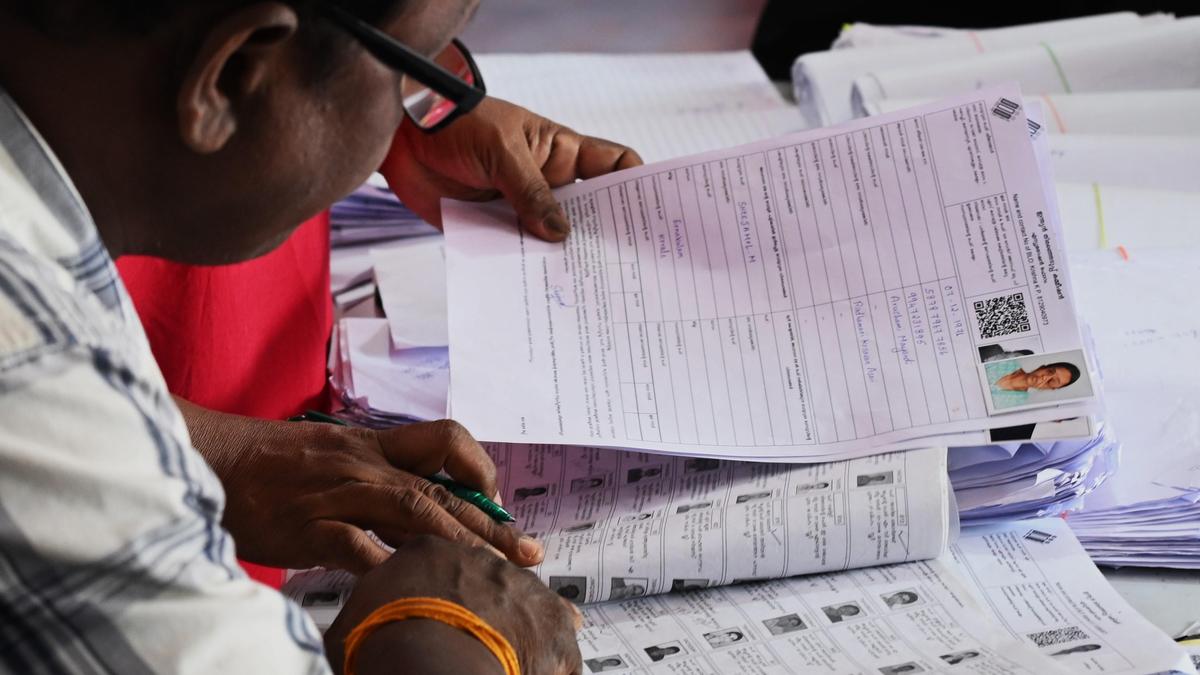
BLOs offer limited help: most function mainly as distributors and collectors of paper EFs. Lacking past polling records, many demand birth certificates and extra address proofs despite EC rules requiring none. Many also lack data-entry skills, resulting in piles of undigitised EFs; over half of Uttar Pradesh’s EFs remain undigitised as per an EC press release on November 27. Paper EFs double the workload: forms are filled by hand and then digitised, and photo-pasting forces poor voters to pay for photographs while BLOs re-digitise them. This digital-to-paper-to-digital loop is inefficient and error-prone.
By contrast, ECINet enables fast, error-free online EF submission with no digitisation, paper-photos, signatures, or documents. Forms 6, 7, and 8 facilitate online insertion, deletion, correction, and Aadhaar linking — separate from BLOs. Aadhaar verification makes the process smooth and reliable.
Minor mismatches — mostly inherited from flawed 2002-04 rolls — can be corrected via Form 8, yet the EC has imposed unnecessary approval requirements that are rarely granted. Voters who have been deleted from the EC rolls have to falsely declare themselves as first-time voters when using Form 6. EF submissions via BLOs show only “received,” with no details, unlike transparent online submissions. Thus, a simple digital workflow is blocked by bureaucratic hurdles and official inertia.
For non-tech-savvy citizens, the EC could have deployed mobile digital kiosks with handheld devices and trained staff to help them file EFs online, thereby easing pressure on BLOs and eliminating the need for paper forms.
Instead of delivering the paperless, people-friendly, transparent system it promised, the EC’s paper-era methods have created confusion and crisis engulfing both voters and BLOs.
How to go fully digital
The following workflow can make SIR 2026 fully digital, paperless, and verifiable:
Searchability through digitisation: convert all State/UT rolls into a fully searchable digital format, using English as the standard for searchable data and metadata, with regional languages retained as non-searchable fields.
Data integration: fuse old records with reliable datasets — Aadhaar, PAN/Income Tax, driving licence, and local body records — using robust APIs and consistency checks. Aadhaar must be strengthened as the anchor for identity verification.
Differentiate voter categories: classify voters into three groups: (i) stable-address voters, (ii) frequent movers, and (iii) those with immigration/nationality issues.
Submission of EFs online: ensure EFs are submitted entirely online, supported by mobile digital kiosks operated by trained personnel. India has an ample supply of tech-savvy workers who can assist efficiently, while electoral officials handle ground verification.
Digitise all steps: complete document verification, uploads, and post-validation checks entirely online, with transparent workflows.
With these reforms, SIR 2026 can transition from its dependence on outdated paper records to a modern, trusted, technology-driven national exercise.
The way ahead
A fully digital system, as outlined above, would eliminate the long-standing flaws of legacy SIR and enable seamless integration of all processes through ECINet. These reforms are straightforward, feasible, and implementable within the extended timelines of the ongoing SIR. Most steps require minimal effort; only data integration may be deferred beyond SIR 2.0. Once adopted, every component of the SIR will become simpler, faster, and more reliable, with grievances addressed in real time preventing panic, confusion, and unnecessary stress.
A digital SIR is not optional; it is indispensable — there is no alternative. SIR 2026 must become a trust revolution powered by technology, transparency, verification, and integrity. It is better late than never.
Rajeev Kumar is a former professor of computer science at IIT Kharagpur, IIT Kanpur, BITS Pilani, and JNU, and a former scientist at DRDO and DST.