
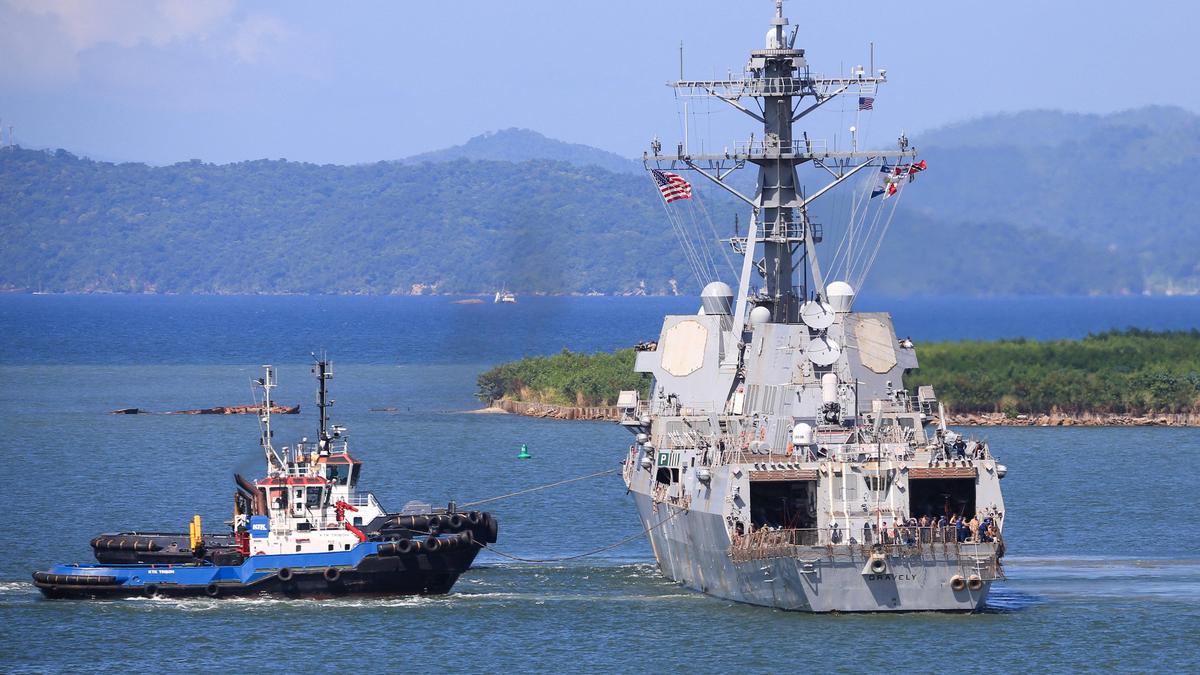

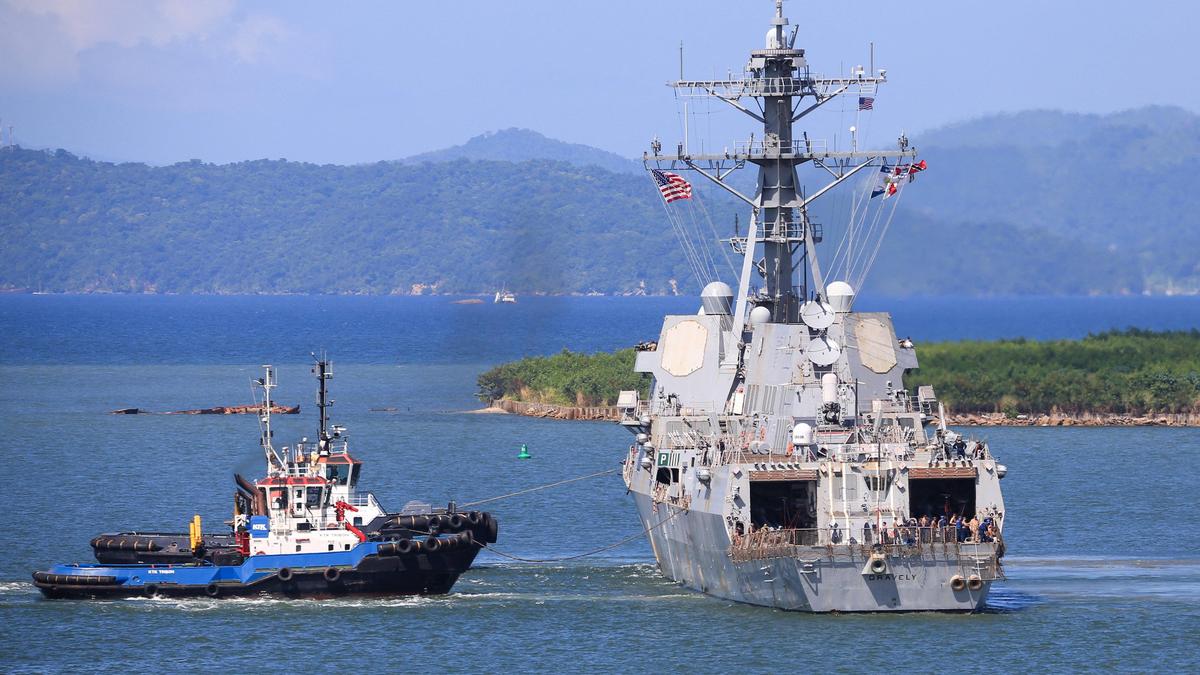
The U.S. Navy destroyer USS Gravely (DDG-107) sails from the Port of Spain amid heightened tensions in the region between the U.S. and Venezuela, as seen from Port of Spain, Trinidad and Tobago.
| Photo Credit: Reuters
On August 7, U.S. Attorney General Pam Bondi announced that the Trump administration had doubled the existing bounty on Nicolas Maduro, the left-wing President of Venezuela, to $50 million for information leading to his capture. The administration has accused Mr. Maduro of being “one of the largest narco-traffickers in the world”. According to Washington, he heads Cartel de los Soles (Cartel of the Suns), a Venezuela-based drug cartel that has been designated as a global terrorist organisation by the U.S. The U.S. Treasury Department said in July the Maduro regime facilitated “narco-terrorism through terror groups like Cartel de los Soles”. Ms. Bondi further claimed that Mr. Maduro has links with Tren de Aragua and Sinaloa Cartel, both criminal organisations designated as terror groups by Washington.

On September 2, President Donald Trump announced an air strike on an alleged drug smuggling boat in the Caribbean. Ever since, the U.S. has carried out a series of strikes in the Caribbean and Pacific waters on boats which the Trump administration claimed was carrying drugs, killing at least 57 people. The U.S. is also building up troops in the Caribbean, in levels not seen in decades. It has already deployed some 10,000 troops to the region, including two Jima Amphibious Ready Groups with over 4,500 Marines and Sailors, three guided missile destroyers, an attack submarine, a special operations ship, a guided missile cruiser and reconnaissance aircraft.
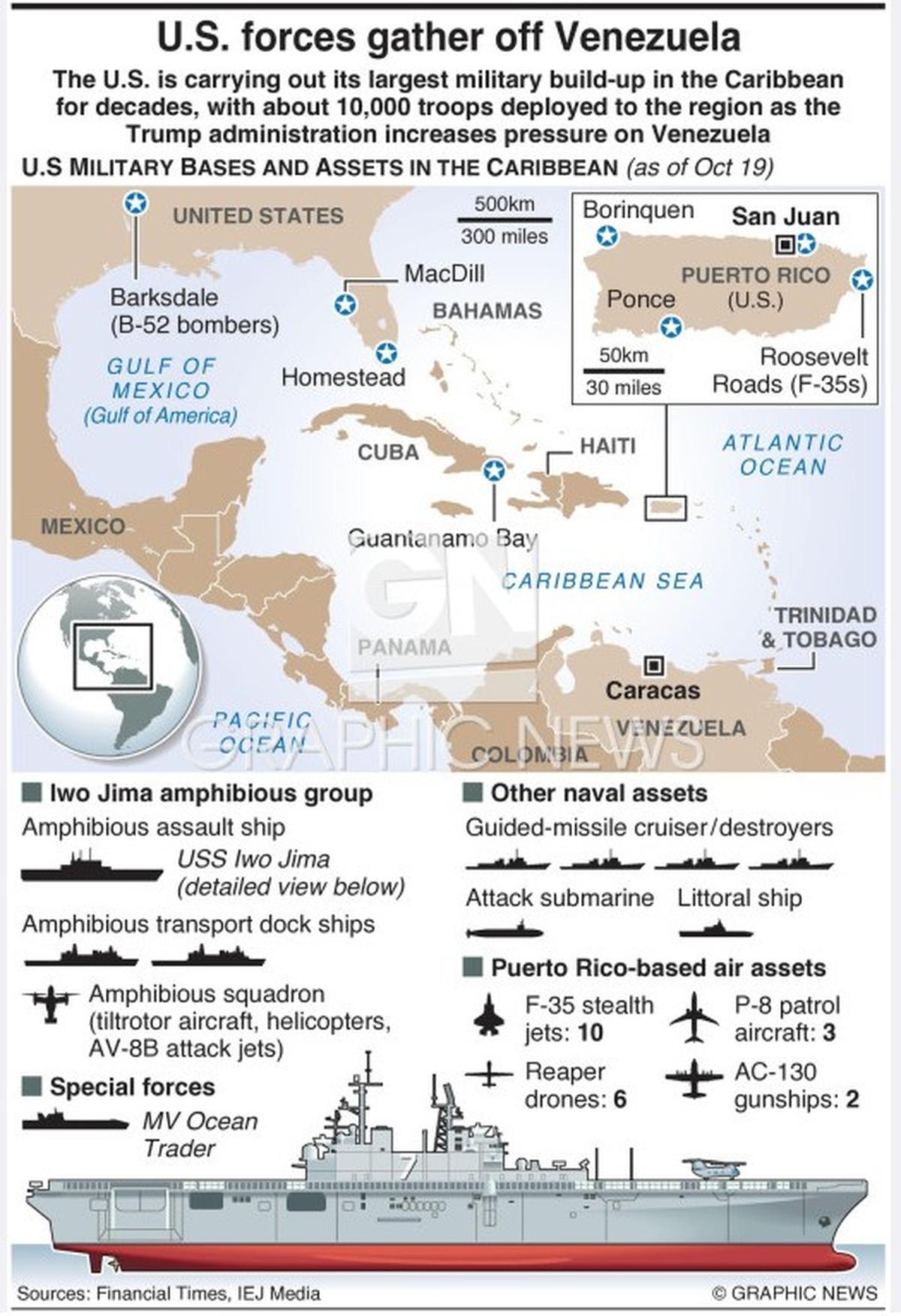
Late last month, the Pentagon rerouted USS Gerald Ford, the Navy’s most modern aircraft carrier, to the Caribbean, with about 5,000 personnel aboard. The U.S. has also deployed at least 10 F-35 fighter jets and three MQ-9 Reaper drones to Puerto Rico, a U.S. territory in the Caribbean located less than 1,000 km off the Venezuelan coast. In October, the U.S. military flew a pair of supersonic B-1 Lancer bombers, which can carry more bombs than any other planes in the U.S. fleet, up to the coast of Venezuela.

The target
The troop buildup, along with the strikes on boats off Venezuela’s coast, makes it clear who the Trump administration’s target is — the Maduro regime. Venezuela has long been used as a transit route by drug traffickers from Colombia, source of most of the world’s cocaine. Venezuelan military officers were accused of involvement with cartels even before the Chavistas (followers of former Venezuela President Hugo Chavez) came to power in 1999. The cartels have deep influence in Venezuela, Colombia and other countries in the region. But Cartel de los Soles, which the Trump administration says is headed by Mr. Maduro, is not a “hierarchical, ideologically driven drug trafficking organisation”, according to a Crisis Group report. It is a “profit-based system of generalised corruption involving high-ranking military figures”, it adds.

The Trump administration has not provided any evidence to substantiate its claim that Mr. Maduro heads the cartel or his government is directly involved in drug production and trafficking. Earlier this year, U.S. media had reported that a U.S. intelligence memo had concluded that there was no evidence linking Mr. Maduro to Tren de Aragua, the criminal syndicate. Nonetheless, the administration seems determined to turn up the heat on the Venezuelan leader, whose regime maintains deep ties with Russia, China and Iran. Mr. Trump recently announced that he had authorised a covert CIA operation in Venezuela.
The method
During Mr. Trump’s first administration, the U.S. formally charged Mr. Maduro and his top aides for their alleged involvement in drug trafficking. But this time, the Trump administration is taking the anti-Maduro campaign to the military level. The Trump White House wants to focus more on America’s backyard where they have recently stepped up political and economic campaigns against left-wing governments and provided generous economic assistance to Javier Milei’s far-right libertarian government in Argentina. Trump officials also believe Mr. Maduro is far weaker today than five-six years ago. Accused of rigging the May 2025 election to retain power, he faces a reinvigorated right-wing opposition led by María Corina Machado — this year’s Nobel Peace Prize laureate — who has openly endorsed Mr. Trump’s Venezuela policy of crippling sanctions and military threats. Several close allies of Mr. Trump have already called on Mr. Maduro to quit and flee the country.

As of now, despite the $50-million bounty and the U.S. military pressure campaign, Mr. Maduro continues to hold his administration together. The military still backs him, and he has claimed to have raised militia to “defend” Venezuela. What will Mr. Trump do next? There are speculations that the U.S. would strike Venezuela’s military infrastructure in the name of expanding its war on drugs but aimed at weakening the regime further. Mr. Trump said on October 30 that he was not considering strikes on Venezuelan soil. But for Mr. Trump, inconsistency is a weapon rather than a liability. In June, he had said the U.S. was “fairly close to a pretty good agreement with Iran” over its nuclear programme, and warned Israel not to blow it up. Within a day, Israel bombed Iran, and a few days later Mr. Trump joined the war.
Published – November 01, 2025 04:40 pm IST