



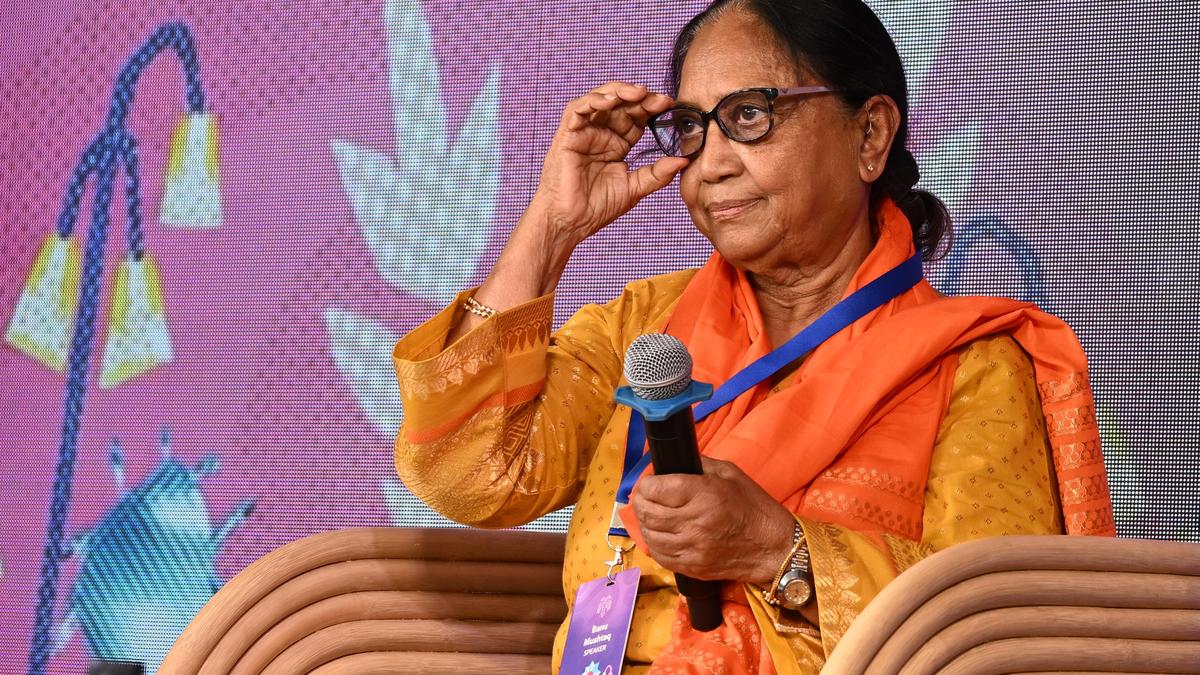

Writer and Booker Prize awardee Banu Mushtaq at the 14th edition of the Bangalore Literature Festival in Bengaluru on Saturday.
| Photo Credit: K. MURALI KUMAR
When Banu Mushtaq was struggling to make sense of the words in her Urdu school back in Shivamogga, a Hindu friend of her father who dabbled in astrology predicted, half jokingly, that the young girl would one day be a writer. It worried her father enough to transfer her to a Christian convent opposite his office, where she was introduced to Kannada.
Soaking in a language
For a child from a Dakhini Urdu-speaking household, the shift was a gradual immersion into a new language, new words, and new ways to express herself. This early exposure to Kannada shaped the writer she would become, the language in which she would later craft the stories that, through translations, reached an international audience to with the Booker Prize, Ms. Mushtaq recalled.
At the 14th edition of the Bangalore Literature Festival on Saturday, she captured the theme “Being Banu, Being Bandaya” lucidly and succintly: “It is to stand before a mirror that reflects not just one woman, but an entire history of dissent, a lineage of writers who refuse to be silenced, and a geography of struggle and tenderness. Being Banu is born of stories of soil, of maternal memory, of the lives I witnessed as an advocate. Being a Bandaya writer is not a label; it is an inheritance. It is a responsibility. A fight that must be fought.”
Not in comfort
She described how her words were shaped not by comfort but by confrontation, by code rules, cross-examination, and the people who came into her chambers with their defeats, dreams, and dignity. “Every award reminds me that the world is waiting for stories that dismantle, disturb, and rediscover. Bandaya or rebellion is not against society, but it is for society. It is about sharpening the whisper, believing literature can create a world where no woman is invisible, no child voiceless, no minority disposable, no truth unfashionable.”
Ms. Mushtaq turned to specific stories in Heart Lamp. She explained how the story “Be a Woman Once, O Lord” drew directly from her experiences as an advocate and participant in social movements. In this story, the protagonist addresses God, questioning the inequalities of creation and the power structures that favour men.
She discussed another story that focuses on high heels, where the focus is on the tension between societal expectations and individual agency. Here, a husband pressures his pregnant wife to wear pencil heels and emulate her sister-in-law’s lifestyle. The story ends with a small but powerful act of defiance against the domestic and societal structures that attempt to control the woman.
Confluence of three
Ms. Mushtaq reflected on the connections between her writing, work as an advocate, and an activism. She said all three are closely intertwined, bound by emotion, empathy, and engagement with real human experiences. “Writing, advocacy, activism, they are like three rivers that meet in a confluence,” she said.
Published – December 06, 2025 10:24 pm IST