





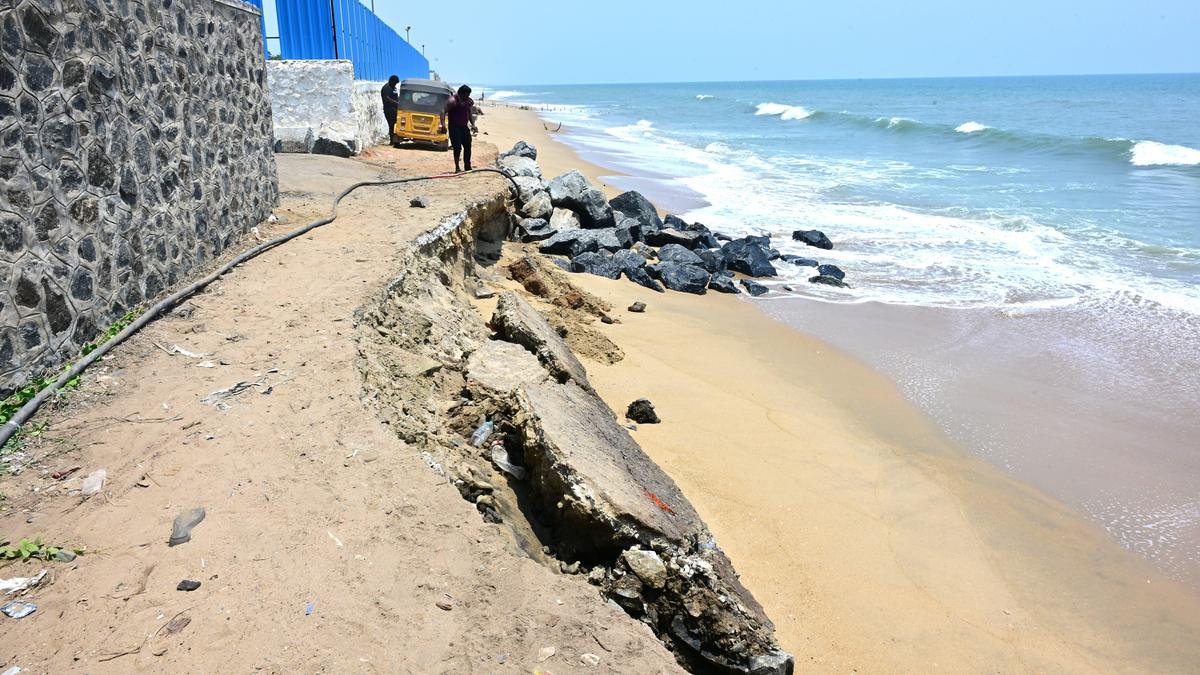
Image used for representation
| Photo Credit: B. Velankanni Raj
With coastal erosion posing a growing threat in several parts of Tamil Nadu, Water Resources Department has put forward project proposals to mitigate shoreline degradation in five vulnerable districts.
The proposals are awaiting nod from National Disaster Management Authority (NDMA) and are likely to take off next year.
The WRD has identified Mayiladuthurai, Kanniyakumari, Tiruvallur, Chengalpattu and Chennai districts as vulnerable hot spots to implement mitigation measures on priority.
Mayiladuthurai district is among the worst-hit places, with large stretches of its coastline experiencing erosion.
WRD officials said the department had submitted 41 project proposals worth Rs. 755 crore to reduce the risk of shoreline degradation in the vulnerable stretches. The projects were prepared based on the draft shoreline management plan and shoreline changes report from the National Centre for Coastal Research (NCCR).
41% in stable condition
Citing the report, the officials said 41% of the 992 km of T.N. coastline analysed was in stable condition and 39% was facing sea erosion risk. In Mayiladuthurai district, nearly 71% of the shoreline was facing erosion.
Residents of fishing hamlets in Mayiladuthurai district voice concerns about escalating risks to their homes.
M. Sivasubramanian of Vanagiri in Sirgazhi taluk of the district, said: “We have lost shoreline of a minimum of 50 metre, including Naickerkuppam and Pudukuppam, in the past decade.”
Many voluntary organisations have started palm seeds sowing campaign along the shorelines and waterbodies to curb erosion. M. Rajavelu, chief coordinator of Green Needa, said, “We have planted lakhs of palm seeds in Mayiladuthurai district since 2023. Palm seedlings have emerged as a protective shield in some villages near Velankanni during cyclones.”
The WRD has sought funds through State Disaster Management Authority under the 15th Finance Commission to implement a combination of nature-based solutions. Officials said besides beach nourishment, the department planned bio-plantation and other protection measures, including coral reefs, coir structures and oyster shell beds, to act as a natural barrier and install geo tubes.
Living shorelines is another intervention proposed. The revised shoreline management plan framework will soon be submitted to the State government.
Noting that shoreline change assessments were updated periodically, M.V. Ramanamurthy, former Director, NCCR, said balancing development along the coastline and addressing climate change impact were crucial to mitigate erosion risk.
Effective solutions
He said bioshields and sand nourishment would be effective solutions to protect the shrinking coastline. Living shoreline, a process to stabilise shoreline using natural systems, was time-consuming, but could be adopted based on site conditions. Hard engineering solutions like groynes might be executed in places with high population density. Shoreline showed recovery after three or four years.
Once the NDMA grants approval, the WRD would prepare a detailed project report and seek Coastal Regulation Zone clearance.
Published – November 20, 2025 02:42 pm IST