






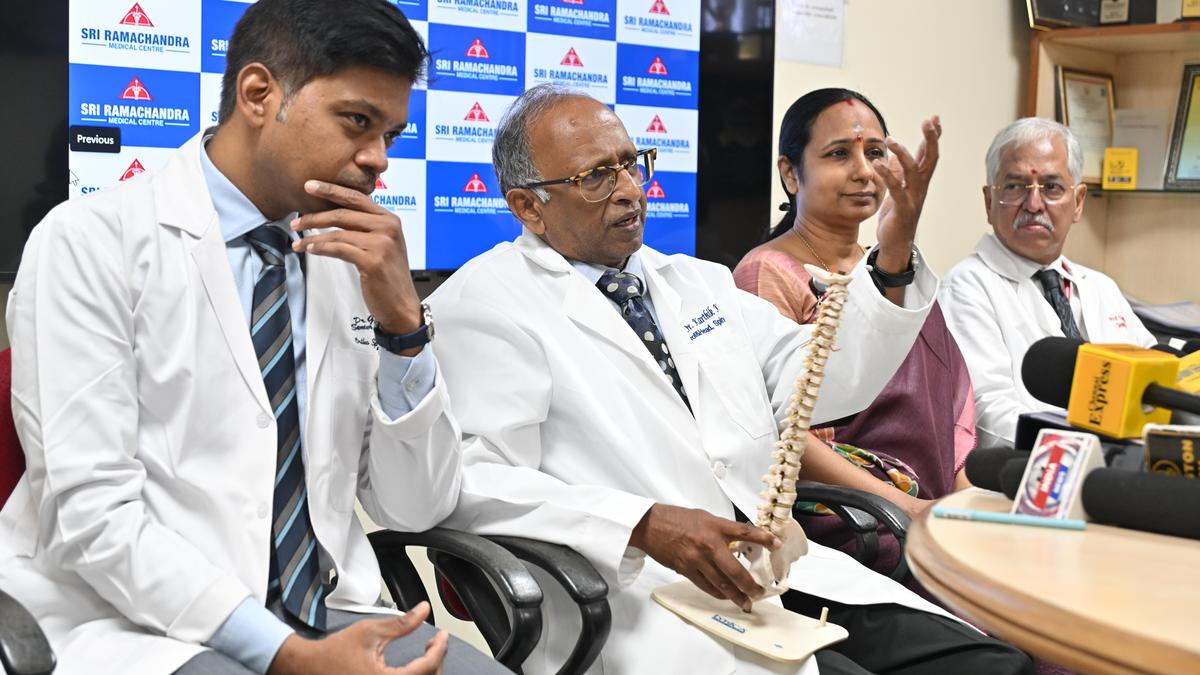


Karthik Kailash, professor and HoD, Spine Surgery, SRIHER, speaking at a press conference in the city on Tuesday.
| Photo Credit: M. SRINATH
Experts at Sri Ramachandra Medical Centre described the advantages of awake spine surgery using percutaneous and endoscopic techniques.
Addressing a press conference on Tuesday, Karthik Kailash, professor and HoD, Spine Surgery, Sri Ramachandra Institute of Higher Education and Research, said: “We have completed 100 cases. This is an important milestone for our institution. What makes this achievement particularly meaningful is our ability to offer spinal fusion procedures to selected high-risk patients without the need for conventional general anaesthesia. High-tech surgery should reach everybody. The awake spine surgery concept is used in foreign countries such as the U.S. We do the surgery when the patient is awake, particularly for high-risk patients who are unable to walk. We are able to operate and discharge them the next day.”
G. Sudhir, Senior Consultant Spine Surgeon, SRIHER, said: “The same day we make the patient walk. Bone damage and muscle damage are minimal. Endoscopic spine procedures performed under awake spine surgery represent an evolving approach to minimally invasive spinal care, combining the benefits of muscle-sparing surgical techniques with the potential advantages of avoiding general anaesthesia in appropriately selected patients. Awake spine surgery, using local anaesthesia with carefully titrated sedation, allows patients to remain responsive during selected stages of the procedure, facilitating real-time neurological assessment and communication with the surgical team.”
“In endoscopic spine fusion, through small keyhole incisions, specialised endoscopic instruments enable targeted removal of structures compressing the neural elements while minimising disruption to paraspinal muscles, ligaments, and surrounding tissues. Potential benefits include reduced postoperative pain and nausea, lower analgesic requirements, earlier mobilisation, shorter hospital stays, and faster functional recovery. Endoscopic spine procedures also offer the biggest advantage of enhanced magnification and visualisation of the neural structures, which is vital in preventing intraoperative complications,” said Dr. Sudhir.
Aruna Parameswari, HoD, Anaesthesiology, said: “There is no need for neuro monitoring, which is expensive. We just give a sedative dose, analgesic, so the patient is sleeping, if you call them, they will respond, but they won’t feel the pain. The role of anesthesiologist is as important in awake spine surgery as general anesthesia. The procedure is done with a combination of intravenous sedation and ultrasound guided fascial plane blocks with continuous monitoring of the patient’s vitals like ECG, blood pressure, oxygen saturation and capnography. It provides pain relief for 24 hours avoiding postoperative opioids, enabling early ambulation. It can be used in patients with cardiac and respiratory conditions that make them high risk for general anesthesia.”
Published – October 13, 2026 10:15 pm IST