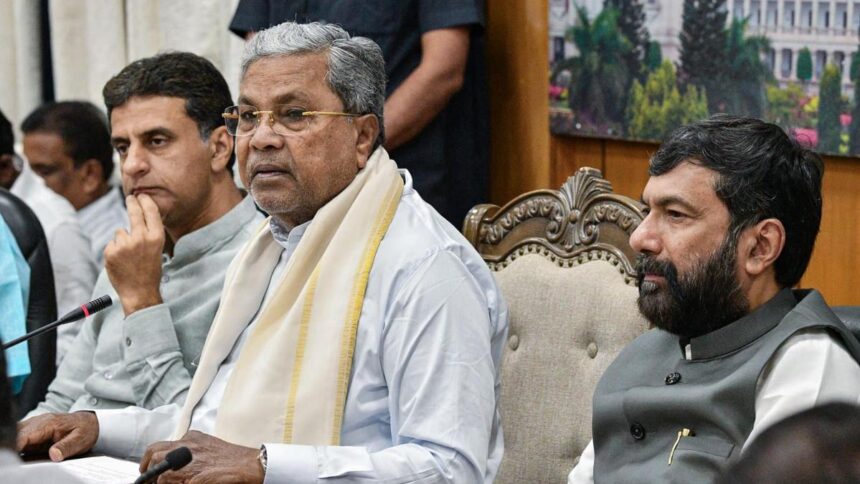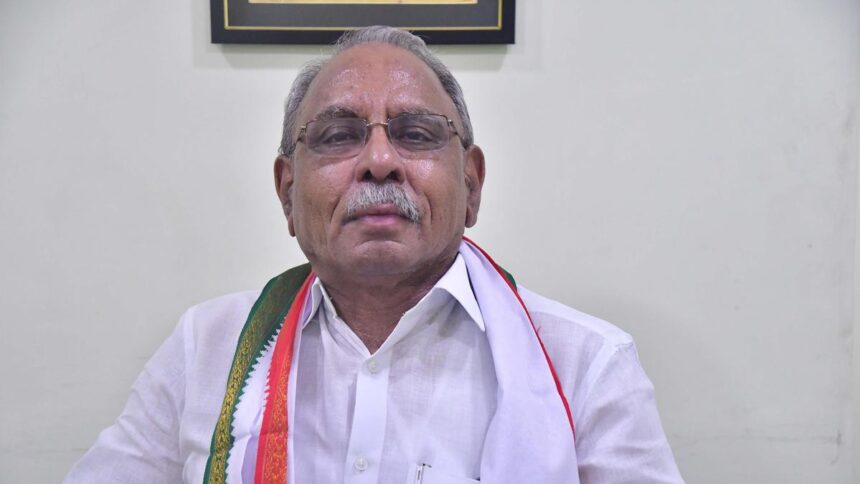



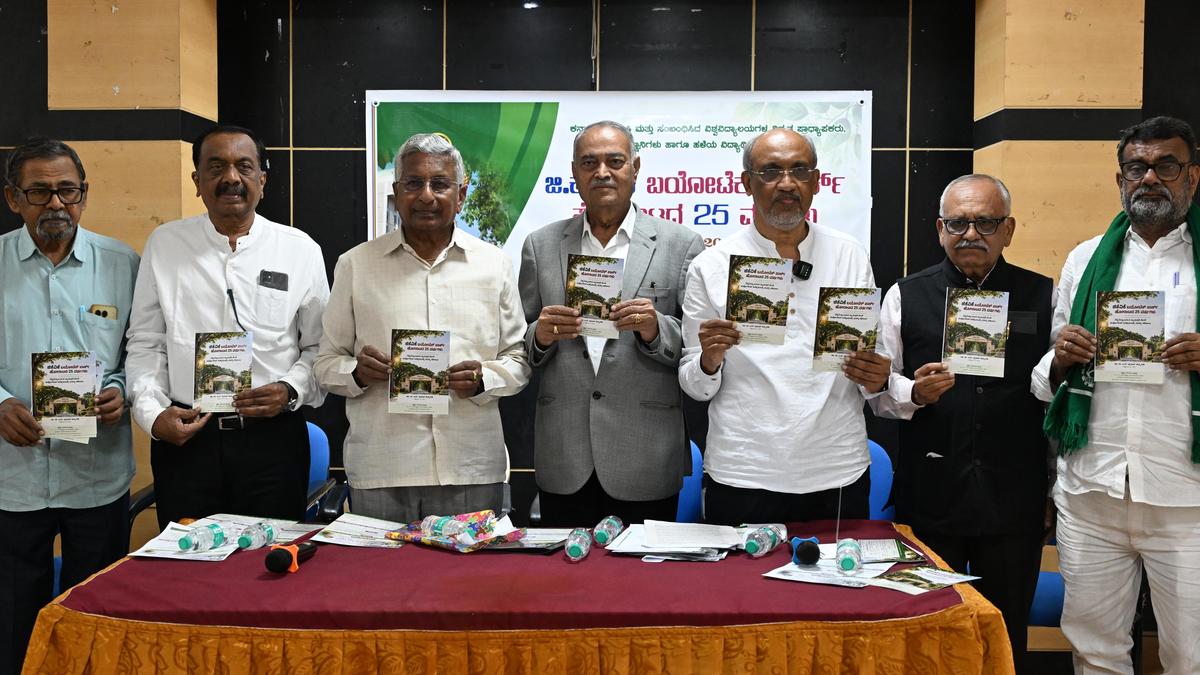


State Finance Commission Chairman C. Narayanaswamy, former Karnataka Agricultural Prices Commission chairman T.N. Prakash Kammaradi, former UAS-B Vice-Chancellors K. Narayana Gowda and P.G. Chengappa, KRRS president Badagalapura Nagendra, and others at a programme marking the 25th anniversary of the struggle against efforts to acquire 100 acres of land belonging to the university for a biotech park in Bengaluru on Thursday.
| Photo Credit: ALLEN EGENUSE J.
The sprawling campus of the University of Agricultural Sciences – Bengaluru (UAS-B), a serene space in the city, was marked by commotion and tension on the morning of September 27, 2001. On that day, instead of the chirping of birds and the sound of wind blowing through the foliage, one heard the shrill cries of students and teaching faculty being chased and beaten by the police.
The students and teaching faculty were protesting against the government’s move to take away 100 acres of prime land on the university campus to set up a biotech park for private companies.
They embraced trees as excavators moved in to remove them from an area that housed a rare germplasm collection of various tree species. The university campus, larger than Cubbon Park and Lalbagh put together, was filled with smoke from tear gas shells lobbed by the police, while wild honey bees attacked people after their hives were disturbed by the tear gas.
Though the protesters were taken into custody and cases were booked against 18 teaching faculty members, the intensity of the agitation grew, forcing the then government led by Chief Minister S.M. Krishna to withdraw its plans.
Several scientists and professors of the university, now retired, and former students gathered in Bengaluru on Thursday to recollect the events of that day and deliberate on the lessons learnt from the biotech park struggle. They also brought out a booklet on the struggle, hoping it would inspire the present generation to take up similar causes.
Former Karnataka Agricultural Prices Commission Chairman T.N. Prakash Kammaradi, who played a crucial role in the biotech park struggle, recalled that it was possible to save the university’s land because of the commitment and strong support of everyone involved.
Former UAS-B Vice-Chancellor K. Narayana Gowda recounted the experience of lecturers, including himself, being arrested. His predecessor, P.G. Chengappa, made it clear that the university was not opposed to a biotech park, but that the manner in which the land was being forcibly acquired for the project had angered everyone.
State Finance Commission Chairman C. Narayanaswamy underscored the importance of such struggles in protecting government land.
Karnataka Rajya Raitha Sangha (KRRS) president Badagalapura Nagendra expressed concern over the trend of governments acquiring farmland for non-agricultural purposes and argued that farmers, particularly rural youth, should not face obstacles in continuing with farming.
KRRS leader Chukki Nanjundaswamy expressed concern over the present education system, which, she said, had failed to understand and appreciate the knowledge possessed by farm youth. She expressed happiness over Gen Z taking part in public struggles.
Former chairman of the Karnataka Backward Classes Commission C.S. Dwarakanath wondered whether it would be possible to mount such a struggle today, given the “lack of courage” among those concerned to question the top authorities.
Published – September 24, 2026 08:42 pm IST