





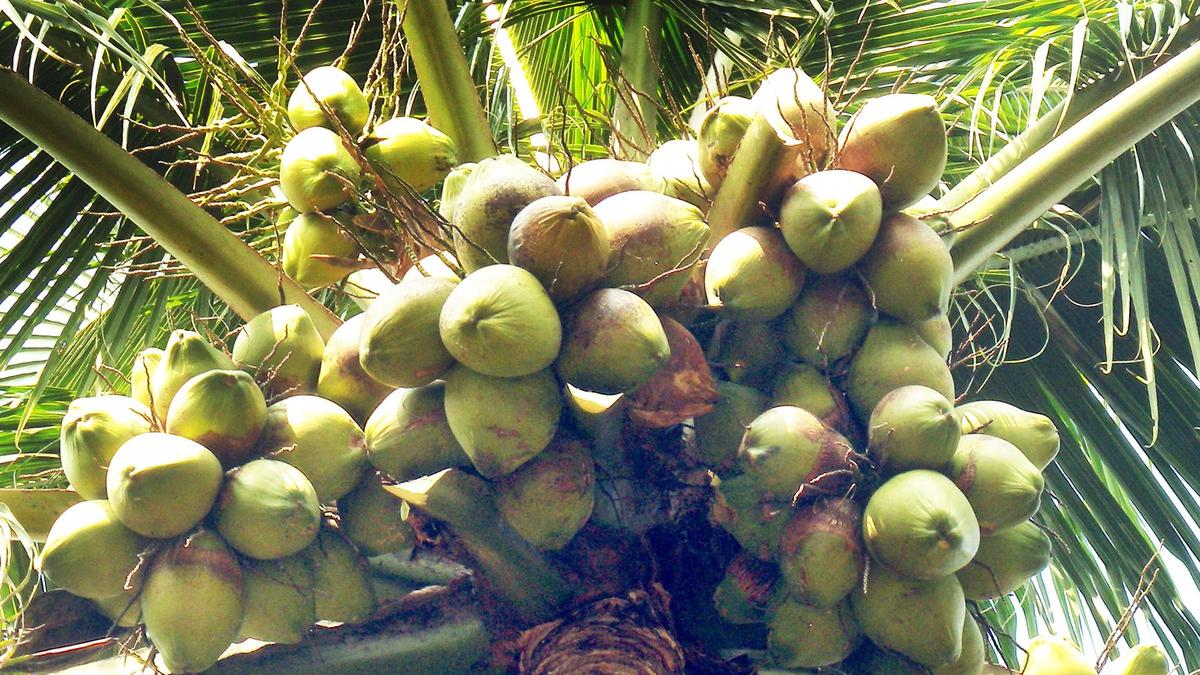


The Kalpa Suvarna, a dwarf coconut variety developed by CPCRI, Kasaragod, Kerala.
| Photo Credit: Shyama Prasad of CPCRI
With the Union Budget for 2026-27 proposing a Coconut Promotion Scheme, the Central Plantation Crops Research Institute (CPCRI), Kasaragod, Kerala, has already launched an initiative for replacing old and non-productive coconut trees with the improved varieties developed by the institute.
“Some of the improved varieties yield in two to four years,” its Director K. Balachandra Hebbar told The Hindu.
Under the ‘coconut rejuvenation’ initiative, Mr. Hebbar said, the institute has begun issuing its licence to nurseries to develop seedlings of improved varieties under the supervision of CPCRI. The licenced nursery gets CPCRI’s technology to develop improved varieties for selling to farmers. “As of now, the licence has been issued to 12 nurseries,” the Director said, adding that more nurseries are coming forward to purchase CPCRI’s technology to develop the seedlings.
The technology is transferred and the licence is issued to nurseries after entering into a memorandum of understanding (MoU). “The CPCRI monitors the quality of the seedlings before the licenced nursery starts selling them to farmers,” he said.
Mr. Hebbar said that high-yielding varieties can be planted in irrigated areas. Climate resilient varieties can be grown in high temperature and dry belts.
The improvised varieties developed by the institute included 11 tall, six dwarf, and seven hybrid.
He said some coconut trees, which are 60 or 70 years old, either do not yield or yield less. Farmers can replace them with the improved CPCRI varieties.
Cocoa production
Referring to cocoa production, Mr. Hebbar said that India requires about one lakh tonnes of cocoa beans a year, while the domestic production stands at only 30,000 tonnes a year. The government has aimed at achieving self-sufficiency in cocoa production by 2030, for which the area under cocoa will have to be expanded.
Stating that the CPCRI has developed about eight improved varieties of cocoa, he said that the VTLCH 2 variety is tolerant to black pod rot, which affects many cocoa plants, acting as a worry factor for farmers. “This hybrid variety, which is an early bearer and is high-yielding, is suitable for high-density planting in medium canopy under arecanut and coconut shades,” he said.
Mr. Hebbar said that cocoa cultivation is expanding in Karnataka, Andhra Pradesh, and the North East. It can be grown as an inter-crop both in arecanut and coconut plantations.
The CPCRI is yet to issue the licence to nurseries, he said.
Published – February 02, 2026 08:22 pm IST