



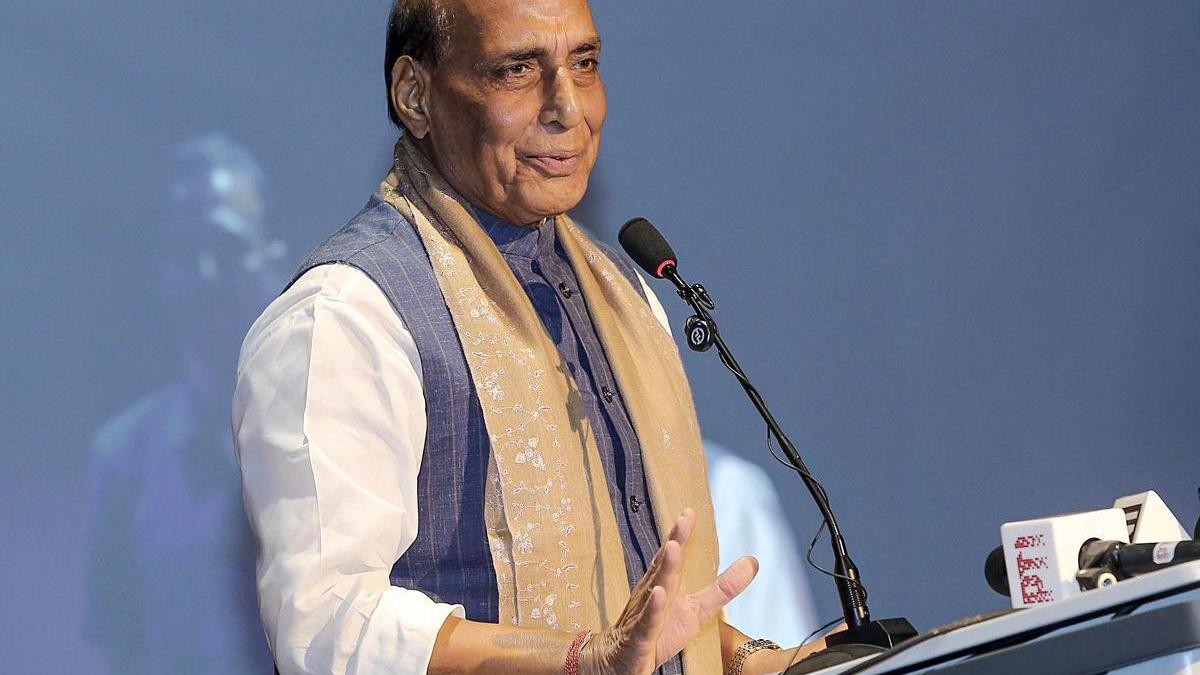


Defence Minister Rajnath Singh said the collaboration between the DRDO and industry should extend beyond production to the entire technology value chain, including research, design, testing, certification and manufacturing.
| Photo Credit: File
Defence Minister Rajnath Singh on Tuesday (September 15, 2026) unveiled a set of policy initiatives aimed at lowering technical and financial barriers for MSMEs and deep-tech start-ups seeking to participate in defence research, development and manufacturing.
Unveiling the initiatives at ‘VIMARSH 2026’, a DRDO-Industry Synergy Meet, Mr. Singh said the collaboration between the Defence Research and Development Organisation (DRDO) and industry should extend beyond production to the entire technology value chain, including research, design, testing, certification and manufacturing.
The new framework provides for direct funding, incubation support and dedicated access to DRDO testing facilities for MSMEs and start-ups.
A standardised and secure mechanism for sharing DRDO-developed software source codes with licensed industries has also been introduced to accelerate software-defined defence capabilities and address technology obsolescence.
Nine Licensing Agreements for Transfer of Technology (LAToTs) were handed over to 13 manufacturing partners to facilitate commercial production of advanced defence systems.
Strategic MoUs were also exchanged with the Society of Indian Defence Manufacturers (SIDM) and Laghu Udyog Bharati (LUB) to widen industry outreach and encourage greater participation from smaller enterprises.
The DRDO also signed a contract with the Quality Council of India for version 2.0 of the System for Advanced Manufacturing Assessment and Rating (SAMAR), aimed at benchmarking the manufacturing maturity of domestic defence enterprises.
Mr. Singh said India’s goal of becoming a developed nation by 2047 would require self-reliance in critical technologies, higher indigenous content, a significant expansion of defence exports and a stronger presence in global supply chains.
He said the Government’s measures, including the Positive Indigenisation Lists, Make in India, iDEX, ADITI and allocation of 25% of the defence R&D budget to the private sector, had created a broader ecosystem for defence innovation.
“Companies that invest in new and emerging technologies today will become the leaders of tomorrow,” he said, stressing that future warfare would be shaped by technological superiority.
Defence Secretary and DRDO chairman Rajesh Kumar Singh said VIMARSH 2026, themed ‘Varta se Vikas’, was intended to move the defence ecosystem from a transactional buyer-seller relationship towards a collaborative technology-development model.
He said more than 2,300 technology transfers had so far been handed over to over 1,100 industries. Technologies relating to around 50 DRDO-developed missiles have also been made available to industry.
The event, attended by more than 250 industry leaders, officials and DRDO scientists, also discussed technology absorption, Development-cum-Production Partner models and faster induction of indigenous technologies into the armed forces. Technical roadmaps were presented for aeronautical systems, missiles, armaments, microelectronics and naval systems.
Published – September 15, 2026 07:47 pm IST