


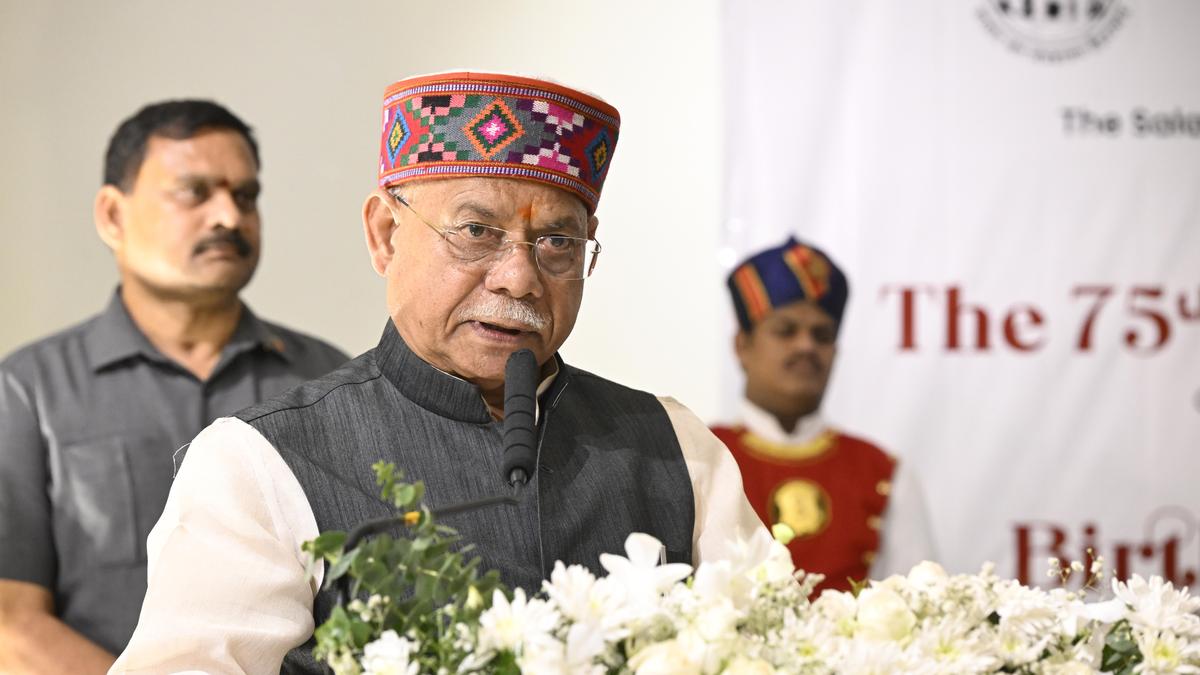


Telangana Governor Shiv Pratap Shukla.
| Photo Credit: File Photo
Public policy expert Donthi Narasimha Reddy has urged Governor Shiv Pratap Shukla to return the Core Urban Region (Integrated Governance) Bill, 2026, to the Telangana Legislative Assembly for reconsideration, citing concerns over its governance architecture, local self-governance and property tax provisions.
Mr. Reddy said several of the concerns related to provisions in the Bill itself and could not be addressed merely through rules after its enactment. He pointed out that the proposed CURE Apex Governance Council would have overarching powers over the agenda, policy direction, plans and programmes of CURE, but would not include elected representatives from the corporations. He said this raised constitutional questions.
He also objected to provisions allowing the State government to authorise CURE authorities to exercise their powers outside the Core Urban Region and sought their deletion.
Mr. Reddy said the Bill reduced the statutory rights and functions of ward committees compared with those under the GHMC Act, 1955. It does not retain comparable provisions relating to access to information, supervision of civic services, monitoring of certain institutions and participation in the implementation of government schemes. He sought restoration of these powers and functions.
He also raised concerns over the extent to which the composition, powers and functions of several newly created bodies had been left to executive notifications.
On property tax, Mr. Reddy said concerns raised during the public consultation had not been addressed. He objected to the absence of a specialised Property Tax Board in the Act, the Government’s power to modify the manner of determining guideline value and the automatic revision of property tax following changes in guideline values.
He also questioned the Commissioner’s power to alter assessment units without specified criteria, prior notice or a requirement to issue a reasoned written order. While acknowledging that the Act provides for a CURE Appellate Authority, the representation said an effective appeal would require the underlying assessment decision to be properly recorded and communicated.
The representation also sought safeguards for the use of property tax revenue, including ward- or zone-specific accounting and allocation of a portion of the revenue towards infrastructure such as water supply, sewerage, drainage and roads in the same area. It also sought a time limit on the deemed interim property tax rate and objective criteria for correcting assessments.
Mr. Reddy raised concerns over changes made to the Bill after the public consultation and sought publication of a consolidated text clearly indicating the changes made following the consultation.
He has requested the Governor to return the Bill for reconsideration and, alternatively, to refer the constitutional questions and alleged excessive delegation of powers to the Law Department or Advocate General before according assent.
Published – September 16, 2026 09:33 pm IST