






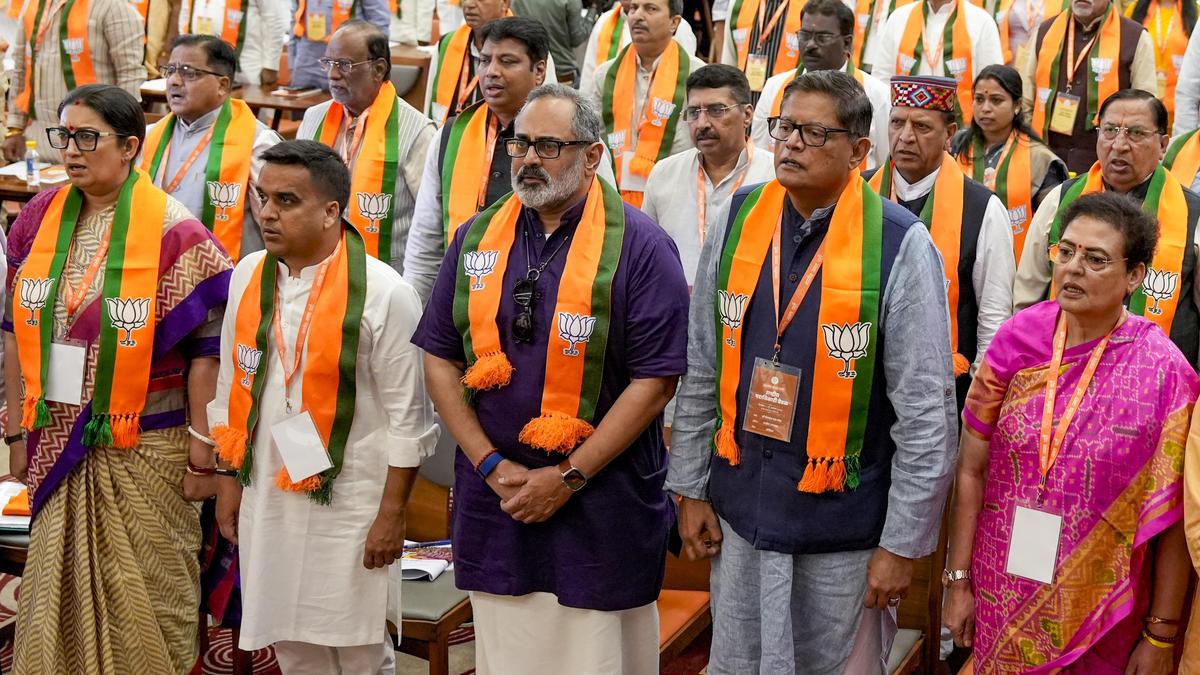

Prime Minister Narendra Modi walked into a meeting of the newly appointed Bharatiya Janata Party (BJP) national office-bearers on August 22. The 64 office-bearers present assumed he would address them on how they should approach their assignments. Instead, he spent the next four-and-a-quarter hours individually querying them on their past organisational work.
The exchange was unhurried, with PM Modi at one point telling the audience that he too was once like them, a national office-bearer of the party during the late Atal Bihari Vajpayee’s tenure as Prime Minister (1999-2004), say some of the new office-bearers.
The identification was interpreted in some quarters as a pep talk to the new team of how far organisational service can take you in the BJP, but for others it pointed to a unifying characteristic in a list of names that otherwise lacked a meta narrative, and instead, in a piecemeal fashion exhibited the political anxieties of the BJP.

This privileging of organisational experience by the Prime Minister was the highlight of the new team. The BJP, now in its third term in power and seeking a fourth in 2029, is, with this new team, attempting a reset amid various political anxieties.
Journalist Shekhar Iyer, who has tracked the BJP for decades, says, “The new team marks a big shift in the party top brass’ approach to the challenges ahead of the 2029 Lok Sabha poll. Increasingly, the BJP is signalling to itself that, henceforth, the chosen men and women will represent less of their individual personality and more of their abilities and capabilities for the tasks to be accomplished.”

“The BJP is signalling to itself that, henceforth, the chosen men and women will represent less of their individual personality and more of their abilities and capabilities for the tasks to be accomplished”Shekhar IyerJournalist
This means the BJP is choosing workers over personalities, some of whom may not be known to the world outside the party. “If they meet the expectations of the top brass, they will move up the ladder faster,” Mr. Iyer says.
The only exception to this weight given to backroom operators is former Union Minister and current general secretary Smriti Irani, whose oratorical skills have been considered valuable.
The only two general secretaries retained from the older team, Vinod Tawde and Sunil Bansal, have had a good run with Bihar and West Bengal respectively, States they were in charge of. Others such as general secretaries Satish Poonia and Biplab Deb, as well as new vice-president Ram Madhav also have a proven track record of behind-the-scenes organisational work in Jammu and Kashmir, West Bengal and Haryana.
The BJP’s anxieties have more to do with the party’s ability to run the election machinery.

The 2024 Lok Sabha polls and its discontents
The new list of office-bearers hides within it attempts to settle the disquiet engendered by the results of the Lok Sabha poll of 2024, which saw the BJP lose its single-party majority.
The unease between the BJP and its ideological mothership, the Rashtriya Swayamsevak Sangh (RSS), stood out during the 2024 election. It became public when the then BJP president, J.P. Nadda, said during an interview that the party did not require the help of the RSS as electoral muscle, adding that the BJP was “saksham” or adequate for the task.
Long-held resentments within the RSS — of the parent organisation being overlooked while its political wing, the BJP, flexed its muscles — burst to the fore, with particularly harmful effects for the party’s prospects in Maharashtra, where the Mahayuti alliance of the BJP, the Eknath Shinde-led Shiv Sena and the Ajit Pawar-led Nationalist Congress Party suffered electoral losses.

Prime Minister Narendra Modi with BJP national president Nitin Nabin and the party’s newly appointed national office-bearers during an organisational meeting at the BJP headquarters, in New Delhi on August 22.
| Photo Credit:
ANI
In the Assembly election in the State later that year, this uneasiness was resolved by a coordination mechanism between the BJP and the RSS. The latter was headed by office-bearer Atul Limaye, who helped deliver a win to the alliance.
The awareness that the RSS and the BJP needed each other to remain in power had been reinforced by the results of the Lok Sabha election of 2024.
The return of Mr. Madhav, first as poll in charge of Jammu and Kashmir in the 2024 Assembly election, the first such poll after it became a Union Territory and after the reading down of Article 370 in 2019, and as vice-president in August 2026 was the second part of this rapprochement.
The understanding within the Sangh Parivar that internal issues should not endanger the government was driven home to the RSS and the BJP. Mr. Madhav, in an interview to The Hindu, described himself as someone who believed in a “middle path”. In this case, he was the halfway meeting point for the BJP and RSS.
Analysis: Why Amit Malviya lost his job as BJP’s social media chief
Insider-outsider
A few months before the BJP announced its new team of national office-bearers, a meeting was held at Defence Minister and former party president Rajnath Singh’s residence.
Those present included not just the new BJP president Nitin Nabin, but also Union Home Minister Amit Shah, party’s general secretary (organisation) B.L. Santhosh, and senior office-bearers of the RSS.
The topic of discussion was how to reconcile the aspirations of old-timers in the party with the flood of newcomers in the BJP since it came to power. This was not a new discussion. In an interview just before the Assembly poll in Assam this year, BJP vice-president and Assam in-charge Baijayant Panda, who was earlier with the Biju Janata Dal, told The Hindu that selectivity in distributing tickets to newcomers was the answer to the conundrum.
The BJP has profited from outside talent, especially since 2014. Three of the party’s Chief Ministers — Himanta Biswa Sarma in Assam, Samrat Choudhary in Bihar and Suvendu Adhikari in West Bengal — have joined the BJP from other political parties.

**EDS: THIRD PARTY IMAGE** In this image posted on Aug. 22, 2026, Prime Minister Narendra Modi speaks during a meeting with newly appointed office-bearers and national functionaries of the party as BJP National President Nitin Nabin and others look on, at BJP Headquarters, in New Delhi. (@narendramodi/X via PTI Photo)(PTI08_22_2026_000557B)
| Photo Credit:
–
In the new team, Rohan Gupta, who joined the BJP from the Congress, and Sandeep Pathak, who came from the Aam Aadmi Party (AAP), have been appointed as national secretaries. They don’t qualify as long-term players within the party, but they do bring in the value of being backroom operators, with Mr. Pathak especially valued for his organisational work for AAP before the Punjab poll of 2022, which AAP had won.
The apprehensions of old-timers in the BJP, who see the party expanding with little reward for themselves, are being soothed by making newcomers do the organisational grind.
All the President’s men
Another issue that arose during the Lok Sabha poll of 2024 was the perception that the organisation’s work was subordinate to that of the government, that the strings of the party were being pulled by a high command, at the cost of the authority of the BJP president.
“Naddaji had been a general secretary in the national team in the past, served an apprenticeship under Amit Shah as the national working president of the BJP in 2019 and his subsequent team gave no inkling of his own personal likes or dislikes,” said a senior office-bearer in the BJP.

BJP national president Nitin Nabin (seen folding his hands) receives a floral welcome upon his arrival to attend the party’s State executive committee meeting, in Haldwani; he is joined by Uttarakhand Chief Minister Pushkar Singh Dhami (left).
| Photo Credit:
PTI
In Mr. Nabin’s case, however, he has had remarkable autonomy in bringing people with whom he shares a good rapport into his team. BJP’s national secretaries Swadesh Singh and Siddharth Shambhu are known to enjoy Nabin’s trust, as does the newly appointed chief of the party’s Scheduled Caste wing, Shivesh Ram.
The new social media cell chief of the party, Deepak Mhaskey from Chhattisgarh, has also been hand-picked by Mr. Nabin, who had worked with him when latter handled the 2023 Assembly poll in that State.
Gen Z protests and social media
It was Mr. Mhaskey’s appointment, replacing long-serving IT cell chief Amit Malviya, that made headlines after the new team was announced. The announcement came on the back of the Gen Z protests against the NEET paper leak, and the pasting that the BJP and the government took on social media throughout that period. That was a departure for a party that had, for the previous 12 years held a tight hold over the narrative, especially on social media.

One reason given for his replacement was the need for the BJP to strategise differently to counter this narrative. At a brainstorming session held soon after the new team’s announcement, with many of its young leaders called in, it was decided not to look at Gen Z as a homogeneous unit. Ami Shah, a political communications professional and visiting faculty member at IIM Bangalore, says that the BJP had hyperlocalised communications in Maharashtra in 2014.
She speaks about having studied the jokes and humour, which were segmented, with people from Vidarbha preferring slapstick humour, while those in Konkan preferred wit.
“The BJP deployed its cultural knowledge of the area effectively in the Assembly poll in Maharashtra in 2014,” she said.
Mr. Mhaskey is supposed to channel these segmented tier-two city and rural sensibilities in the BJP’s communications game, but has had a rough start. Most of his team leaders, Priti Gandhi, Alok Bhatt and Arun Yadav, have had to delete objectionable posts from their social media handles, and some of the content put out by State BJP IT cells and even by the Centre trying to use Gen Z language has turned out to be tone-deaf.
When the new team was announced by the BJP, the party was careful to point out that six of the office-bearers were below the age of 40.
There are 15 between the ages of 40 and 49 and 21 between 50 and 59, bringing the average age of office-bearers to 50 years. More than 40% of the office-bearers come from marginalised communities. Moreover, 12 women from across the country have also made the cut.
The current national team faces the unprecedented challenge of steering the BJP’s efforts to win a fourth term in office in 2029. Apart from the usual distribution of organisational berths to poll-going States, caste groups, and other demographics of gender and age, the new team reflects the BJP’s attempts at a reset as the exigencies of three terms in power kick in.