






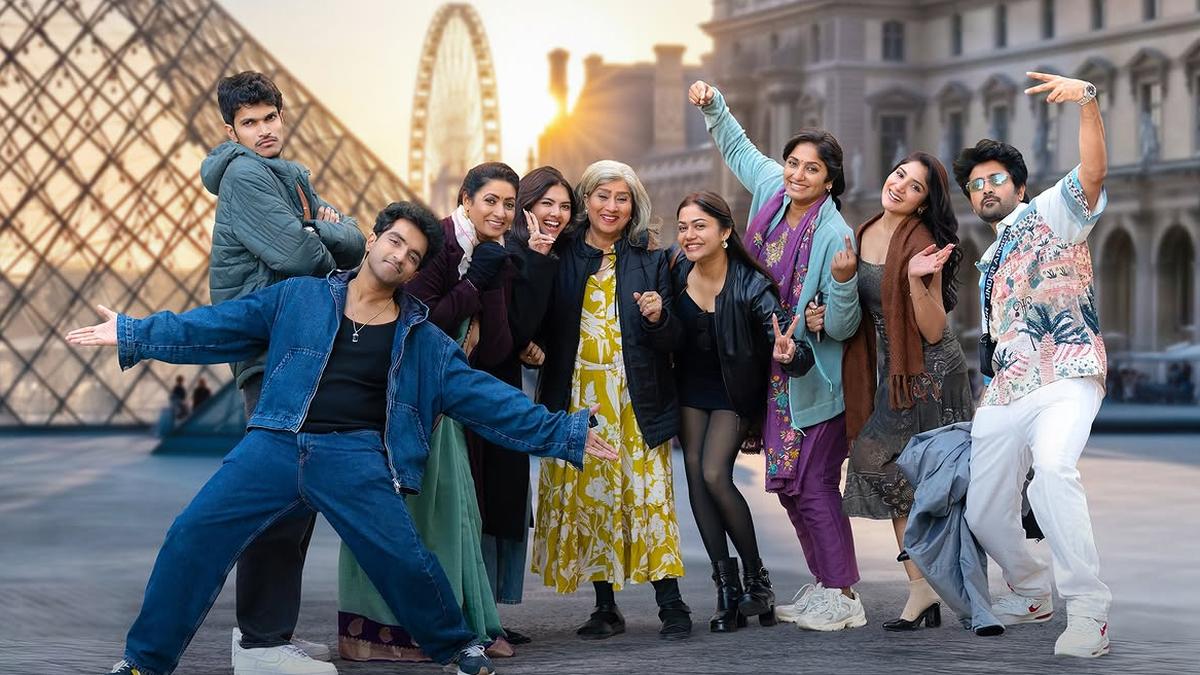

The prospect of a bright, colourful Telugu film about women across age groups and walks of life bonding over a European holiday is like music to the ears. The sheer rarity of such a narrative in an industry that often functions like an all-boys club can make some of us root for it instantly.
After all, an all-woman road film offers abundant room to unpack how these characters view the world while indulging in some mischief. Director Abhiramm Naidu’s film is packed with contrasting characters wanting to set themselves free and forget the voids in their lives, albeit temporarily.
A grandma seeks to tick one box off her bucket list through the holiday. A politician’s wife wants a break from the monotony of caring for her husband day in and day out. A woman on the cusp of a divorce wants some solo time. A mother-daughter duo gets some space to breathe before a big-fat wedding in the family.

Another girl uses the trip as an excuse to meet a man she’s been interacting with on a dating portal. An introverted mother needs the trip to overcome the loss of a loved one and find her way. Some of their quirks and traits are unique, but the film struggles to substantiate the characters effectively.
Happy Journey (Telugu)
Director: Abhiramm Naidu
Cast: Annapurna, Aamani, Jhansi, Vamsi, Payal Radhakrishna
Runtime: 120 minutes
Story: Women from various walks of life rediscover themselves on an all-expenses-paid trip to Europe
Happy Journey lacks a strong hook to bring these women together. The entire tour plan feels vague and contrived, kicked off by out-of-the-blue phone calls about the women winning an all-expenses-paid holiday, from amateur tour organisers who seem to have no real grasp of Europe.
The other sub-plots are equally frivolous. One of the organisers is in a household where the mother-in-law and daughter-in-law tear into each other over a television remote and keep bickering. A sister is obsessed with making video calls to her frustrated Dubai-residing husband.
While the Europe tour takes off, the organiser duo passes off absurd, fabricated stories about key destinations as humour. They hit on French receptionists at a hotel. Perhaps for shock value, the grandma asks for alcohol at every given opportunity. Another woman grabs everything she finds if it is marked free.
A lady keeps calling her husband at odd hours to know the time back in India. The soon-to-be-married girl is frequently chased by her fiancé throughout the trip despite her repeated requests to stop stalking. Vaguely shifting from one location to another, the film is devoid of a firm context to enable their sisterhood.
After this rather clumsy beginning, the film finds its groove from the intermission, when a woman loses her way in France. It fares better when the film isn’t burdened by the pressure to carve out their identities. The space is left open for freewheeling conversations for them to bond, bicker and eventually reunite.

There’s a quintessential folk number set in the middle of a street as the women party and have fun like there’s no tomorrow. A no-holds-barred breakfast sequence has the characters spilling out all the venom in their minds, judging each other for their clothes, relationships and attitudes, and dividing into groups.
In a trope you expect from a film with female bonhomie, the women go from fighting with one another to fighting for one another. The conversation between Jhansi and Annapurna about the masks that women are forced to wear owing to their past traumas strikes a chord.
An aspect that remains quite frustrating is how every key sequence in the film ends with the tour organisers (i.e. men) making vague generalisations about either of the genders. At one point, one of them remarks, ‘Why are the women tearing into one another as if they are in front of a tanker, fighting for water?’
As a fiancé repeatedly tries to strike up a conversation with the bride, the men attribute it to male overprotectiveness, adding that the ‘women won’t understand it.’ When the film sets itself up for a happy ending, they tag women as extremists who fight and resolve problems at the drop of a hat.
Just when it would have been right not to stretch the envelope further, there are dialogues pointing to why family is not a burden, but the backbone in the lives of women. Its conservative take on modern-day dating and divorce doesn’t ring relevant to the times.
Though the film is about women rediscovering themselves through the trip, it fails to address their internalised conservatism and patriarchy. Regardless of the problems, the filmmaker succeeds in portraying their sisterhood, the joys of finding a new family extending beyond their bloodline.

Annapurna, Jhansi and Payal Radhakrishna lend gravitas to their performances and make us empathise with the characters despite the short-handed writing. Aamani gets a raw deal, though Sunaina makes a mark in a role that is in sharp contrast to her usual vivacious appearances.
Vamsi and Ravi Siva Teja’s comedy track is fun but works against the film’s intentions. Subramaniyan Manigandan’s pleasant frames rise above the film’s constraints, and the songs by Shekar Chandra are quite disappointing.
Happy Journey is a mixed bag. As much as the filmmaker and the writer deserve a pat on the back for the central theme and the multifarious characters, the wayward execution and inconsistent writing are a letdown.
Published – September 18, 2026 04:43 pm IST