





Across much of India’s urban development, open space has rarely been a starting point. In fact, it has been what’s left behind: the ground that remains once buildings, roads, parking and infrastructure have claimed their share.
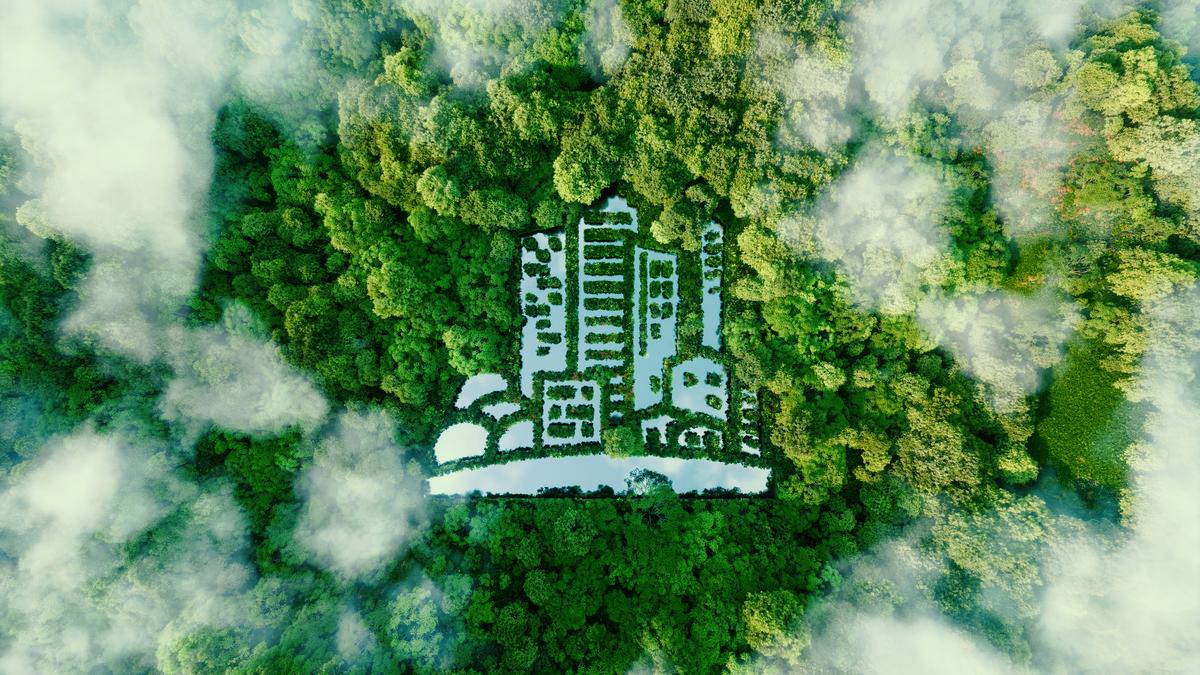
That approach is not sustainable. As cities become denser and climate crises intensify, it is progressively important to reimagine open spaces as an integral part of the planning process, rather than as leftover land around buildings. The shift is from building first and filling the gaps later to designing buildings around the landscape. The distinction is clear, and increasingly urgent.
This is particularly relevant for rapidly growing cities such as Bengaluru. Recent research on Bengaluru’s urban environment found that impervious landscapes recorded land-surface temperatures 2–6°C higher than previous surfaces, underlining the role that vegetation and permeable landscapes can play in mitigating urban heat.
Open area as urban infrastructure
Accessible open space in residential areas has more function than being just a pleasant view. Parks, landscaped areas, courtyards, tree-lined streets, wetlands and other permeable surfaces can contribute to thermal comfort, rainwater management, biodiversity, air quality and opportunities for recreation.
Their distribution matters as much as their quantum. A city can post impressive green cover on paper and still leave most people without a park they can reach on foot if all of it sits fenced off in a few pockets. This makes open-space planning a question of connectivity, accessibility and equity.
The Bengaluru Climate Action and Resilience Plan, for instance, identifies increased access to public open spaces and the proportion of residents within a 15-minute walk of such spaces as relevant measures of urban resilience and liveability.
Private communities must evolve too
The same principle applies to planning neighbourhoods. In residential projects, open areas should not be conceived simply as the percentage of a site left unbuilt. Their quality, location, treatment, and relationship to the built environment are equally important.
A well-planned open space can facilitate movement, fuel social interaction and help inhabitants establish a stronger connection with nature.
This is why low-density planning can be particularly valuable when approached thoughtfully. Fewer buildings create opportunities to think more carefully about orientation, landscape, circulation and the relationship between private and communal spaces. The objective should not simply be to reduce the number of buildings, but to use the resulting space to create a more functional and restorative environment.
From landscape to living structure
The next step is to move away from treating landscape as decoration. Trees, water-sensitive landscapes, shaded pathways and permeable surfaces should be integrated into the masterplan from the beginning, alongside buildings and mobility infrastructure.
This also requires greater attention to what happens beneath the surface. Stormwater management, groundwater recharge and soil health are increasingly important especially in cities experiencing heavier rainfall events and rising temperatures.
Density to be designed
This does not mean that every city should pursue low-density development. India needs compact, connected cities, and efficient land use will remain essential as urban populations grow. The challenge is to distinguish between density and overcrowding.
Ideas to build around nature should begin during the design phase. It should influence land planning, orientation, building placement, landscape strategy, water management and mobility rather than being addressed after the built footprint has already been determined.
For cities, the same principle applies at a larger scale. Public parks, ecological corridors, lakes, pedestrian networks and neighbourhood open spaces need to be planned as interconnected systems rather than isolated parcels.
India’s urban growth will inevitably bring greater density. The answer is not to resist that growth, but to make it more intelligent. Open space is part of that intelligence. When planned well, it supports climate resilience, ecological health, social interaction and everyday well-being.
The future of urban development should therefore not be measured only by how efficiently we build. It should also be measured by how thoughtfully we create the spaces between what we build.
The writer is founder & CEO of White Lotus Group.
Published – September 18, 2026 06:14 pm IST