






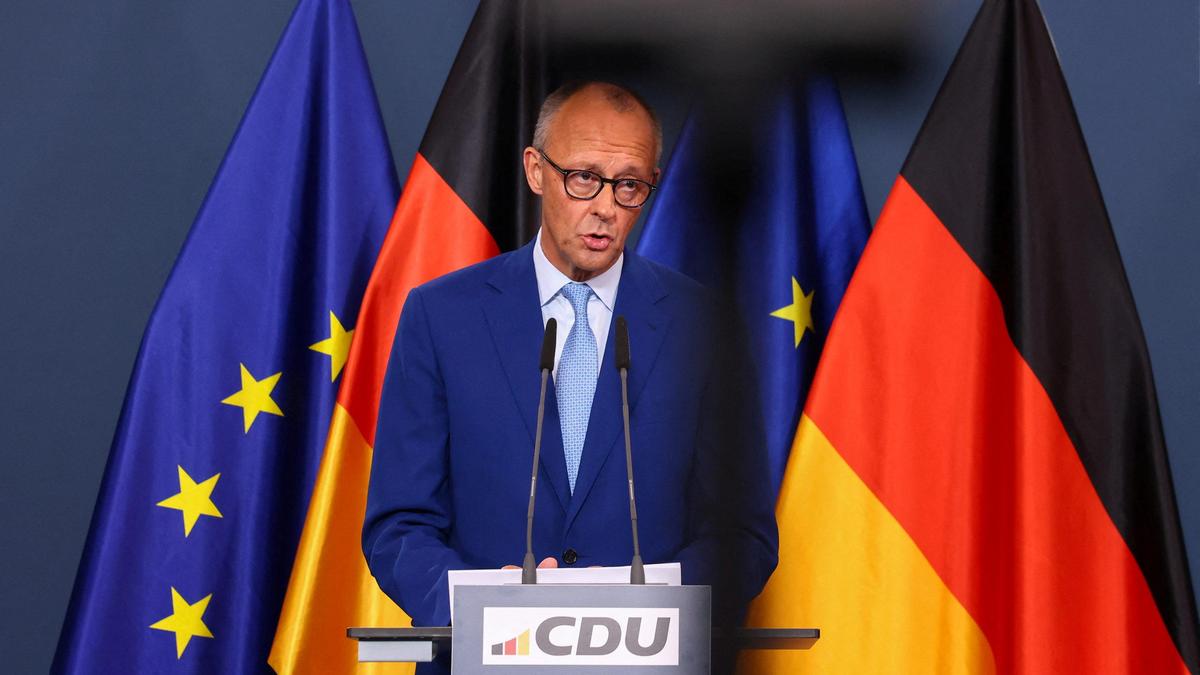

German Chancellor Friedrich Merz was clinging to power on Monday (September 21, 2026) after his conservative Christian Democratic Union (CDU) suffered its worst regional election defeat in post-War Germany, and members of his coalition clashed over his unpopular reform agenda.
Mr. Merz himself described the loss on Sunday (September 20, 2026) in the northeastern state of Mecklenburg-Western Pomerania as a “disaster”, as his party missed the 5% threshold for entering a state parliament for the first time.
The far-right Alternative for Germany (AfD) came first. While it fell well short of a majority, it was the second time within a month that the party had topped a state election, which it sees as building momentum towards national power.

Mr. Merz’s party also lost votes in a second election, in the state of Berlin, where the far-left Die Linke party, whose roots lie in the Communist party that once ran East Germany, could take power in a coalition after winning the most seats.
German Chancellor’s future in the balance
The results may not prove a knockout blow for Mr. Merz, but his low approval ratings, unpopular reforms and the AfD’s surge have left his future in the balance.
Several conservative state premiers met on Sunday (September 20, 2026) to take stock, after publicly backing Mr. Merz in an open letter last week.

“The meeting was not about a revolt or a plot against Chancellor Merz,” one of the participants told Reuters. “However, there was agreement that the Chancellor needs to deliver more following the CDU’s difficult results in the state elections.”
Within minutes of the results coming in, Mr. Merz vowed in televised remarks to press on with his reform agenda, which he says is vital to revive sluggish growth in Europe’s largest economy and keep it globally competitive.
But members of the centre-left Social Democratic Party (SPD), his coalition partner, pushed back. They include Manuela Schwesig, the incumbent Premier of Mecklenburg-Western Pomerania, who has sharply criticised the federal government’s pension reforms.
Ms. Schwesig said she was “very irritated” by Mr. Merz’s remarks. “I think more humility is actually called for on the part of the Chancellor,” she told the broadcaster ARD.
Bitter pill for Germany’s immigrant communities
The AfD leads national opinion polls but has been kept from power by the refusal of the other main parties to work with it, in a policy known as the “firewall” that has come under increasing scrutiny as the party gained strength. Its hardline stance on immigration has left some people of migrant background in Germany questioning their future.

Yasmin Goudarzi, an educational scientist who attended an election event hosted by a migrant organisation in Schwerin, the capital of Mecklenburg-Western Pomerania, said: “The fact that the AfD is in the lead is quite a bitter pill to swallow.”
In Berlin, Die Linke topped a state election for the first time, on a campaign to nationalise housing from corporate landlords and put a cap on rents, echoing the rise of New York Mayor Zohran Mamdani.
Elif Eralp (45), Die Linke’s lead candidate and the daughter of left-wing Turkish parents who fled a coup in Turkiye in 1980, said: “From today, we’re changing Berlin together.”
Mr. Merz, who was elected in 2025 on a promise of reforms to return Germany’s stagnant economy to growth, has struggled to win over voters, as a stream of communication missteps compounded resentment over unpopular pension, tax and healthcare reforms.

Disillusionment with his government has hung over the campaigns in both Mecklenburg-Western Pomerania and Berlin, where voters have focused on soaring energy and housing costs.
Ms. Schwesig, sometimes seen as a potential next national leader of the SPD, is likely to remain in power in the state.
Detlef Spelker, a passer-by in Schwerin, said: “Yes, I would have imagined a different outcome as well because, let’s say, the troublemakers who voted for the AfD clearly weren’t paying attention in history class.”
“We’ve been in a similar situation before, almost 100 years ago. Inflation, problems with jobs, nobody had any money. We’ll see what this brings now. I don’t know whether they’ll deliver,” he said.
Published – September 21, 2026 04:54 pm IST