






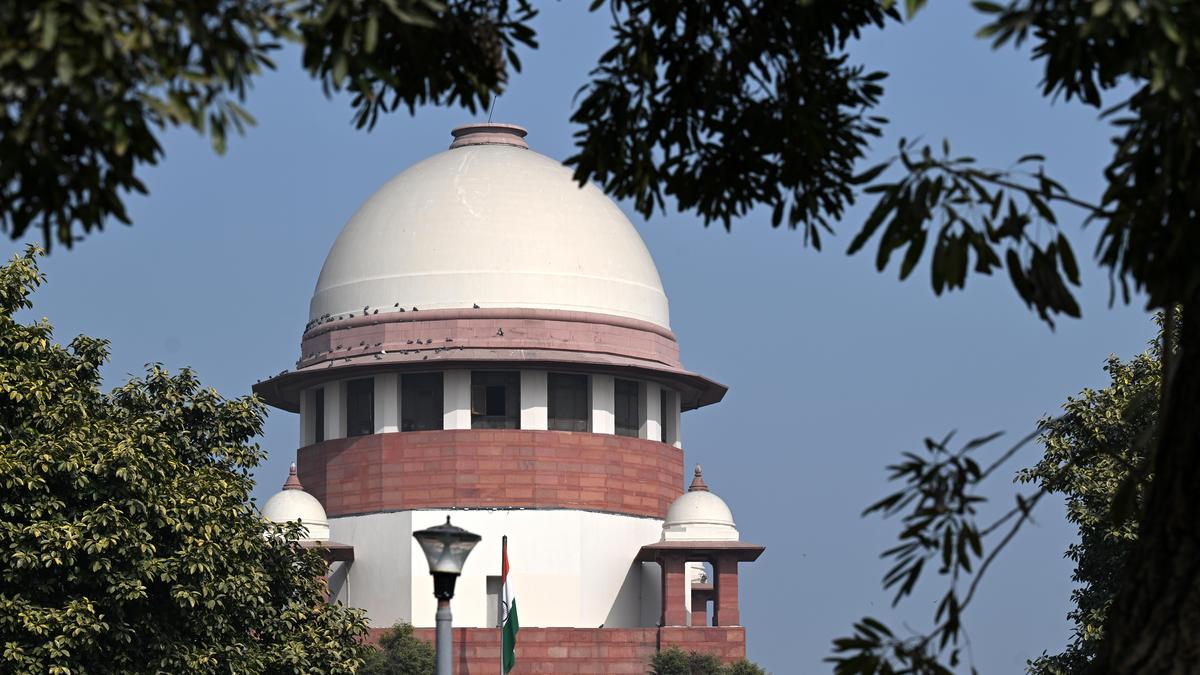


The Supreme Court also exempted Meeran Haider from appearing before the police station on his wedding day and on October 24, 2026. File
| Photo Credit: Shashi Shekhar Kashyap
The Supreme Court on Friday (September 25, 2026) partially relaxed a select bail condition for 2020 Delhi riots accused Meeran Haider, reducing his mandatory police station appearances from twice a week to once a week. The relief comes ahead of his scheduled wedding on October 17.

The court also exempted his appearance before the police station on his wedding day and October 24.
The short hearing before a Bench headed by Justice Aravind Kumar witnessed Additional Solicitor General S.V. Raju crack a “light-hearted” comment that “he [Haider] can get married at the police station”.

Senior advocate Siddharth Aggarwal, appearing for Haider, vocalised his objection to the comment made by the law officer appearing for the NCT of Delhi, the respondent in the case.
“Mr. Raju is right. He is saying that police stations are now equipped to conduct marriages [weddings] also,” Mr. Aggarwal explained to the Bench, which did not catch the comment.
Mr. Raju downplayed his comment, explaining that it was only said in a lighter vein. “My learned friend is serious all the time. He should be jovial also sometimes,” he remarked.

Mr. Haider said he was facing a lot of hardship due to a bail condition requiring him to mark his attendance twice a week, on Mondays and Thursdays between 10 a.m. and noon, before the jurisdictional Delhi police station. His counsel said the condition was affecting his attempts to get employment as these were both working days.
The court, after Mr. Raju fairly expressed no objection, modified the bail condition to permit Haider to mark his attendance at the police station every Saturday at the same time.
Justice Kumar, speaking for the Bench at the very outset, said the court would not budge on Haider’s plea to relax other restrictions imposed in the bail order, including a complete ban on his attending or speaking at any public function or rally, whether physically or virtually, till the conclusion of the trial. Haider, along with his co-accused, had also been prohibited from circulating any post, handbills, posters or banners either in electronic or physical form.

On January 5, the Supreme Court had granted bail to Mr. Haider, along with activists Gulfisha Fatima, Shifa Ur Rehman, Mohd Saleem Khan and Shadab Ahmad in the 2020 Delhi riots conspiracy case and imposed conditions while emphasising that any misuse of liberty would attract cancellation of bail.
The Supreme Court, in the same decision, had refused bail to former JNU student leader Umar Khalid and Sharjeel Imam. The duo had been incarcerated since 2020. They were allowed to file fresh bail applications after the examination of protected witnesses or after a year.
The February 2020 riots in northeast Delhi broke out during protests against the Citizenship (Amendment) Act (CAA) and the National Register of Citizens (NRC), leaving 53 people dead and more than 700 injured.
All the accused were booked under the stringent anti-terror UAPA and the provisions of the Indian Penal Code for allegedly being the “masterminds” of the riots.
Published – September 26, 2026 05:37 am IST