


Saina Nehwal chuckled when asked if the 3×15 scoring system, set to come into force from January 2027, could tempt her to return to the badminton court.
In theory, Saina, at least at her peak, would have revelled in this abridged format. Her natural attacking flair, speed and ability to close out games would have made her a neat fit.
While this could make for a good debate over coffee, the reality is quite different. At 36, and having gone through the intense grind of the professional tour for nearly two decades, Saina is unable to meet the physical demands of the sport.
“I wish I could come back, but I have total cartilage damage,” she said during a virtual interaction. “My knee is in a seriously bad shape. I cannot push for more than half an hour. But yes, I really do want to play.”
Saina believes that her contemporary P.V. Sindhu will benefit from the new rules. Sindhu, 31, maybe in the final stages of her career, but has plenty of fight left. In July, the double Olympic medallist served a reminder of her class by becoming the first Indian to win the Japan Open.
Merits and demerits
“The good thing is that Sindhu has the best physiotherapist and trainer. This is really helpful. Her court movement is very good,” Saina observed.
“From next year, when the points system shifts to 3×15, matches will get shorter. You will get a lot of recovery time between fixtures. There are big breaks between Super 1000 tournaments too, which guarantees good rest periods.
“Careers will extend longer because the matches are shorter. Any player can win tournaments in that scenario,” the two-time World championships medallist added.
Saina, the first Indian woman to reach the summit in the World rankings, added a note of caution regarding training regimens.
“The new scoring system will tilt the game towards power and speed. But when you train for power and speed, chances of getting injured are higher. If Sindhu can take care to avoid injuries, she can play for a long time,” she opined.
Looking at the talent that has emerged after Saina and Sindhu, there remains a gap in quality. The likes of Unnati Hooda and Tanvi Sharma have registered some impressive wins, but are not yet world-beaters in the class of their seniors.
“In terms of attitude and skill, Tanvi and Unnati have a very bright future. They have gained experience and produced results. Devika [Sihag] and the other players need to improve a bit more.
“There are challenges – how do you make a comeback from a loss? How much do you train on a regular basis? Are you ready to push yourself and not give up? As far as I have seen, Tanvi and Unnati don’t give up. They keep fighting. They have the best coaches too. Tanvi is training under Park [Tae-sang], while Unnati is training with her father,” Saina stated.

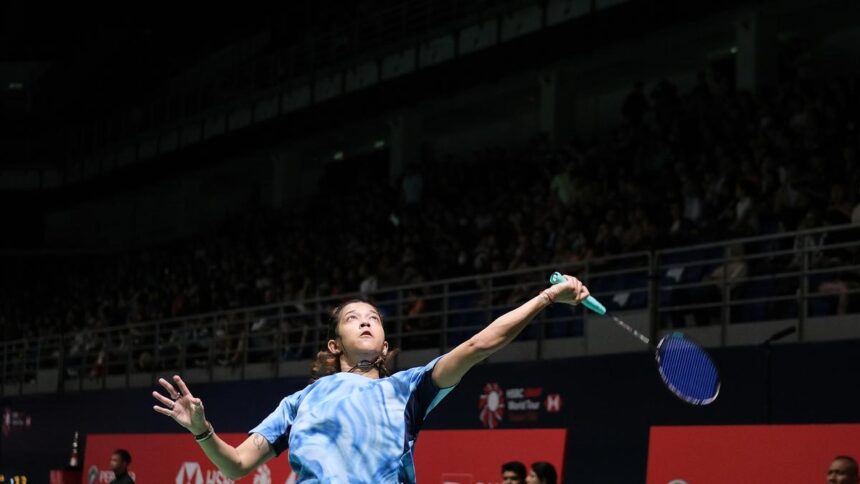
Far from finished: With badminton set to shift to a shorter 3×15 scoring system, Saina feels double Olympic medallist P.V. Sindhu can extend her career
| Photo Credit:
PTI
As for the best in the world, Saina rates 2024 Paris Olympics gold medallist An Se-young as a “once in a generation” player. She had taken on the South Korean when the latter was a promising youngster, sharing the spoils with a 1-1 head-to-head record.
“An can rally very well, and the improvement now is that she dives well to pick up shots. She has also improved the speed of strokes. She is not the fastest player, but she has fast strokes and her court coverage is very smooth,” Saina said.
And then there is the 24-year-old’s intense drive – a trait Saina views as key.
“Even after having won the Olympic gold and so many titles, you can still see that hunger to win. When she lost recently, you saw her crying. A player with that sort of desire is tough to defeat.”
Against the odds
The 2012 London Olympics bronze medallist is of the opinion that with cricket taking centrestage in India, athletes in other sports must stay at an elite level to gain recognition.
“In India, the problem is that if you perform in any sport apart from cricket, you don’t get much importance unless you win tournaments. Tanvi and Unnati have won tournaments, and that’s why everyone is talking about them. You have to show results and win consistently. That is when you get popular in this country.”
Saina, who is serving on the expert panel of Sony Sports Network for its coverage of the 2026 Asian Games, is hopeful that the hype around the Indian cricket teams will not overshadow other disciplines at the multi-sport extravaganza.
“I will be happy as long as medal winners from other sports are [also] celebrated. We expect the Indian cricket team to win medals at the Asian Games and the Olympics. But this could mean that medallists from other sports might feel bad if they don’t receive the same encouragement as the cricketers.
“I have a feeling that [even] if they (non-cricket sportspersons) win a gold medal, they will get sidelined. In that scenario, I will feel bad because only cricket gets the support,” Saina explained.
The Padma Bhushan awardee reflected on the challenges she faced during her playing career, especially when it came to getting the attention of the general public.
“I had to win multiple Super Series titles in a year to be there [in the spotlight]. Just one Super Series victory was not enough. I had the motivation to win an Olympic medal, and to become the World No. 1. The victories helped me appear in newspapers, and people started to notice me.”
Guts and glory
Her groundbreaking achievements were marked by self-improvement and dedication to the sport.
“I worked on improving myself every day – listening to my coaches, thinking about how to prepare for the next tournament, staying injury-free… I had big goals for myself, which is why I was able to win at Super Series events and the World championships,” Saina stated.
“Having said that, I also feel sad that after winning 24 international titles and an Olympic medal, many people confuse me with tennis player Sania Mirza.

Full of potential: Saina credits Unnati Hooda, India’s second highest-ranked women’s singles player after Sindhu, for having the requisite skills and right attitude
| Photo Credit:
SHIV KUMAR PUSHPAKAR
“I am sure that about 70 to 80% of girls in India do not know anything about the world of sports. We have to find out how we can promote sports. I am not against cricket, but other sports cann ever overtake cricket unless athletes keep winning at the highest level.”
Saina emphasised the role of a stable support system, starting with good parenting.
“To win even a couple of Super Series tournaments is very, very challenging for Indian players. If there is no financial support, we should not expect to win a single title.
“When my parents took the risk to support my badminton dreams, they did not think much about the great financial rewards I may get. They just wholeheartedly supported me, and luckily I could come back with so many good results. But how many parents can do this? It’s not that easy.”