


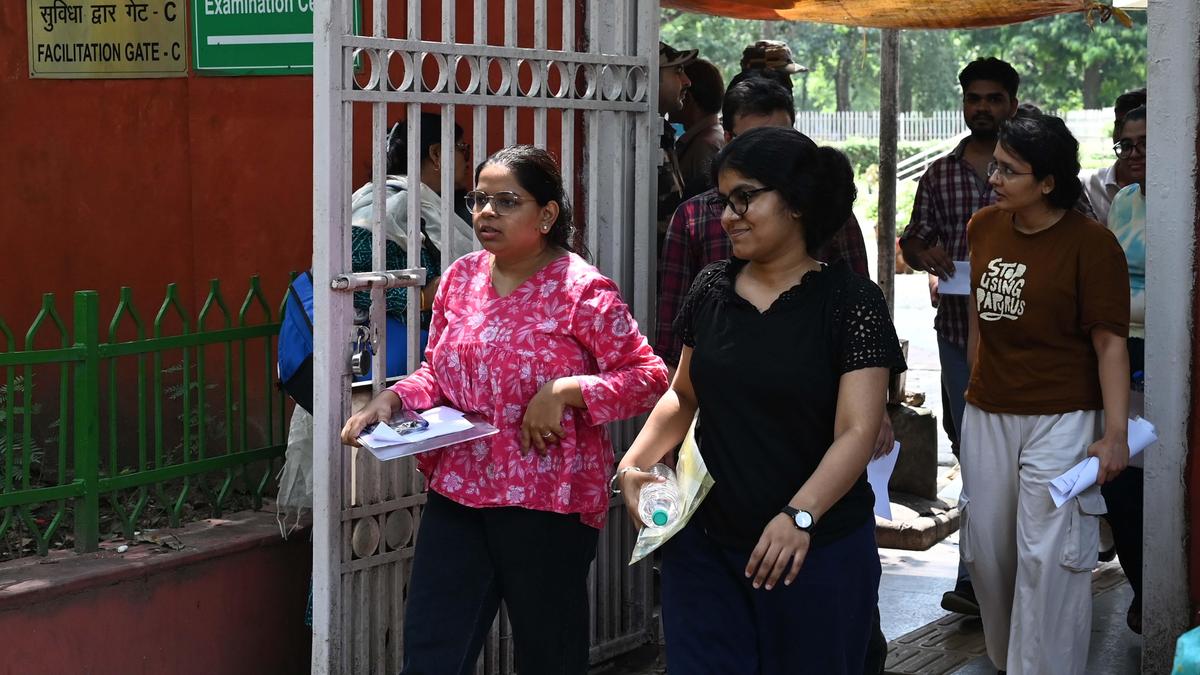


Aspirants leave a UPSC 2026 exam centre in New Delhi.
| Photo Credit: Sushil Kumar Verma
At least 27 questions in this year’s Civil Services Examination (CSE) Prelims, across general studies and aptitude papers, have come under dispute, with candidates claiming that the answers in the Union Public Service Commission’s (UPSC) provisional answer key are either incorrect, have no correct answer or allow more than one possible answer.
At least two groups of aspirants have challenged the questions in court. One group of four candidates have challenged eight questions, while another group of 63 aspirants have challenged 27 questions, including the eight challenged in the first petition. The cases are being heard by the Central Administrative Tribunal (CAT).
On September 9, the Tribunal issued a notice to the UPSC regarding the 27 questions. The two cases will next be heard together on October 8.
The preliminary examination was held on May 24, and the provisional answer key was uploaded three days later. In June, candidates were informed whether they had qualified for the Mains examination, which was held in August. The examination has three stages—Preliminary, Mains, and interview.
In their petitions, the candidates argued that many of them missed the cut-off for the Mains examination by only a few marks. The aspirants, who did not wish to be identified, said that a disputed answer is rarely just about one question, as it can render a candidate ineligible for the Mains examination, cost them an entire year of preparation and, for those appearing in their final attempt, potentially end their chances of qualifying.
Questions under aspirant scanner
Among the questions cited by the aspirants was one on the Grand Slam tennis tournaments. They claimed that the answer accepted in the provisional key “omits a ranking threshold that the tournaments’ own rulebook makes explicit for entry”.
Another disputed question concerned the “Zero FIR” procedure under the Bharatiya Nagarik Suraksha Sanhita, 2023. The candidates alleged that the Hindi version uses a word closer to “investigation”, while the English version says “preliminary inquiry”. They said that the legally correct answer depended on “which language a candidate reads the paper in”.
‘Contradicts govt sources’
Aspirants also flagged at least four questions relating to the Rigvedic period, saying only one of them could be easily traced to textbooks they usually study.

One of the 27 disputed questions was about Indian agriculture and well irrigation during the Rigvedic period. The question contained two statements, and the candidates were asked to pick the supporting statements given below. The aspirants claimed that the answer they considered correct contradicted the option provided in the provisional answer key.
The question stated that there was evidence from the Rigvedic period of the use of “ashma chakra” and “ahava” (strapped wooden pails) to draw water. According to aspirants, however, the Ministry of Culture’s website states that “ahava” is a trough. They claimed this led candidates to a “narrower reading” of the question and to an answer that “goes against established facts in source material”.
Another aspect of the same question, the aspirants alleged, contradicted information on the National Council of Museums’ website.
They said, “The issue may appear obscure, but that is precisely the point: when an examination tests candidates on highly specific factual distinctions, the answer key itself must meet the same standard of precision.”
Published – September 26, 2026 06:20 pm IST