





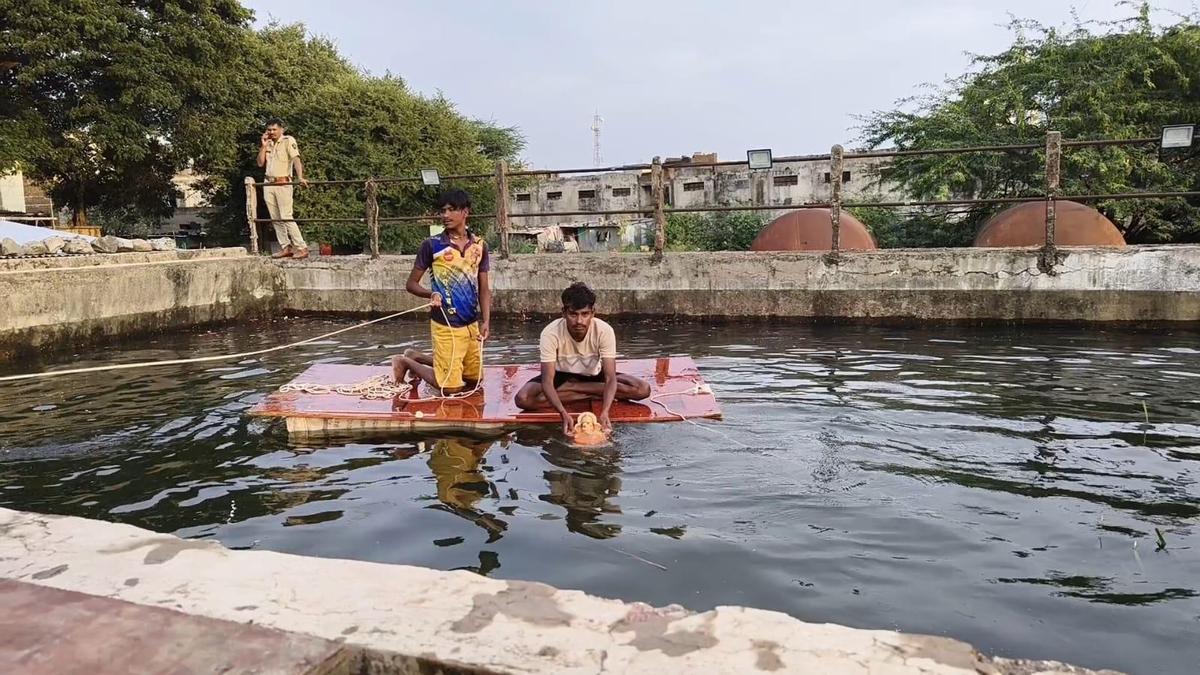


An artificial water tank created by Kalamb civic body in Dharashiv district to immerse Ganesh idols.
| Photo Credit: Special Arrangement
The vibrant beats of dhol-tashas and chants of ‘Ganpati Bappa Morya’ faded into a sobering reality across Maharashtra this week as the 10-day annual Ganesh festival concluded on Friday and the State government on Saturday declared drought in 265 of the 358 talukas, including several parts of the Marathwada and Vidarbha regions.
In Kalamb town, Dharashiv district (Marathwada), the local administration scrambled ahead of idol immersion day. Because the local Manjara river and surrounding water bodies were completely dry due to a glaring monsoon deficit, civic authorities had to resort to filling temporary ponds using water tankers. For idols taller than four feet, desperate pleas were made to reroute processions to a nearby stone quarry holding residual water.
“We didn’t even have water to immerse the idols. You can only imagine what is going to happen until the next monsoon,” said Balaji Adsul, a Kalamb resident.
The crisis extends far beyond a single town. According to India Meteorological Department data, 20 out of 36 districts in Maharashtra have recorded deficient rainfall. The severity is starkly reflected in reservoir levels. Marathwada dams are currently sitting at just 46% capacity compared to 81% at this time last year, while those in Amravati division in Vidarbha hace dropped to 64% from 85%.

A stone quarry in Kalamb holding residual water was used to immerse Ganesh idols.
| Photo Credit:
Special Arrangement
Faced with fast-depleting reservoirs, G. Sreekanth, Divisional Commissioner of Chhatrapati Sambhajinagar, a division covering eight Marathwada districts, had urged Ganesh mandals to avoid traditional water immersions entirely, suggesting instead that idols be donated, saved for the following year, or subjected only to symbolic immersion.
However, the appeal found little resonance among tradition-bound communities. In Renapur taluka of Latur district, frustration boiled over when one Ganesh mandal carried their large idol directly to the tehsil office, asking where was the water to immerse the idol.
“The situation here is grim, though some water in the Wardha river allowed for idol immersions,” said Madhuri Khadse, a farmer from Yavatmal in Vidarbha. “We have submitted a memorandum to the District Collector urging immediate aid for farmers to prevent a surge in suicides.”
Meanwhile, in Amravati, the local civic body deployed numerous water tankers to ensure Ganesh mandals had enough water for idol immersions.
Parched rites
As festivities fade and crops wither in parched fields, thousands of farmers across Maharashtra are urgently seeking relief.
The crisis extends far beyond agriculture, deeply affecting personal and cultural lives. Sominath Gholwe, a farmer and social science researcher from Beed, highlights how severe water shortages force families to rely on tankers even for sacred rituals like dashkriya vidhi (the tenth-day funeral rite). “One of my relatives in Pathardi (Beed) passed away. We had to bring water via tankers from borewells, store it in a well, and then perform the rites,” he said.
With rivers entirely dry and groundwater depleted, signs reading ‘Water tankers for dashkriya vidhi available here’ have become a grim reality across Marathwada. Having travelled through five districts in the region, Mr. Gholwe notes that 85% of crops have failed, creating a dire humanitarian situation.
“This is a big drought. The State government has earlier waived off loans and electricity bills. Now we will pay compensation in cash. We will ensure they get water, foodgrains and children continue their education,” said Chief Minister Devendra Fadnavis while touring the drought region in Marathwada earlier this week
Published – September 27, 2026 12:44 am IST