




Representational image only. File
| Photo Credit: ANI
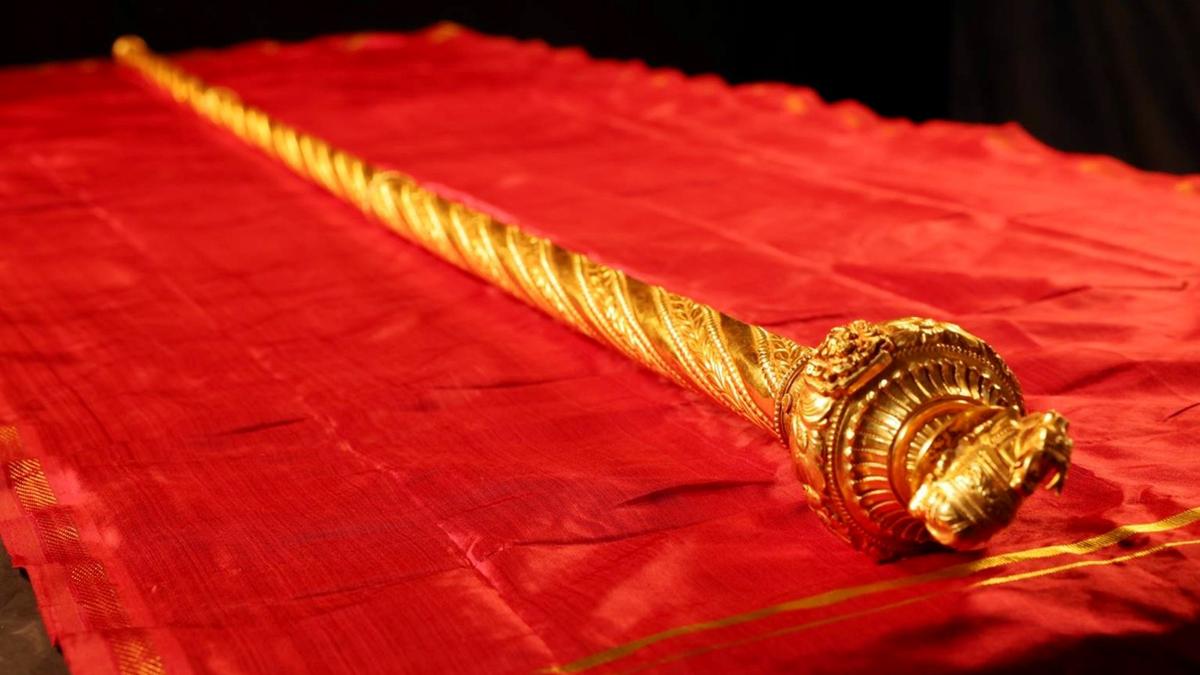
The Bharatiya Janata Party (BJP) government’s claim that Sengol, which is a sceptre anointed by Hindu religious leaders, marked the transfer of power in 1947 when India became independent, finds a mention in the National Council of Educational Research and Training’s (NCERT) newly released Class 9 social science textbook.
The new textbook ‘Understanding Society and Beyond – Part 2’ states, “The Sengol, a cultural marker of rulership and good governance, was placed in India’s newly inaugurated Parliament building in the year 2023 by Prime Minister Narendra Modi. The tradition of using the Sengol as a mark of righteous governance began more than a thousand years ago during the reign of Chola dynasty,” the textbook reads.

“To mark the occasion of India’s Independence, at the stroke of midnight on 15 August 1947, the first Prime Minister, Jawaharlal Nehru, received the Sengol from the Adheenam saints (an old Shaivite tradition) of Tamil Nadu,” it states.
Ethical responsibilities
Describing the Sengol, the website of the Union Ministry of Culture states, “Once integral to the coronation rites of Tamil monarchs, the Sengol was not merely a ceremonial object but a profound testament to the ethical responsibilities bestowed upon a ruler. This sacred tradition was momentously revived on the eve of India’s independence in 1947, when a Sengol was solemnly presented to Pandit Jawaharlal Nehru. It marked the ‘civilisationally rooted,’ transfer of authority from colonial rule to a sovereign Indian state.”

This theory has been contradicted time and again by experts. For instance, historian and biographer of C. Rajagopalachari (Rajaji), Rajmohan Gandhi has earlier stated in public domain during the inauguration of the new Parliament that there is no record or mention of the Sengol serving as a formal symbol of the ‘transfer of power,’ in the personal papers, letters or autobiographies of either Jawaharlal Nehru or Rajaji.
Historian Aditya Mukherjee had also criticised the 2023 ceremony and the installation of the Sengol stating that the event was an effort of political self-glorification rather than celebrating parliamentary democracy.
Also, the textbook states that India’s national motto — Satyameva Jayate — is linked to Mundaka Upanishad replacing British-era ‘Heaven’s Light, Our Guide.’

The textbook also states that the Supreme Court’s post-independence motto Yato Dharmastato Jayah, which translates into ‘Where there is righteous duty, there is victory,’ is linked to the epic Mahabharata. This is stated in the chapter — ‘Governance and Public Policy,’ of the new textbook.
The chapter also links Mahatma Gandhi’s reference to Ram Rajya, which is an ideal governance structure based on probity, transparency, compassion and welfare to the Ramayana and 16th century literary work of Ramcharitmanas, calling these two texts as ‘examples of good governance and good collective life.’
‘Sacred responsibility’
The textbook also states that from the Vedic period to the Ramayana and Mahabharata, Indian traditions viewed governance as a ‘sacred responsibility,’ rather than merely a means of exercising power.
The chapter also states that colonial powers imposed their models of governance on societies which had previously followed ‘local and organic systems,’ and that many colonial institutions have continued post-independence.
In another chapter titled ‘Resistance and Resilience,’ the textbook states that many kings and princes are believed to have received swords from goddesses such as Kali, Durga and Bhavani to resist invasions since the 7th century.
“Annamaraja, ruler of Bastar is believed to have received his sword from Manikyadevi (Danteshvari) while Kumara Kampana (Vijayanagara) was believed to have used a goddess-given sword against the Sultanate forces at Madurai. Similarly, Shivaji is also traditionally believed to have obtained a sword from goddess Tulja Bhavani,” states the chapter.
Published – September 30, 2026 08:45 pm IST