






The story so far: In mid-September, a Bengaluru motorist was issued an online traffic violation challan. When he checked the Bengaluru Traffic Police’s e-challan website, he found that he had been issued a challan for pillion riding without a helmet, even though he had no pillion on his scooter. Soon, he realised the reason: he had been wrongly flagged by the BTP’s Artificial Intelligence (AI)-based violation flagging system for the guitar strapped to his back, which was mistaken for a human.
A senior traffic police officer explained to The Hindu that it was a judgement error by the AI camera, part of the BTP’s Intelligent Traffic Management System (ITMS), which subsequently went through a manual review. However, a challan was issued due to human oversight as well.

The incident raised questions and triggered debates online about the accuracy of AI systems and the shortcomings of using AI in smart policing and rule enforcement. The BTP says that striking a balance between AI systems and human intervention yields the best results, while also acknowledging that certain anomalies will occur.
How are challans raised?
The BTP raises contactless challans using three different systems: through ITMS, Field Traffic Violation and Regulation Analytics (FTVR), and through Public Eye.
The ITMS was adopted in Bengaluru in December 2022 to minimise human intervention in issuing challans and to deploy more officers for traffic regulation. The ITMS uses AI and machine learning to automatically detect traffic violations, and the feed is sent to the Traffic Management Centre (TMC), which is the BTP’s head office.
The FTVR system involves traffic police officers capturing pictures of violators or vehicles in violation of traffic rules and raising a challan online. Public Eye is an option for citizens to take pictures and upload them on the BTP application anonymously.

Image of the two-wheeler rider in Bengaluru, who was slapped with a helmetless riding challan after the AI camera for traffic rule enforcement mistook the guitar for a pillion rider.
| Photo Credit:
The Hindu
What is the accuracy?
Karthik Reddy, Joint Commissioner of Police (Traffic), claimed that the AI system (ITMS) with minimal human intervention has nearly 99% accuracy and that wrong flagging is negligible.
The Hindu reviewed the Actionable Intelligence for Sustainable Traffic Management (ASTraM) data, an initiative of the BTP that uses AI for traffic management, according to which the BTP issues an average of nearly 26,500 challans through contactless means every day, of which over 19,000 challans are generated after identifying violations through Artificial Intelligence (AI) cameras. Of the average 19,000 challans, 25 cases, or 0.13% of cases, are challenged every day.
But the 0.13% challenge rate cannot be treated as a measure of AI accuracy.
Mr. Reddy explained that once a violation is detected by the ITMS, a team at the Traffic Management Centre (TMC) reviews the violation flagged by the system, after which a challan is generated.

Another senior officer, however, explained that after filtering the data for cases rectified by the team manually reviewing the violations, the AI accuracy could drop to about 90%. By the end of 2023, the BTP had identified that the system’s accuracy had dropped to 80%, especially in certain violations such as pillion riding without a helmet, seatbelt violations and signal jumping. However, over the past two years, the accuracy level has been scaled up.
“Despite machine learning and constant feeding of data having improved the system, we need human intervention, at least to verify some aspects. We cannot completely rely on AI,” he said, highlighting the limitations of the system.
For instance, he explained that at several junctions where ITMS cameras are installed, the zebra crossing line has faded, and motorists tend not to notice it. However, even a minor inconsistency like that is flagged by the ITMS.
“These violations are not actively booked by us, because in many cases civic bodies would be at fault for not painting zebra crossing lines. In such instances, human intervention is necessary,” he explained.
Mr. Reddy, however, said that FTVR flaggings are challenged more than the ITMS flaggings. He said that many times officers take pictures of violations that occur at places where there are no traffic signs, so those cases have to be dismissed if objected to.

What are the violations flagged by ITMS?
The ITMS can flag over 10 violations but predominantly identifies eight. This includes riding without a helmet, pillion riding without a helmet, driving without a safety belt, jumping a traffic signal, defective number plate, using a phone while driving, no entry, and triple riding.
According to ASTraM data, among contactless challans issued in 2026, 29% of the cases were related to riding without a helmet, 21% to wrong parking, while pillion riding without a helmet and jumping a traffic signal accounted for 14% each. Another 6% were for driving without a seat belt, with the rest pertaining to other violations.
Among contact challans, 38% of cases pertained to no entry (one-way), 12% to wrong parking, and 7% each to riding without a helmet and pillion riding without a helmet.

Artificial intelligence (AI)-enabled traffic enforcement camera in Bengaluru on September 27, 2026.
| Photo Credit:
ALLEN EGENUSE J
According to traffic police sources and previous requisitions assessed by The Hindu, among the erroneous flaggings by ITMS, most are related to wearing helmets and jumping traffic signals.
For example, if a motorist takes off their helmet for a prolonged period while waiting for a signal to turn green, the system is likely to flag it as a violation. Similarly, there have also been cases where, at some junctions, right turns are paused after a brief period while driving straight is allowed. In such cases, commuters have challenged the ITMS for wrongly identifying them as jumping a signal despite driving straight.
There have also been cases where number plates are flagged as faulty because of variations in fonts. Individuals wearing black shirts, with the colour frequency closer to that of a seat belt, have been flagged as driving without a safety belt despite having fastened their seat belts.
The BTP, however, is attempting to improve the accuracy of the system while also acknowledging that there are limitations in collecting enormous amounts of data for specific aspects, such as the seat belt matching the colour of the shirt. Therefore, achieving 100% accuracy becomes a very long process, BTP sources explained.
Fancy being a traffic cop for a day in Bengaluru?
The Hindu reporter gets an opportunity to man one of Bengaluru’s busiest traffic junctions during the morning peak hour. This is Bengaluru Traffic Police’s new initiative ‘Be a Traffic Cop for a Day’.
| Video Credit:
The Hindu
Can wrong flaggings be challenged?
Yes. The BTP’s ASTraM application offers multiple services, including planning a commute route, e-FIRs, and paying traffic fines, among others. Citizens can check challans issued against their vehicles on the application, along with images either taken by the police, uploaded by citizens, or captured by ITMS cameras.
For each violation flagged, the system allows citizens to raise a dispute and provide a detailed description explaining why it is erroneous. In addition, the BTP allows citizens to raise objections on the BTP website. Citizens can also dispute a challan by email or by visiting a Traffic Management Centre (TMC) in person.
What is the extent of contactless (tech-based) issuing of challans?
Around a whopping 7.9 lakh contactless challans are issued every month, accounting for 87% of the BTP’s total challans. In comparison, only around 1.05 lakh challans are issued through physical interception each month, against a monthly total of 9–9.1 lakh challans.
However, this also shows a change in the approach of the BTP. When ITMS was introduced in 2022, one of its objectives was to curb manual checking, which often led to complaints of harassment. The same year, several accidents were also reported while commuters tried to avoid being caught by traffic police.

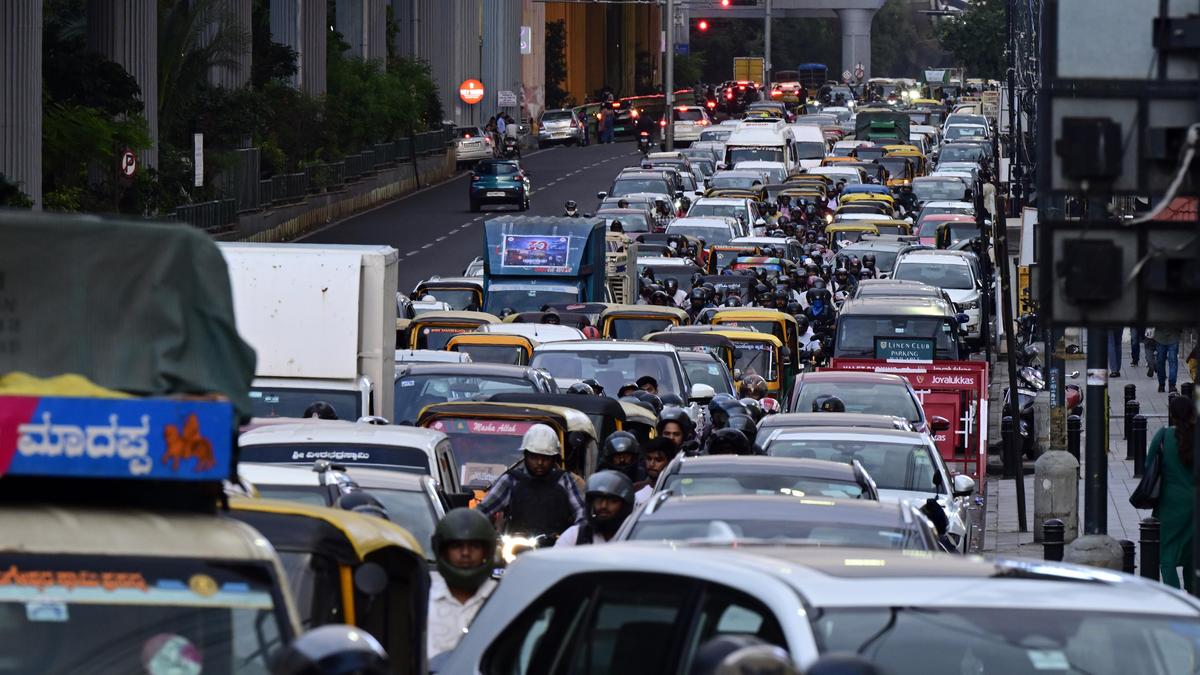
A traffic police at work at Vittal Mallya Road in Bengaluru.
| Photo Credit:
ALLEN EGENUSE J
After this, M.A. Saleem, the current head of the police force and DG&IGP of the State, who was the Special Commissioner of Traffic for Bengaluru city in 2022, had said that there would be minimal on-ground interception of commuters and that only visible violations would be intercepted.
As a result, in 2022, 97% of the total cases booked were through contactless systems, relying on technology and other interventions. In 2024, the percentage dropped to 93% and further dropped to 88% in 2025. In the current year, the percentage is around 87%.

According to traffic police sources, citizens had stopped paying traffic fines despite challans being issued, while several violations also went unchecked. Even serious violations such as drunk driving dropped to 6,000 in 2023, while the average used to be around 35,000, raising safety concerns.
“There was no fear of fines at all, which is a major tool for traffic rules enforcement. So, we are required to strike a balance between using technology for smooth enforcement while also keeping the fear of fines. Thus, we increased on-ground checking as well,” a senior officer said, adding that the department has been ordered not to intercept anyone during peak hours unless there is a visible violation.
As a result, during non-peak hours, vehicle checking has increased substantially in the city over the past year.