




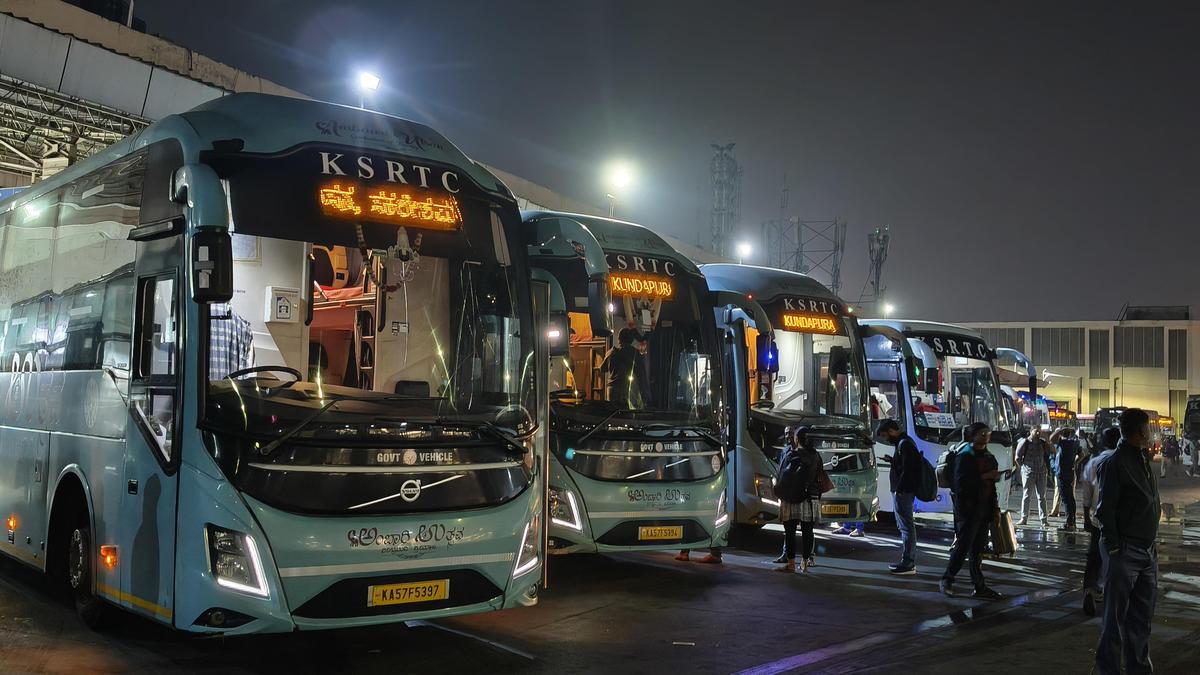


The survey found that 55.8% of overnight household journeys are undertaken by bus. File
| Photo Credit: ANIL KUMAR SASTRY
Buses are significantly more popular than trains for overnight travel in India, with more than half of all household overnight journeys undertaken by bus, according to the country’s first-ever National Household Travel Survey released by the National Statistics Office (NSO) on Monday (October 5, 2026).
The survey found that 55.8% of overnight household journeys are undertaken by bus, compared with 17.7% by inter-city railways. Together, buses and railways account for nearly three-fourths, or 73.5%, of all overnight travel. Cars account for 15.1% of such journeys, while two-wheelers make up another 8.8%.

Railway use is significantly higher among urban households. About 22.7% of urban households use rail for overnight journeys, compared with around 14% of rural households.
Overnight journeys, however, are largely not undertaken for tourism. The survey found that 70.2% of overnight household trips are for social, communication, and religious purposes. Culture, leisure, sports and tourism account for just 7.4% of such trips.
The daily commute
The pattern changes sharply when it comes to daily travel to work. Two-wheelers are the dominant mode of transport for workers, accounting for 42.6% of journeys to fixed or non-fixed workplaces. Their share rises to 52.3% among urban workers, compared with 37.1% in rural areas.
Public transport has a much smaller share of daily workforce mobility nationally. Buses account for 6.7% of work trips, while trains, the monorail, and trams together account for 2.1%. However, urban mass transit is considerably more important in some States and cities. In Maharashtra, metro, suburban rail, monorail, and trams account for 20.7% of urban worker commutes, followed by West Bengal at 16.5% and Delhi at 14.4%, against the national urban average of 5%.

The survey also shows that most Indians have relatively short daily commutes. The average journey to a fixed workplace takes 25 minutes, with the average rising to 27 minutes in urban areas from 23 minutes in rural areas. Overall, 83.4% of workers reach their fixed workplace within 30 minutes, while 13.7% take between 30 minutes and an hour.
Gender disparity in workplace mobility
The average monthly expenditure on commuting to a fixed workplace is ₹785 per worker. Urban workers spend substantially more, at ₹1,044 a month, compared with ₹612 for rural workers. Male workers spend an average of ₹835 on their commute each month, against ₹533 for female workers.
The survey also highlights a gender disparity in workforce mobility. While 61.9% of male workers undertake work-related trips of more than one kilometre, the corresponding share for women is only 41.9%. There is also a gender gap in commuting expenditure: male workers spend an average of ₹835 a month, compared with ₹533 for female workers.

The National Household Travel Survey, conducted between July 2025 and June 2026, covered 4,92,023 households and 20,34,371 people across 14,274 villages and 10,377 urban blocks.
Published – October 06, 2026 07:18 pm IST