






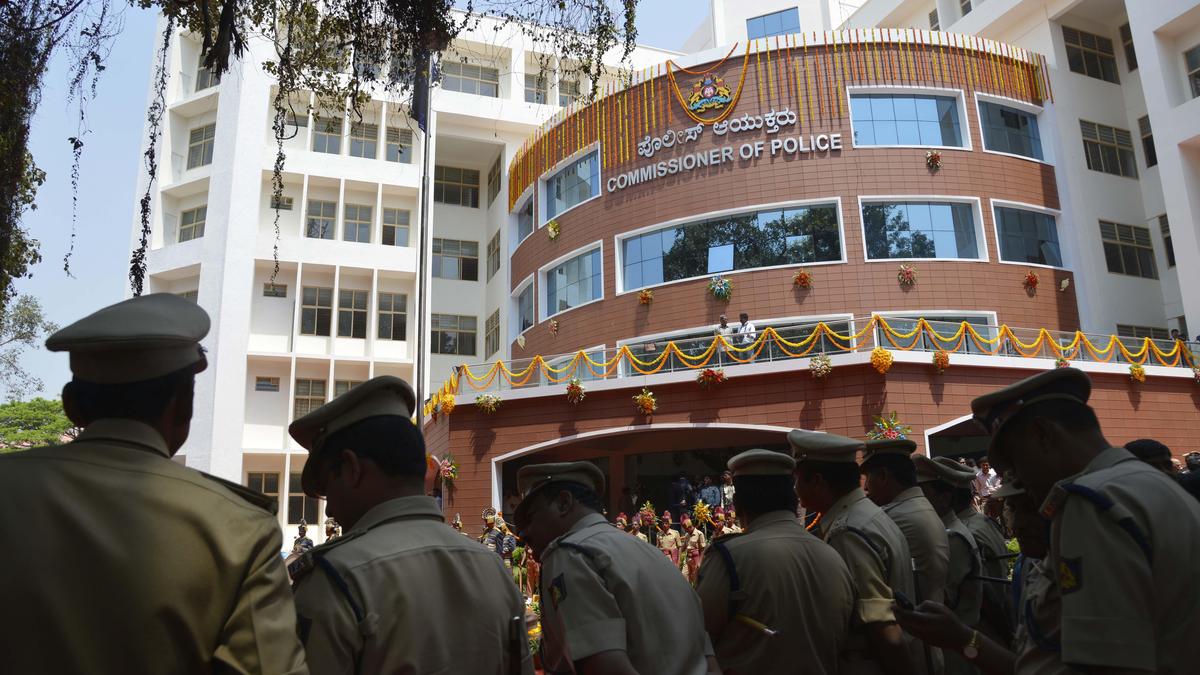

The Karnataka Cabinet on Tuesday approved the reorganisation of the Bengaluru police commissionerate into five commissionerates, with a Chief Police Commissioner to oversee them.
The proposed overhaul has triggered a sharp debate among serving and retired police officials.
The restructuring has been proposed against the backdrop of Bengaluru’s rapid expansion and the creation of the Greater Bengaluru Authority (GBA), which has divided the civic administration into five corporations. The proposed police model broadly seeks to mirror this arrangement to improve coordination between the police and civic authorities.
However, former senior police officers have questioned whether a civic structure can be directly replicated in policing, arguing that crime, law and order, traffic management and emergency mobilisation do not necessarily follow municipal boundaries.
A former DGP who served in the Bengaluru city police said the proposed arrangement could create more problems than solutions, particularly in operational policing. According to the former officer, the proposal appears to be driven partly by the desire to “accommodate senior officials seeking postings in major metropolitan centres rather than by a clearly established operational requirement”.
‘Existing command structure could be weakened’
The former DGP said the present city police structure has a clearly defined chain of command involving the Commissioner of Police, DCPs, inspectors and constables, with responsibilities and jurisdictions understood at every level. The proposed five-commissionerate system, he argued, could dilute this established structure by creating multiple command centres and overlapping responsibilities.
“The existing system has a clear chain of command. The new arrangement could make these established positions less significant and create confusion at different levels,” the former officer said.
He also warned that the mobilisation of police forces during major emergencies could become considerably more difficult. At present, the city police commissioner can mobilise forces across the entire city depending on the requirement. Under a five-commissionerate system, however, the deployment of personnel across jurisdictions could require greater coordination between several commissioners and their establishments, he said.
VIP movements could expose coordination problems
The former DGP cited the movement of high-profile dignitaries as an example.
At present, when the Prime Minister, President or other VVIPs visit Bengaluru, the city police commissioner can coordinate security and traffic arrangements across the entire route.
Under the proposed system, if a convoy passes through multiple commissionerates, each commissionerate could be required to coordinate and deploy its own personnel. The officer said this could result in duplication of manpower and unnecessary deployment of specialised units.
He cited the example of the City Armed Reserve (CAR) units, which are currently deployed and coordinated through the existing city police structure for escort and security duties.
Under the proposed arrangement, individual commissionerates could be required to deploy personnel and resources for the portions of the movement falling within their respective jurisdictions, potentially resulting in duplication of deployment and coordination.
‘Why create five establishments?’
The former officer also questioned the financial implications of creating five separate commissionerates.
Apart from the proposed 6,000 additional posts, the government would have to provide office infrastructure, vehicles, communication systems, accommodation, administrative staff and other facilities for the new establishments. The infrastructure requirement alone, he said, could impose a significant additional financial burden on the government.
“If the objective is better policing, the money should go towards strengthening police stations, investigation, beat policing and manpower rather than creating multiple administrative establishments,” the former officer argued.
Public could face confusion
Another concern raised by the former DGP is the impact on the public. At present, Bengaluru residents broadly identify the city police commissioner as the head of the city police force. Under the proposed arrangement, there would be five commissioners functioning across different jurisdictions, in addition to a proposed Chief Police Commissioner. The former officer said this could create uncertainty among citizens about which commissionerate is responsible for a particular area or issue.
Instead of making policing more accessible, the arrangement could create confusion about jurisdiction, particularly when an incident involves more than one commissionerate, he said.
Former city commissioner favours leaner model
Another former city police commissioner also questioned the need for five independent commissionerates, while agreeing that Bengaluru needs greater decentralisation.
According to him, the city should ideally have no more than two commissionerates, with the rapidly expanding areas and rural belts beyond the Outer Ring Road brought under a separate commissionerate.
An ADGP-rank officer could head the new commissionerate, while existing Additional Superintendents of Police could be redesignated as DCPs and given greater territorial responsibility, he suggested.
Such a structure, he said, would provide decentralised policing without creating multiple layers of senior command.
Existing divisions had worked well
The former commissioner pointed to the restructuring undertaken in 2016, when new divisions such as Whitefield and Electronic City were created as Bengaluru expanded.
Several new police stations were established, while the Central Crime Branch was also given police-station powers. Despite resistance from some political leaders at the time, the restructuring subsequently helped the police manage the growing city, he said.
The creation of new divisions gave senior officers better control over their jurisdictions and reduced the burden on the central city police establishment.
The model was also relatively cost-effective and allowed the government to reorganise police jurisdictions as the city expanded, the former officer said.
Instead of creating five commissionerates, the existing system could be strengthened by adding more DCP-led divisions wherever population and policing requirements warrant it, he suggested.
Five commissionerates have supporters
The proposed restructuring, however, has its supporters among former police officials. Another former city police commissioner described the move as a positive step considering Bengaluru’s rapid growth and future expansion. The officer said dividing the city into five commissionerates could help address increasing demands relating to law and order, traffic management and local policing, provided there is effective coordination between the commissionerates.
Smaller jurisdictions could allow senior officers to devote greater attention to local problems and work more closely with the respective civic administrations, the officer said. The success of the system, however, would depend on clearly defining the jurisdiction, powers and responsibilities of each commissionerate and ensuring seamless coordination, the officer added.
Do five corporations need five commissionerates?
The larger debate centres on whether the five GBA corporations should automatically translate into five police jurisdictions.
Former officers opposing the model point out that organised crime, cybercrime, financial offences, drug networks and major law-and-order incidents frequently cross territorial boundaries. Major traffic corridors and public events can similarly affect several parts of the city.
They argue that police jurisdictions should instead be determined by population, crime patterns, geography, traffic movement, police-station workload and emergency response requirements, rather than simply mirroring civic boundaries.
While there is broad agreement that Bengaluru needs more police personnel, the additional manpower should strengthen police stations, investigation teams, beat policing, traffic enforcement, cybercrime investigation and specialised units.
Officers favouring a leaner structure argue that Bengaluru could achieve decentralisation through two or three strong commissionerates supported by expanded DCP divisions. Under such a model, the existing urban core could form one commissionerate, while the rapidly expanding peripheral and rural areas could come under another. Additional divisions could subsequently be created as the city grows.
The advantage, they argue, would be greater flexibility to reorganise police jurisdictions periodically without having to undertake a major restructuring of the entire city police establishment.
The larger question
The debate is not over whether Bengaluru needs police reform. There is broad agreement that the city’s expansion requires more manpower, stronger field-level supervision and better coordination.
The key question is whether these objectives are best achieved through five independent commissionerates or through a smaller number of stronger territorial units under a unified city police command. The former DGP said the government should carefully examine the operational consequences before implementing a system that could be difficult and expensive to reverse.
The success of any restructuring, retired officers said, should ultimately be measured not by the number of senior officers appointed or commissionerates created, but by whether it delivers faster response, effective force mobilisation, stronger investigations, better traffic management, clear accountability and improved policing at the police-station level. Whether these services can be delivered to the people is the bigger question.