







Devadas VM’s Eru is a pandemic novel, not because it is about the outbreak. But because it was born when he was forced to stay indoors in his apartment in Chennai, with family and children, the younger one a few months old.
Published in 2021, the novel is back in the news post the release of its English translation, Backlash, by Nandakumar K. Eru’s protagonist is Sreedharan Nair, a retired policeman. His wife is abroad with their daughter, who had recently given birth. The lonely Sreedharan faces an unknown enemy — someone who is pelting stones at his house every night. As he ruminates on who the culprit might be, he wonders if it is someone he might have wronged while he was working. He catches up with all the suspects, but to no avail. Installing CCTVs does not solve the problem either. As news about his predicament spreads solutions come from all quarters. He agrees to do a pooja to ward off a possible attack from ‘invisible, evil forces’. But the whole village is divided over his decision, and the tussle that follows takes the novel forward.
Thrissur-native Devadas, a prominent figure in contemporary Malayalam literature, has written five novels and seven short-story collections. He is a recipient of the Kerala Sahitya Akademi Award and the OV Vijayan Memorial Literary Award, among others. Excerpts from an email interview with Devadas, who is an IT professional in Chennai:

The journey to Eru
Many of my stories and novels stem from ideas captured in that fleeting moment between sleep and wakefulness. Sometimes, an entire story or even a movie unfolds in these dreamlike states. I usually jot down the thoughts so that I can use them later. But what if I decide to put it off and go back to sleep? Everything that appeared so clearly vanishes like an illusion. During one such afternoon nap, I dreamt that a hole had appeared in the ceiling directly above me. When I woke and looked, I saw there was a bright glow on the ceiling. I had to rub my eyes to wake myself up to figure out whether it was a dream or reality. Only then did I realise that it was a reflection of my daughter’s toy, which was lying on the floor. I was tricked by the sunlight falling on it, which was being reflected on the ceiling. I then began to think about what it would mean if a hole suddenly appeared in the ceiling while we were asleep. Our sense of peace and privacy could be shattered in an instant. A sudden blow can shatter our tranquillity. As a person’s strength and power begin to fade, the actions of their past can return to haunt them like a stone hurtling through the air. It was in this thought that I found the inspiration to write Eru.
How much has the pandemic shaped the narrative?
Ever since I left home for work at the age of 23, I have lived in various cities across India. Because of this, I do not believe in romanticised notions like the inherent goodness of one’s hometown or the purity of village life. In Chennai, I lived in a rented house in a colony of over 50 houses. There was nothing to fear. However, everything I had considered as sources of support and security slowly morphed into sources of fear when pandemic struck. The security guard sneezing or coughing near the gate, the maid working in four or five different houses in the neighbourhood, workers delivering mineral water and vegetables without wearing masks, taxis dropping off strangers on the streets — all of these became metaphors for fear.

Devadas VM
| Photo Credit:
SPECIAL ARRANGEMENT
During the first wave of COVID-19, Chennai was one of the worst affected cities. My second child was born around this time. The lockdown offered an opportunity to explore many new possibilities. I experimented with new recipes, successfully made wine and ice cream for the first time, crafted paper toys for the kids, cut my own hair, and shaved my son’s head. But none of these activities could entirely erase the fears. With Chennai persistently remaining in the red zone, many items became completely unavailable. The number of patients in the city began surging toward its peak. It was this terrifying atmosphere that paved the way for the fear experienced by the retired policeman, Sreedharan Nair, in the novel.
Why a policeman as the protagonist?
Although the military and the police are security forces in a sense, the primary difference between them lies in how they interact and function within society. Soldiers have army camps, designated bases and exclusive canteens for their purchases. In contrast, police officers, especially those below the rank of Circle Inspector, live in close proximity to the general public. The accused or criminal is not an obvious enemy on a battlefield, but a part of the very society in which the officer lives. Yet, within that society, a policeman possesses an air of pride and authority.

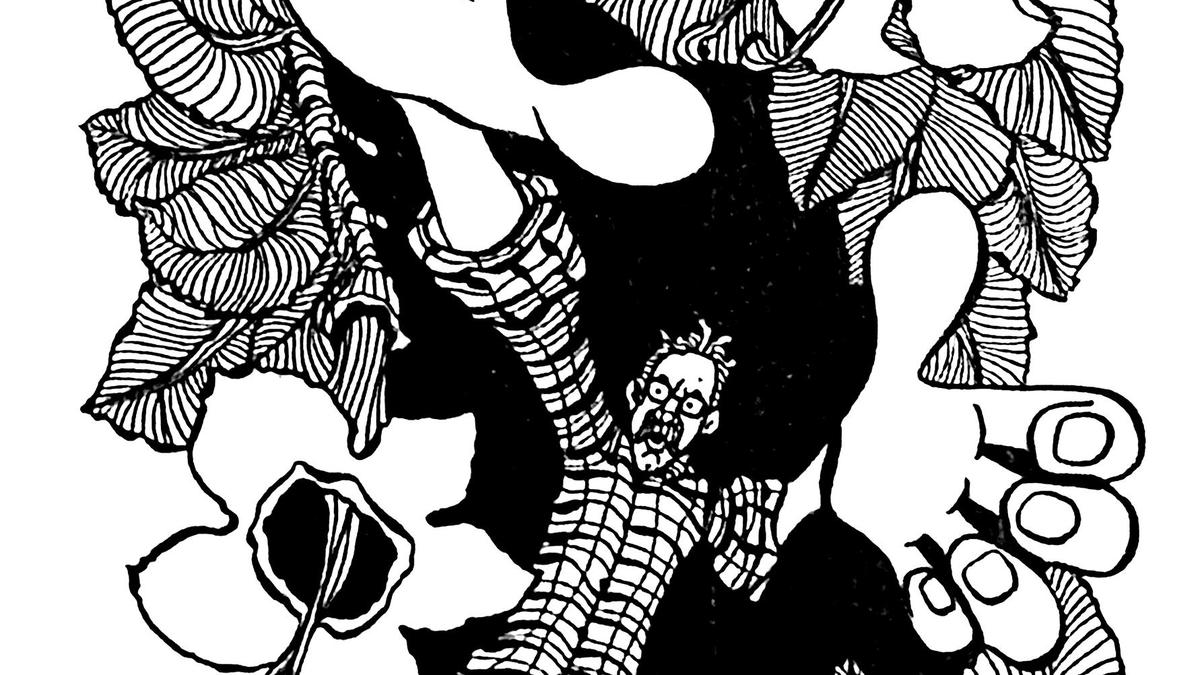
Illustration by Bony Thomas for the book Eru written by Devadas VM
| Photo Credit:
Special Arrangement
It is the power of the uniform that drives him to do many things. For example, the police can convict a person as a suspect in a bomb blast on the basis of purchasing a battery, as in the case of Perarivalan [Rajiv Gandhi assassination case]. One of the charges against Ajmal Kasab, the terrorist apprehended in 2008 Mumbai blast, was entering the Chhatrapati Shivaji Terminus railway station without a ticket.

Eru by Devadas VM
| Photo Credit:
Special Arrangement
The police embody this kind of irony. My novel explores the psychological turmoil of a police officer who once wielded such authority. The consequences of his past actions come together to put him on trial. In his frantic attempt to find a way to deal with this, everything he does is a blunder. No matter how hard he tries to hide, his guilt relentlessly pursues him. Interestingly, guilt arises only where there is an underlying sense of morality. It is this moral consciousness, awakening in him only after his power and uniform are gone, that ultimately drives him into deep remorse.
You have woven myths, legends, stories from history, our culture, rituals, beliefs, etc into the narrative. Did it happen organically?
This novel explores the complexities of a man’s memories, the guilt they evoke and his desperate attempts to escape them. It is the society around him that transforms his internal guilt into fear. Consequently, his personal memories and past deeds become deeply intertwined with the broader social fabric. How do memories endure in a society across generations? Myths, folklore, ballads, beliefs, rituals, bedtime stories, and history all play crucial roles in shaping a society’s collective memory.

Illustration by Bony Thomas for the book Eru written by Devadas VM
| Photo Credit:
Special Arrangement
After all, the public consciousness of today is an amalgamation of the remembered and forgotten histories of countless generations, absorbed through both oral and written traditions. So yes, it became a very organic process when I set out to narrate all the possible dimensions of the stone-pelting incidents at a retired policeman’s house. King Parikshit, who hid in fear of the serpent Takshaka, realising that his royal power could no longer save him, and Sreedharan, who loses his sleep, terrified by stones thrown by an unseen assailant, are ultimately consumed by the exact same fear.
Several crucial incidents from across the country have been touched upon in the storyline. Be it the Rajan case (illegal arrest, torture and disappearance of the student P Rajan during Emergency), Babri Masjid demolition, Coimbatore blast case, Gujarat chief minister’s [Narendra Modi] rise to the post of Prime Minister, Purulia incident and many others.
Without power, the retired officer is left entirely vulnerable to the moral consequences of his past. The collective trauma and unresolved injustices of the nation transform into his personal paranoia. The unseen threat and the stones landing on his roof represent the inevitable return of these historical actions. By weaving these historical incidents into the narrative, it becomes both evident and inevitable that history is never entirely left in the past. For those who once wielded unquestioned authority, the loss of power turns memory itself into an inescapable psychological trial. Every incident mentioned here plays a crucial role in the history and justice system of India. When those in power attempt to erase history even from textbooks, what else should we discuss if not historical events? Furthermore, I believe that historical facts serve as the touchstone or yardstick needed to calibrate society’s lapses in memory.
In the climax, you have taken a stand on what is happening in the present society rather than revealing who the culprit is….
Attributing crimes to specific individuals to evade guilt is an escape mechanism employed by society. That is how a politician, businessman or officer ends up becoming the ultimate villain in popular fiction or cinema. Movies and novels following the ‘whodunit’ narrative arc operate on the same principle, hunting down a single culprit upon whom all the blame can be pinned, allowing everyone else to feel vindicated and safe. However, as a society, it is incredibly rare for us to put our collective crimes and complicities on trial. This is exactly why my novel’s central theme deliberately shifts from the question, ‘Who is throwing the stones?’ to the realisation, ‘Why must one suffer from the stone-pelting?’. After all, we are all familiar with the story in which a mob lowers its raised hand, armed with stones, upon hearing the words, “He who is without sin among you, let him be the first to throw a stone.”
Your take on Backlash, the translation of the novel?
The novel incorporates myths, ballads, folklore, and other elements of oral tradition. So I believe translating it must have been a challenging task. Nandakumar, a seasoned translator, has done a commendable job of staying faithful to the original. Whenever there was scope for transcreation, he would discuss it with me as well, which helped preserve the spirit and nuances of the original work.
Eru is published by DC Books and Backlash is published by Ekada.