




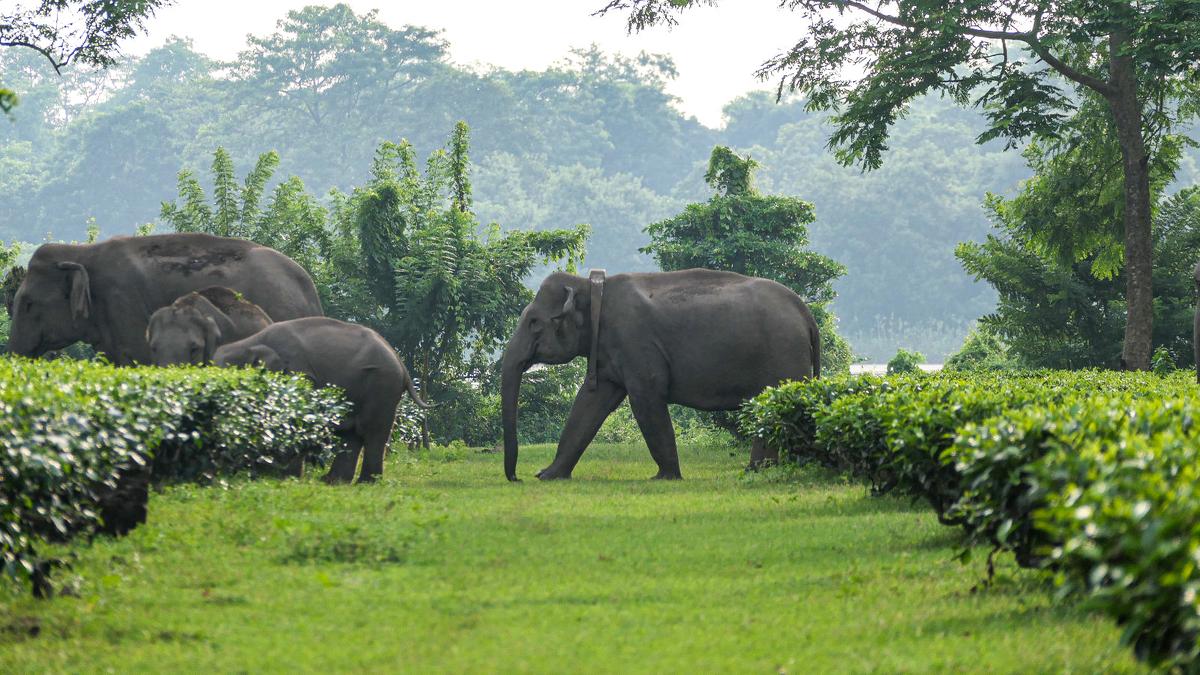


The study generated more than 38,000 GPS (Global Positioning System) locations, providing high-resolution data on seasonal elephant movements across multi-use landscapes.
| Photo Credit: Special arrangement
A five-year satellite tracking study has provided new insights into how wild elephants navigate Assam’s forests, tea plantations, agricultural areas, and riverine habitats, yielding “crucial” data for the authorities to strengthen habitat protection and mitigate conflicts with humans.
Wildlife officials and conservation ecologists tracked four female-led herds and a solitary male elephant in three high-conflict districts of Udalguri, Sonitpur and Biswanath — all on the northern bank of the Brahmaputra River — between April 2021 and June 2026 for the “breakthrough” study.
The findings of the study, conducted by the Assam Forest Department and World Wide Fund for Nature-India (WWF-India), were published in a report titled ‘Tracking the Giants: Movement and Habitat-Use Patterns of GPS-Collared Elephants in Assam’.
“The study will help guide conservation planning, strengthen wildlife-friendly infrastructure and support safer coexistence between people and wildlife across Assam,” Assam’s Forest Minister, Jayanta Mallabaruah, said after releasing the report on the occasion of the 72nd Wildlife Week on Tuesday (October 6, 2026).
The Minister told the 126-member Assam Assembly in July that human-elephant conflicts claimed 1,147 human lives and 246 elephants in the State since 2016.
The study generated more than 38,000 GPS (Global Positioning System) locations, providing high-resolution data on seasonal elephant movements across multi-use landscapes.
According to the 2025 Synchronised All India Elephant Census, Assam remains the stronghold for Asian elephants in the northeastern region with an estimated population of 4,149 individuals.
However, historical and ongoing challenges related to habitat loss and degradation have severely affected elephant populations as well as local communities, forcing them to share space and often resulting in crop and property damage, human casualties, and injury or mortality among elephants.
“This report fills a major knowledge gap in terms of elephant presence and movement in the state. The findings of this study provide important baseline information on elephant-ranging patterns, particularly where they overlap with human land use,” Vinay Gupta, Assam’s Principal Chief Conservator of Forests-Wildlife and Chief Wildlife Warden, said.
Conservation strategies
“The information obtained is crucial because it will help inform conservation strategies and strengthen human-elephant coexistence measures,” he said.
Aritra Kshettry, who heads WWF-India’s Elephant Conservation Programme, said the GPS telemetry survey helped identify core natural and secondary habitats used by the collared elephants and revealed a strong seasonal pattern in their movements.
“This information will guide effective management of human-elephant conflict, which requires a clearer understanding of where elephants move, how they use different habitats and land-use types, and how these patterns change across seasons,” he said.
Sonai-Rupai Wildlife Sanctuary, Behali Wildlife Sanctuary and Bornadi Wildlife Sanctuary emerged as important habitats extensively used by the collared elephants, a WWF-India statement said. At the same time, tea plantations served as significant movement pathways and secondary habitats, often bringing elephants close to people, it stated.
“Protected areas and reserve forests remained important elephant habitats for much of the year, with home ranges of female-led herds expanding during the paddy cropping season, a period also associated with high levels of human-elephant conflict,” the statement read.
Published – October 07, 2026 02:37 pm IST